

In this article:
- Why This Christmas Breakfast Strata Sets Like a Custard
- Red and Green Peppers Do More Than Decorate
- Dry Bread Cubes Are the Whole Secret
- Ingredients for the Christmas Breakfast Strata
- Assembling and Baking the Strata, Step by Step
- The Christmas Eve to Christmas Morning Timeline
- Soggy Middle, Dry Top: Strata Fixes That Work
- Swaps and Variations for Your Table
- Storing, Freezing and Reheating the Strata
- Christmas Morning, Handled
- Questions About This Christmas Breakfast Strata, Answered
Christmas breakfast strata is the dish that lets the cook watch the present opening: a savory bread and egg casserole assembled on Christmas Eve, baked while the coffee brews, and served in golden squares flecked with red and green peppers.
The pleasure is in the contrast. The top cubes toast crisp and cheese pulls at the edges, while the middle stays soft, custardy, and rich with Dijon and nutmeg. Every square shows its layers, bread, vegetables, and melted cheese, like a savory bread pudding built for a celebration.
This version carries no meat at all, and nobody misses it. Sweet peppers, spinach, and two cheeses do the heavy lifting, and the whole dish is seasoned like it means it. Assemble it after dinner on the 24th, and Christmas morning runs itself.
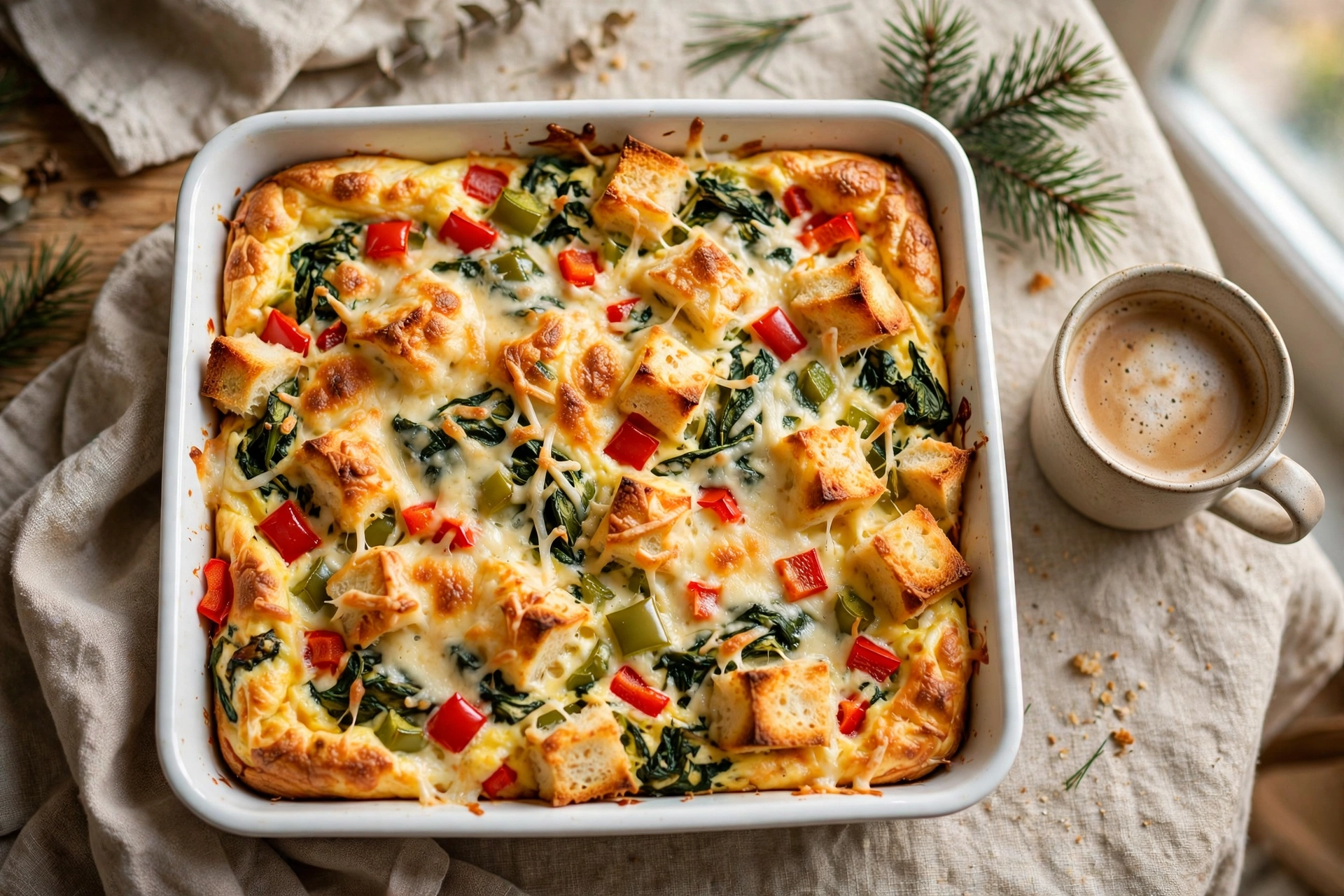
Why This Christmas Breakfast Strata Sets Like a Custard
Christmas breakfast strata stands or falls on one ratio: eight large eggs and two and a half cups of milk for eight cups of bread cubes. That balance gives enough custard to saturate every cube and still set into clean slices, never a wet sponge and never a dry brick.
The layering matters as much as the ratio. Vegetables and cheese are spread between two layers of bread instead of mixed into the custard bowl, so every square carries the same filling. Nothing sinks, nothing pools, and the top layer stays free to toast.
Time in the custard does the seasoning work. As the assembled dish rests, the Dijon, salt, and nutmeg travel into the center of the bread, so the strata tastes seasoned all the way through. A strata mixed and baked at once tastes eggy on the surface and bland in the middle.
The covered then uncovered bake protects both textures. Foil for the first stretch lets the center set gently without browning, and the uncovered finish crisps the top cubes and melts the final cheese into golden patches. The center should read 160°F, the mark the USDA temperature chart gives for egg dishes.
Red and Green Peppers Do More Than Decorate
The two peppers are the flavor plan, not a garnish. Red pepper brings sweetness that balances the salt of the cheese, and green pepper brings a gentle, grassy bite that keeps the custard from tasting flat. Together they season the dish from inside every layer.
They are also the color story of the whole casserole. Red and green against golden custard and dark spinach gives the dish its Christmas look without a single decoration step. Served straight from the white dish, it reads as festive before anyone tastes a bite.
Cooking the peppers first is non negotiable. Raw peppers release water as they bake, and that water has nowhere to go except into your custard. Six minutes in a hot pan drives off the moisture, concentrates the sweetness, and softens the dice so it eats tender, never crunchy, in the finished square.
The spinach gets the same treatment for the same reason. It wilts in the pepper pan, then gets squeezed by hand until almost dry. What goes into the dish is concentrated green flavor, not the cup of liquid a careless handful of spinach would have donated to the bottom layer.
Dry Bread Cubes Are the Whole Secret
Fresh bread is the quiet cause of most failed stratas. A soft, fresh cube is already full of water, so it can only drink a little custard before it collapses into paste. The result is a dense, soggy bottom and a top that never really sets.
Dried cubes behave completely differently. Ten minutes in a low oven drives off surface moisture and firms the crumb, turning each cube into a small sponge with structure. Those cubes drink the custard deeply, swell, and still hold their shape through an overnight rest and a full bake.
A rustic loaf or a sturdy sourdough is the right starting point, cut into honest one inch cubes with the crust left on. The crust is not a flaw to trim away; it becomes the crisp, golden edges on top of the dish, the bites everyone quietly hopes to get.
Day old bread from the bakery counter works without the oven step, as long as it feels dry and firm. When in doubt, dry the cubes anyway. There is no version of this recipe where ten minutes of drying hurts, and many where skipping it ruins the texture.
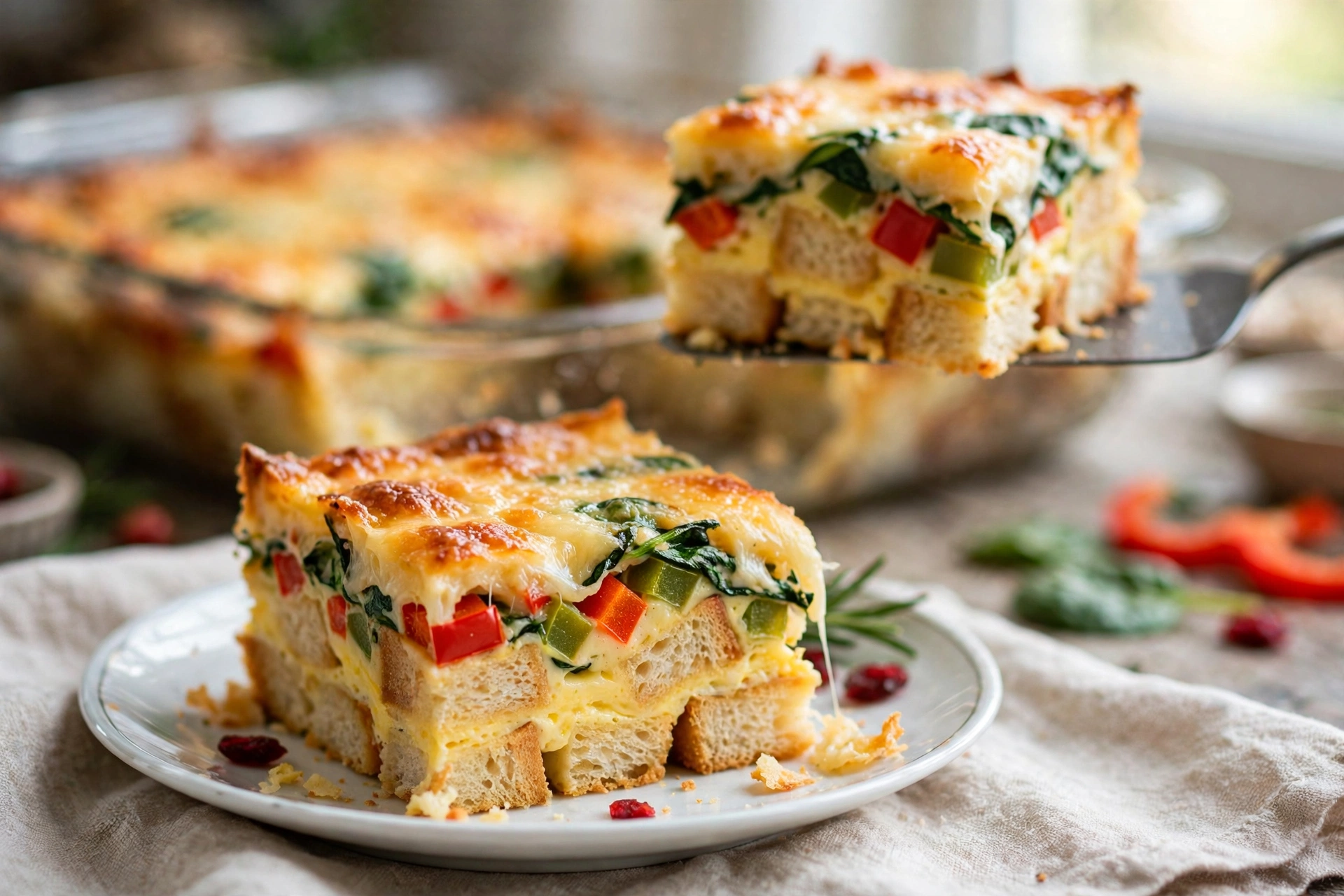
Ingredients for the Christmas Breakfast Strata
Everything here is a supermarket staple in December. The one shopping rule that matters: buy a loaf with real crust and body, not a soft sandwich loaf, and shred the cheese from blocks if you can, since it melts smoother and tastes cleaner.
- 1 tablespoon unsalted butter, for the dish
- 8 cups crusty bread cubes, 1 inch, from a day old rustic loaf or sourdough (about 12 ounces)
- 1 tablespoon olive oil
- 1 medium yellow onion, finely diced (about 1 cup)
- 1 large red bell pepper, diced (about 1 cup)
- 1 large green bell pepper, diced (about 1 cup)
- 2 cloves garlic, minced
- 5 ounces baby spinach, roughly chopped (about 5 packed cups)
- 8 large eggs
- 2 1/2 cups (600 ml) whole milk
- 1 tablespoon Dijon mustard
- 1 teaspoon fine salt
- 1/2 teaspoon black pepper
- 1/4 teaspoon freshly grated nutmeg
- 1 1/2 cups (170 g) shredded Gruyère cheese
- 1 cup (115 g) shredded sharp cheddar cheese
- 2 tablespoons grated Parmesan, for the top
- 2 tablespoons sliced green onions, to serve (optional)
Nutrition estimate per serving: about 345 calories, 18 g protein, 27 g carbohydrates, 18 g fat, 640 mg sodium. The estimate assumes eight generous squares and whole milk; swapping in part skim milk trims roughly 25 calories per serving.
Assembling and Baking the Strata, Step by Step
The method is deliberately calm: cook the vegetables, whisk the custard, layer, pour, rest, bake. Nothing is timed to the minute except the bake itself, and even that gives you a ten minute window.
- Heat the oven to 300°F (150°C). Spread the bread cubes on a baking sheet and dry for 10 to 12 minutes, until the surfaces feel firm and papery and the edges have firmed up. Cool completely.
- Warm the olive oil in a large skillet over medium heat. Cook the onion and both peppers with a pinch of the salt for 6 to 7 minutes, until soft and sweet. Add the garlic and cook 30 seconds.
- Add the spinach to the skillet a handful at a time and toss until just wilted, 1 to 2 minutes. Tip the vegetables into a bowl, cool slightly, then squeeze handfuls of the spinach mixture firmly to remove as much liquid as you can.
- In a large bowl, whisk the eggs, milk, Dijon mustard, remaining salt, black pepper, and nutmeg until completely uniform and no streaks of white remain.
- Butter a 9 by 13 inch baking dish. Layer in half the bread cubes, half the vegetable mixture, and half of each cheese. Repeat with the rest of the bread, vegetables, and cheeses, finishing with cheese.
- Pour the custard slowly and evenly over the whole dish. Press every cube down gently with the back of a spoon until all the tops are wet and the liquid rises around them.
- Cover the dish tightly and refrigerate at least 2 hours and up to 24 hours. Overnight, 8 to 12 hours, gives the deepest flavor and the cleanest slices.
- Set the dish on the counter for 30 minutes while the oven heats to 350°F (175°C). Uncover and sprinkle the Parmesan over the top.
- Bake 50 to 60 minutes, covering loosely with foil for the first 25 minutes, until the top is puffed and deeply golden, the edges pull slightly from the dish, and the center reads 160°F (71°C) on a thermometer.
- Rest 10 minutes so the custard finishes setting. Scatter the green onions over the top, cut into 8 squares, and serve warm, straight from the dish.
If the morning is calmer than expected, the baked strata holds beautifully. Keep it covered in a low oven at 200°F for up to 30 minutes while the table fills, and it will still slice like it just came out.
The Christmas Eve to Christmas Morning Timeline
This Christmas breakfast strata was designed around a real holiday schedule, so here is the schedule. Christmas Eve, after dinner: dry the bread, cook the vegetables, whisk the custard, and assemble the dish. Fifteen unhurried minutes, and the work is done.
The dish then rests in the refrigerator while you sleep, and the rest is doing you a favor, not costing you one. The bread drinks, the spices bloom, and the flavors marry in a way a same morning assembly cannot match. Strata is one of the rare dishes that improves by waiting.
Christmas morning asks for exactly three moves. The dish comes out of the fridge when the coffee starts, rests on the counter for 30 minutes, then bakes for about an hour while presents are opened. Breakfast lands hot at the table precisely when the room slows down.
Serving is part of the design. The strata goes to the table in its baking dish, with a bowl of fruit and the coffee pot beside it, and everyone serves themselves. If your house prefers a sweet note alongside, our eggnog French toast casserole covers that side of the table, and the two dishes share an oven temperature.
Soggy Middle, Dry Top: Strata Fixes That Work
A soggy middle almost always traces back to water, not eggs. Undried bread, uncooked peppers, or spinach that skipped its squeeze will each donate liquid to the custard. Fix the water at the source and the center sets; there is no bake time long enough to rescue a flooded strata.
If the center still jiggles like liquid at the end of the bake, cover the dish and give it 10 more minutes. Then check the temperature, not the clock. A set center at 160°F trembles slightly, like firm jelly; a raw center sloshes. Learn that difference once and every egg casserole you make gets easier.
Dry, hard cubes on top mean the top layer never got wet. That happens when the custard is poured fast and pools in the corners. Pour slowly in a spiral, press every cube down, and check that the liquid line rises evenly before the dish goes into the fridge.
A top that browns too fast is the simplest fix of all: the foil tent. If the cheese is dark before the center is near done, lay foil loosely over the dish and finish the bake covered. The custard catches up, and the top keeps its color instead of crossing into bitter.
Swaps and Variations for Your Table
The cheese pair is flexible as long as one melts and one speaks. Gruyère brings the nutty melt and cheddar brings the familiar sharpness; fontina, Monterey Jack, or a good Swiss can stand in for the Gruyère, and a smoked cheddar turns the whole dish toward a fireside flavor.
Vegetables can follow whatever the holiday leaves behind. Roasted mushrooms, well dried, add depth; leeks softened in butter lean the dish French; a cup of thawed and squeezed frozen spinach replaces the fresh with no other change. Keep the rule, whatever goes in must be cooked and dried first.
For a smaller house, halve the recipe into an 8 inch square dish and bake 40 to 45 minutes. For a crowd, the full dish doubles into a deep roasting pan; add 10 minutes to the bake and check the center temperature in two spots.
Bread swaps reward the adventurous. Challah makes a richer, softer strata, brioche leans almost dessert adjacent, and leftover croissants give flaky, buttery layers. Our eggnog bread pudding uses the same dry, soak, bake logic in sweet form, and readers who master one rarely struggle with the other. A gluten free loaf works too, dried a few minutes longer; the method matters more than the loaf.
Storing, Freezing and Reheating the Strata
Leftovers keep four days in the refrigerator, covered in the dish or moved to containers in single squares. The flavor holds remarkably well; the peppers stay sweet and the custard stays seasoned. Cold squares are firm and snackable, warm ones are breakfast again.
Reheat single squares in a 325°F oven for 12 to 15 minutes, covered loosely, until hot in the center. The microwave works at half power for one square, but the oven protects the toasted top, which is half the personality of this Christmas breakfast strata.
The assembled, unbaked dish freezes for up to one month, wrapped tightly. Thaw it overnight in the refrigerator, rest it on the counter for 30 minutes, and bake as written, adding 5 to 10 minutes. Baked leftovers also freeze well in squares for up to two months.
One safety note worth the habit: an assembled strata should not sit raw in the refrigerator beyond 24 hours, and leftovers belong in the fridge within two hours of serving. Egg dishes reward prompt chilling; the veggie packed breakfast casserole on this site follows the same rhythm for the same reason.
Christmas Morning, Handled
Christmas breakfast strata asks for fifteen minutes on Christmas Eve and returns a calm, golden, completely handled Christmas morning. Dry bread, dried vegetables, an honest custard, and a hot oven while the gifts are opened: that is the whole recipe, and it has never once made a cook miss the best hour of the day. Pass the dish, pour the coffee, and sit down with everyone else.
Jordan
Questions About This Christmas Breakfast Strata, Answered
How far ahead can I assemble this Christmas breakfast strata?
Assemble it up to 24 hours before baking and keep it covered in the refrigerator. The sweet spot is 8 to 12 hours: the bread drinks the custard fully and the Dijon and nutmeg season every cube. Beyond 24 hours the bread starts to break down and the texture turns soft.
Can I bake the strata the same morning without the overnight rest?
Yes, with a shorter rest of at least 2 hours so the cubes absorb the custard. Press the cubes down twice during that rest. The flavor will be a little less deep than the overnight version, but the texture stays custardy and the squares still slice cleanly.
Why is my breakfast strata soggy in the middle?
Water is the cause, almost every time: bread that was not dried, peppers that were not cooked first, or spinach that was not squeezed dry. Each one donates liquid to the custard. Dry the bread 10 to 12 minutes, cook the peppers until soft, squeeze the spinach hard, and bake to 160°F at the center.
Can I use frozen spinach in this strata?
Yes. Thaw a 10 ounce package completely, then squeeze it in a clean towel until no more liquid comes out; you should end up with about a cup of very dry spinach. Skip the wilting step and scatter the squeezed spinach over the bread layers with the peppers.
How do I reheat leftover strata without drying it out?
Cover the square loosely with foil and warm it in a 325°F oven for 12 to 15 minutes. A teaspoon of milk sprinkled over the cut faces before reheating steams the crumb back to softness. In the microwave, use half power in short bursts so the eggs do not turn rubbery.

Christmas Breakfast Strata
Christmas breakfast strata built on dried bread cubes and an overnight rest: layers of crusty bread, sweet red and green peppers, spinach, Gruyere and sharp cheddar under a Dijon and nutmeg custard. Assembled on Christmas Eve, baked while the gifts are opened, with no meat anywhere and no work on Christmas morning.
- Total Time: 10 hours 20 minutes
- Yield: 8 servings 1x
Ingredients
- 1 tablespoon unsalted butter, for the dish
- 8 cups crusty bread cubes, 1 inch, from a day old rustic loaf or sourdough (about 12 ounces / 340 g)
- 1 tablespoon olive oil
- 1 medium yellow onion, finely diced (about 1 cup)
- 1 large red bell pepper, diced (about 1 cup)
- 1 large green bell pepper, diced (about 1 cup)
- 2 cloves garlic, minced
- 5 ounces (140 g) baby spinach, roughly chopped (about 5 packed cups)
- 8 large eggs
- 2 1/2 cups (600 ml) whole milk
- 1 tablespoon Dijon mustard
- 1 teaspoon fine salt
- 1/2 teaspoon black pepper
- 1/4 teaspoon freshly grated nutmeg
- 1 1/2 cups (170 g) shredded Gruyere cheese
- 1 cup (115 g) shredded sharp cheddar cheese
- 2 tablespoons grated Parmesan, for the top
- 2 tablespoons sliced green onions, to serve (optional)
Instructions
- Heat the oven to 300°F (150°C). Spread the bread cubes on a baking sheet and dry for 10 to 12 minutes, until the surfaces feel firm and papery. Cool completely.
- Warm the olive oil in a large skillet over medium heat. Cook the onion and both peppers with a pinch of the salt for 6 to 7 minutes, until soft and sweet. Add the garlic and cook 30 seconds.
- Add the spinach a handful at a time and toss until just wilted, 1 to 2 minutes. Cool slightly, then squeeze handfuls of the mixture firmly to remove as much liquid as possible.
- In a large bowl, whisk the eggs, milk, Dijon mustard, remaining salt, black pepper, and nutmeg until completely uniform.
- Butter a 9 by 13 inch baking dish. Layer in half the bread cubes, half the vegetable mixture, and half of each cheese. Repeat with the rest, finishing with cheese.
- Pour the custard slowly and evenly over the dish. Press every cube down gently with the back of a spoon until all the tops are wet.
- Cover tightly and refrigerate at least 2 hours and up to 24 hours. Overnight, 8 to 12 hours, gives the deepest flavor.
- Set the dish on the counter for 30 minutes while the oven heats to 350°F (175°C). Uncover and sprinkle the Parmesan over the top.
- Bake 50 to 60 minutes, covered loosely with foil for the first 25 minutes, until puffed, deeply golden, and reading 160°F (71°C) at the center.
- Rest 10 minutes. Scatter the green onions over the top, cut into 8 squares, and serve warm straight from the dish.
- Prep Time: 25 minutes
- Cook Time: 55 minutes



1 thought on “Christmas Breakfast Strata With Red and Green Peppers and Two Cheeses”