Classic Roast Turkey with Herb Butter
In this article:
- Why This Roast Turkey Stays Juicy Without a Brine
- How Much Turkey Per Person, and When to Start Thawing
- Ingredients
- The Herb Butter Goes Under the Skin, Not Just On Top
- Roasting the Turkey in Twelve Steps
- The Roasting Chart at 325 Degrees, by Bird Weight
- Two Thermometer Checks and the 40 Minute Rest
- Carving: Take Each Breast Off Whole, Then Slice It
- Thanksgiving Day With a Roast Turkey, Hour by Hour
- Leftover Turkey, Stored Right and Used Well
- Your Roast Turkey Questions, Answered
- The Bird That Carries the Table
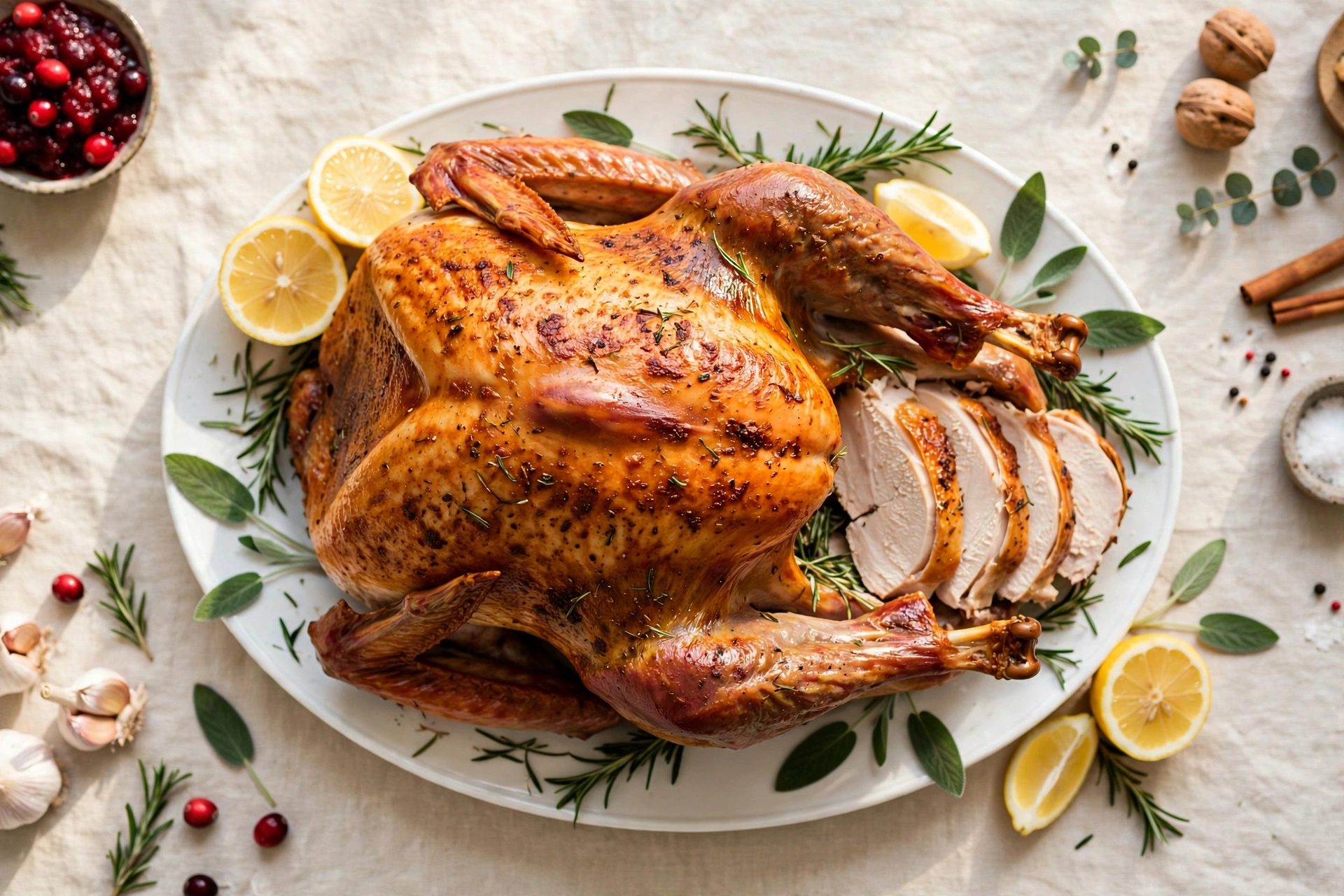
A roast turkey is the one dish nobody gets to practice on the day, so this recipe removes the guesswork: a whole bird, herb butter under the skin, a steady 325 degree oven, and a chart that tells you exactly when to check it. No brine to plan, no special equipment, just a bird that comes out golden, with meat that stays juicy to the last slice.
My grandmother roasted her turkey the same way for forty years, in a pan older than the house, and the whole family went quiet when she started carving. Her rules were simple: butter under the skin, patience in the oven, never skip the rest.
This is her bird, written down with the numbers she carried in her head. Built for a 12 to 14 pound turkey, with a chart below covering 10 to 24 pounds. Cooking for a smaller table instead? The dry brined turkey breast uses the same herb butter and feeds eight.
Why This Roast Turkey Stays Juicy Without a Brine
This roast turkey stays juicy for three working reasons: fat tucked under the skin, gentle steady heat, and a full rest before the knife comes out. Each one protects the meat at a different stage of the roast.
Butter under the skin bastes the breast from the inside as it melts, exactly where a whole bird dries out first. Butter only on the surface seasons the skin and runs off into the pan; butter underneath stays in contact with the meat for the entire roast.
The steady 325 degree oven matters just as much. High heat cooks the outside of a big bird long before the center is done, and that gap is where dry breast meat comes from. A moderate oven narrows the gap, so the thigh and the breast finish close together.
And the dry surface is deliberate. A bird patted completely dry, with salt in the butter and the cavity, roasts up crisp and deeply golden instead of steaming under its own moisture.
How Much Turkey Per Person, and When to Start Thawing
Plan on 1 1/4 pounds of whole turkey per person for generous servings with a little left over, or 1 pound per person for lighter appetites. A 12 to 14 pound bird feeds 10 to 12 people at that rate.
If your table is bigger than 16, roast two smaller birds instead of one giant one. Two 12 pound turkeys cook more evenly than a single 24 pound bird, carve faster, and give you two sets of drumsticks to argue over.
Thawing is the step that decides your week, so start it on time. A frozen turkey thaws in the fridge at roughly 24 hours for every 4 to 5 pounds:
- 8 to 12 pounds: 2 to 3 days in the fridge
- 12 to 16 pounds: 3 to 4 days in the fridge
- 16 to 20 pounds: 4 to 5 days in the fridge
- 20 to 24 pounds: 5 to 6 days in the fridge
Forgot? The cold water method is the safe backup: bird in its wrapper, submerged in cold water changed every 30 minutes, about 30 minutes per pound. foodsafety.gov covers both methods in full.
Ingredients
- 1 whole turkey, 12 to 14 pounds, fully thawed, neck and giblets removed
- 3/4 cup unsalted butter, softened
- 2 tablespoons chopped fresh sage leaves
- 2 tablespoons chopped fresh thyme leaves
- 1 tablespoon chopped fresh rosemary leaves
- 4 cloves garlic, grated
- 1 teaspoon lemon zest
- 2 teaspoons fine sea salt, plus a pinch for the cavity
- 1 teaspoon black pepper
- 1 lemon, halved
- 1 yellow onion, quartered
- 4 sprigs fresh thyme
- 2 carrots, cut into thick chunks
- 2 celery stalks, cut into thick chunks
- 2 cups low sodium chicken or turkey broth
The butter must be properly soft, the texture of mayonnaise, or it will tear the skin when you spread it. Leave it on the counter for an hour; cold butter is the only fiddly part of this recipe.
The Herb Butter Goes Under the Skin, Not Just On Top
Mash the softened butter with the chopped sage, thyme and rosemary, the grated garlic, lemon zest, salt and pepper until the herbs run evenly through it. Grated garlic, not minced, disappears into the butter and never leaves raw, harsh pieces on the meat.
To loosen the skin, slide your fingertips under it at the large cavity opening and work them slowly over the breast, keeping your hand flat. Move gently around the center seam, the one place the skin can tear.
The split is two thirds under, one third over. The under layer does the basting; the over layer is for color and crispness. Push the under butter as far toward the legs as your fingers reach, then smooth it from outside so the layer is even.
One hour out of the fridge before roasting takes the deep chill off, so the center starts cooking when the outside does. A fridge cold bird is the quiet cause of many an overcooked breast.
Roasting the Turkey in Twelve Steps
- Take the turkey out of the fridge 1 hour before roasting. Heat the oven to 325 degrees F with a rack in the lower third.
- Pat the turkey completely dry inside and out with paper towels. Sprinkle the cavity with a pinch of salt and pepper.
- Mash the butter with the sage, thyme, rosemary, garlic, lemon zest, salt and pepper until evenly mixed.
- Loosen the skin over the breast with your fingertips, working from the cavity end and taking care not to tear it.
- Spread two thirds of the herb butter under the skin in an even layer, then spread the rest over the skin.
- Fill the cavity with the lemon halves, onion quarters and thyme sprigs. Tuck the wing tips under the bird and tie the legs loosely with kitchen twine.
- Scatter the carrots and celery in a large roasting pan and pour in the broth. Set the turkey on the vegetables, breast side up.
- Roast for 1 hour without opening the door. The skin will start to color and the pan juices will build underneath.
- Continue roasting to the chart time for your bird below. If the breast skin passes deep golden, tent the bird loosely with foil.
- Start checking the temperature 30 minutes before the chart says done: 165 degrees F in the thickest part of the thigh, and 160 to 165 degrees F in the thickest part of the breast, never touching bone.
- Move the turkey to a cutting board and rest it, tented with foil, for 40 minutes. Pour the pan juices through a strainer for the gravy.
- Carve as described below, arrange the slices on a warm platter, and spoon a little warm pan juice over the top.
The Roasting Chart at 325 Degrees, by Bird Weight
Every roast turkey in this chart cooks at the same steady 325 degrees F, unstuffed, on the vegetable bed described above. Use the range as a window, not a promise: your first temperature check lands 30 minutes before the early end of it.
- 10 to 12 pounds: 2 3/4 to 3 1/4 hours
- 12 to 14 pounds: 3 to 3 1/2 hours
- 14 to 18 pounds: 3 1/2 to 4 1/4 hours
- 18 to 20 pounds: 4 1/4 to 4 1/2 hours
- 20 to 24 pounds: 4 1/2 to 5 hours
Notice what is not in the chart: basting. Every door opening dumps the oven heat and adds minutes to the roast, and the butter under the skin is already basting from inside. Keep the door shut and let the foil tent manage the browning.
The broth and vegetables under the bird do quiet double duty: they perfume the drippings for the gravy and keep a cushion of steam in the pan, so the underside never scorches on bare metal.
Two Thermometer Checks and the 40 Minute Rest
A whole bird needs two readings, not one. Check the thigh first, probe in the thickest part of the inner thigh, angled away from the bone: 165 degrees F is done. Then the breast at its thickest center point, also clear of bone: 160 to 165 degrees F. If the breast is there and the thigh lags, tent the breast with foil and give the bird 15 more minutes.
The 40 minute rest is the step that separates juicy slices from a board flooded with juice. While the turkey rests, the fibers relax and pull their moisture back in, and the temperature coasts up about 5 degrees. A bird carved at minute five loses that juice to the board.
The rest is also your gravy window. Forty unhurried minutes is exactly enough to strain the pan juices and build the turkey gravy from the drippings without rushing either job.
Carving: Take Each Breast Off Whole, Then Slice It
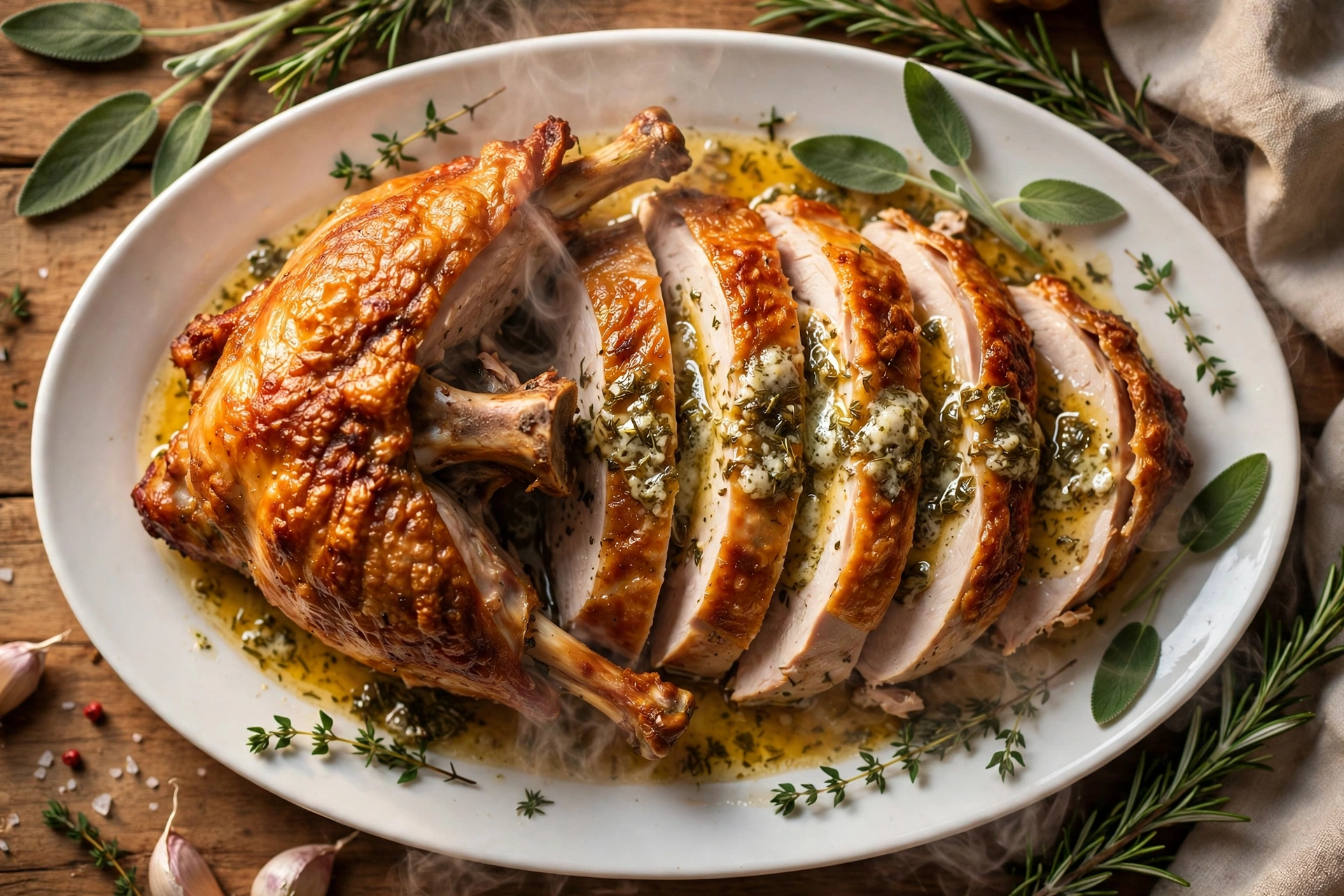
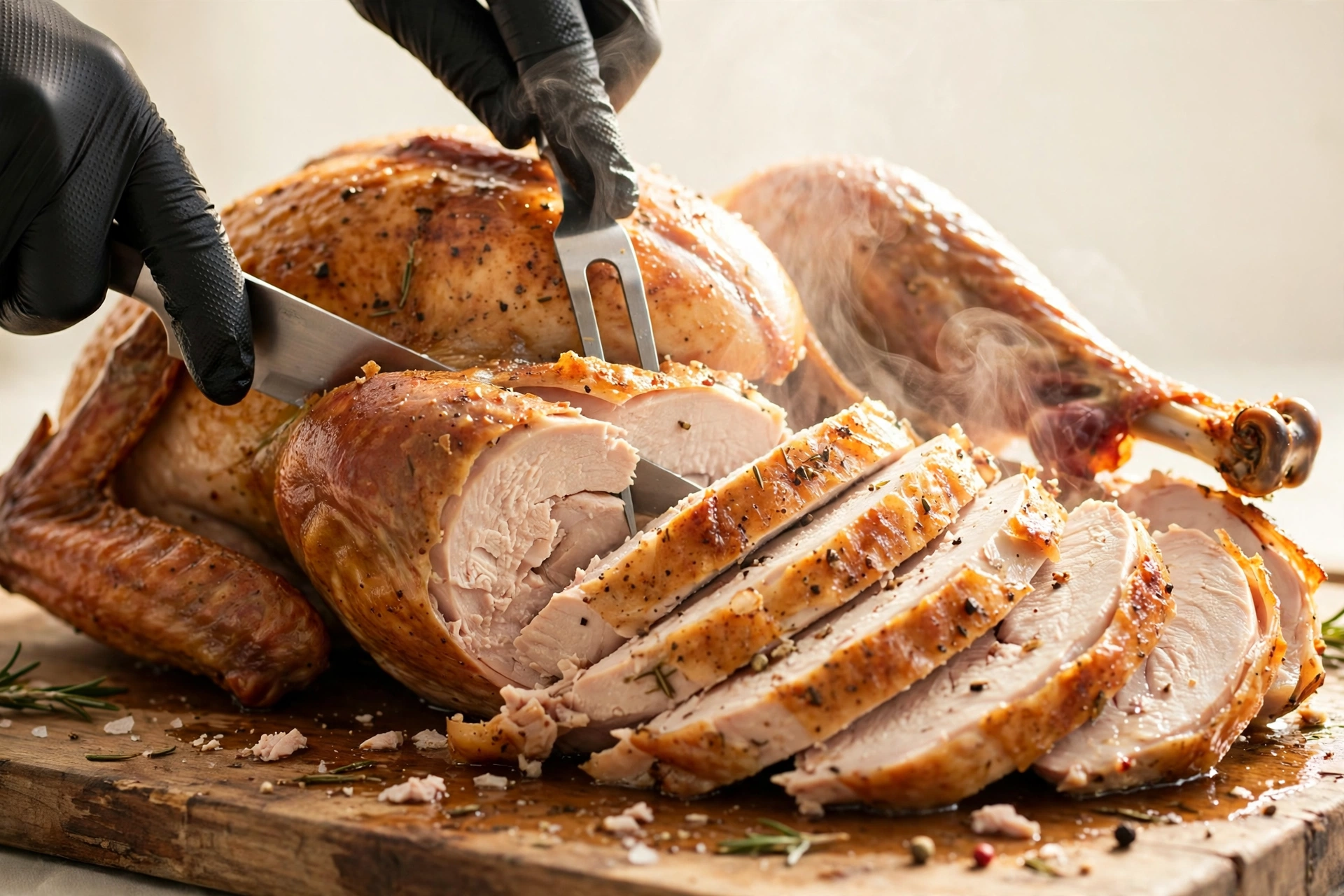
Carving against the bird, slice by slice, is where good turkeys get shredded. Take each breast off in one piece instead: run the knife down one side of the breastbone, following the rib cage with the blade, and lift the whole breast away. Then set it skin side up on the board and slice across the grain into 1/2 inch slices. Every slice keeps its ribbon of skin and its full share of juice.
For the legs, pull a drumstick outward and cut through the joint where it meets the body; the knife finds the gap if you bend the leg back gently. Separate the thigh the same way and slice the dark meat off the bone.
Arrange the dark meat around the edge of a warm platter and the breast slices down the middle, skin up. A platter warmed with hot water keeps everything at serving temperature.
Thanksgiving Day With a Roast Turkey, Hour by Hour
Worked backward from a 3 o’clock table, for a 12 to 14 pound bird. For a bigger bird, shift every time by the chart above.
9:45 am: The turkey comes out of the fridge; the herb butter gets made.
10:30 am: Bird patted dry, buttered under and over the skin, cavity filled, legs tied. Oven on at 325 degrees F.
10:45 am: The turkey goes in. The kitchen is yours for two hours: the homemade stuffing bakes in its own dish and the green bean casserole gets assembled.
1:15 pm: First temperature check, 30 minutes ahead of the chart. Foil tent on if the breast is already deep golden.
1:45 to 2:15 pm: The bird comes out when the checks pass, and rests, tented, a full 40 minutes. Gravy from the strained juices, sides into the oven to finish.
2:45 pm: Carve. Platter to the table at 3, with the slices still steaming.
Leftover Turkey, Stored Right and Used Well
Get the meat off the bone and into the fridge within 2 hours of serving, in shallow containers with a spoonful of pan juice or broth over the slices. Stored that way it keeps 3 to 4 days in the fridge, or 3 months in the freezer, packed flat in bags with the air pressed out.
The carcass is an ingredient, not garbage. Simmer it with an onion, the leftover celery and a few herb stems for a stock that makes the turkey wild rice soup taste like it cooked all day.
Day two is sandwich day in most houses, and these slices were built for it. Warm them gently, covered, so they steam back to tenderness instead of drying at the edges.
Your Roast Turkey Questions, Answered
How long does an 18 pound turkey take to thaw and roast?
Give it 4 to 5 days in the fridge to thaw, then 4 1/4 to 4 1/2 hours at 325 degrees F, plus the 40 minute rest. Work backward from serving time and write the thaw start date on the fridge door; it is the most missed step of the holiday.
Should I cook the stuffing inside the turkey?
No. Stuffing inside the cavity slows the roast unevenly and has to reach 165 degrees F itself, by which time the breast is overdone. Bake the dressing in its own dish, and fill the cavity with lemon, onion and herbs, which perfume the meat without the risk or the wait.
Where exactly does the thermometer go?
Two places. The thigh probe goes into the thickest part of the inner thigh, tip in the center of the meat, not touching bone. The breast probe goes into the thickest center of the breast from the side. Bone contact reads hot and lies to you, so angle away from it.
My turkey is still icy in the middle on Thanksgiving morning. What now?
Use the cold water method: bird in its wrapper, submerged in cold water, water changed every 30 minutes, about 30 minutes per pound. A 12 pound bird needs roughly 6 hours, so start early and shift the timeline, not the oven temperature.
Can I roast the turkey the day before?
Yes, and it reheats better sliced. Roast, rest and carve as written, then store the slices in the strained pan juices. Reheat, covered, at 325 degrees F for 30 to 40 minutes until steaming. The trade is honest: the meat stays juicy, the skin loses its crispness.
How long can the leftovers stay out, and how long do they keep?
Two hours on the table is the limit; after that, refrigerate. In the fridge the meat keeps 3 to 4 days, and frozen slices keep 3 months. When in doubt, the soup pot is the safest delicious answer.
The Bird That Carries the Table
A roast turkey earns the center of the table when three things go right: butter under the skin, a chart instead of a guess, and a rest nobody shortens. Together they are the difference between a bird people praise politely and one they ask about next year.
Write your bird’s weight and your two thermometer readings on the recipe the first year you make it. Next year you will be checking your own notes instead of following a recipe, which is how a dish becomes a family’s.
Nutrition per serving, estimated for 12 servings: Calories 415, Total Fat 20 g, Saturated Fat 7 g, Unsaturated Fat 10 g, Trans Fat 0 g, Carbohydrates 1 g, Fiber 0 g, Sugar 0 g, Protein 57 g, Sodium 720 mg, Cholesterol 195 mg. Ingredient values are informed by USDA FoodData Central.
Print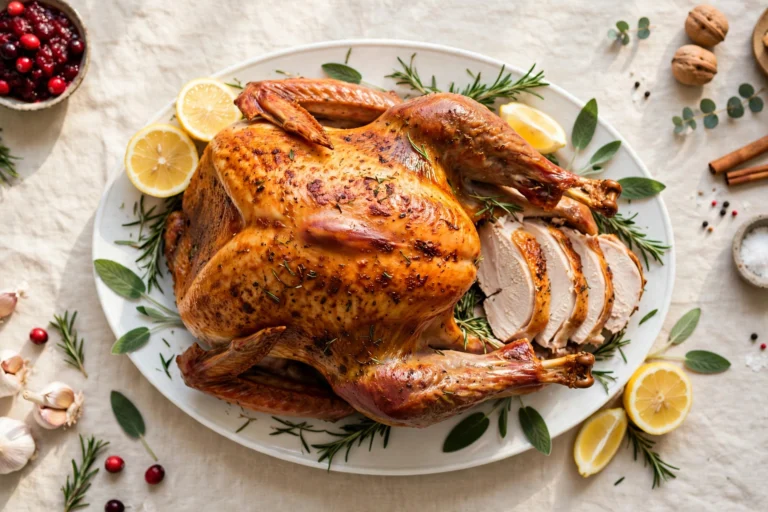
Classic Roast Turkey with Herb Butter
A whole turkey roasted at a steady 325 degrees F with sage, thyme and rosemary butter under the skin, aromatics in the cavity and a broth and vegetable bed in the pan. Includes a thawing and roasting chart by weight, the two thermometer checks and a 40 minute rest for juicy slices. Prep time excludes thawing.
- Total Time: 4 hours 40 minutes
- Yield: 12 servings 1x
Ingredients
- 1 whole turkey, 12 to 14 pounds, fully thawed, neck and giblets removed
- 3/4 cup unsalted butter, softened
- 2 tablespoons chopped fresh sage leaves
- 2 tablespoons chopped fresh thyme leaves
- 1 tablespoon chopped fresh rosemary leaves
- 4 cloves garlic, grated
- 1 teaspoon lemon zest
- 2 teaspoons fine sea salt, plus a pinch for the cavity
- 1 teaspoon black pepper
- 1 lemon, halved
- 1 yellow onion, quartered
- 4 sprigs fresh thyme
- 2 carrots, cut into thick chunks
- 2 celery stalks, cut into thick chunks
- 2 cups low sodium chicken or turkey broth
Instructions
- Take the turkey out of the fridge 1 hour before roasting. Heat the oven to 325 degrees F with a rack in the lower third.
- Pat the turkey completely dry inside and out with paper towels. Sprinkle the cavity with a pinch of salt and pepper.
- Mash the butter with the sage, thyme, rosemary, garlic, lemon zest, salt and pepper until evenly mixed.
- Loosen the skin over the breast with your fingertips, working from the cavity end and taking care not to tear it.
- Spread two thirds of the herb butter under the skin in an even layer, then spread the rest over the skin.
- Fill the cavity with the lemon halves, onion quarters and thyme sprigs. Tuck the wing tips under the bird and tie the legs loosely with kitchen twine.
- Scatter the carrots and celery in a large roasting pan and pour in the broth. Set the turkey on the vegetables, breast side up.
- Roast for 1 hour without opening the door, then continue roasting to the chart time for the bird’s weight, tenting loosely with foil if the breast skin passes deep golden.
- Start checking the temperature 30 minutes before the chart says done: 165 degrees F in the thickest part of the thigh, and 160 to 165 degrees F in the thickest part of the breast, never touching bone.
- Move the turkey to a cutting board and rest it, tented with foil, for 40 minutes. Pour the pan juices through a strainer for the gravy.
- Carve each breast off the bone in one piece, then slice across the grain. Arrange on a warm platter and spoon a little warm pan juice over the slices.
- Prep Time: 30 minutes
- Cook Time: 3 hours 30 minutes
Nutrition
- Serving Size: 7
- Calories: 415
- Sugar: 0
- Sodium: 720
- Fat: 20
- Saturated Fat: 7
- Unsaturated Fat: 10
- Trans Fat: 0
- Carbohydrates: 1
- Fiber: 0
- Protein: 57
- Cholesterol: 195