In this article:
- Why This Homemade Panettone Rises So Tall
- An Overnight Starter Does the Heavy Lifting
- Butter Goes In Last, a Spoonful at a Time
- Ingredients for Homemade Panettone
- Mixing, Rising and Baking the Panettone
- No Paper Mold? Three Pans That Work
- Sunken Dome, Runaway Fruit: Fixes That Save the Loaf
- Dark Chocolate, Espresso Soak and Other Variations
- Wrap It, Freeze It, Gift It
- Conclusion
- FAQ
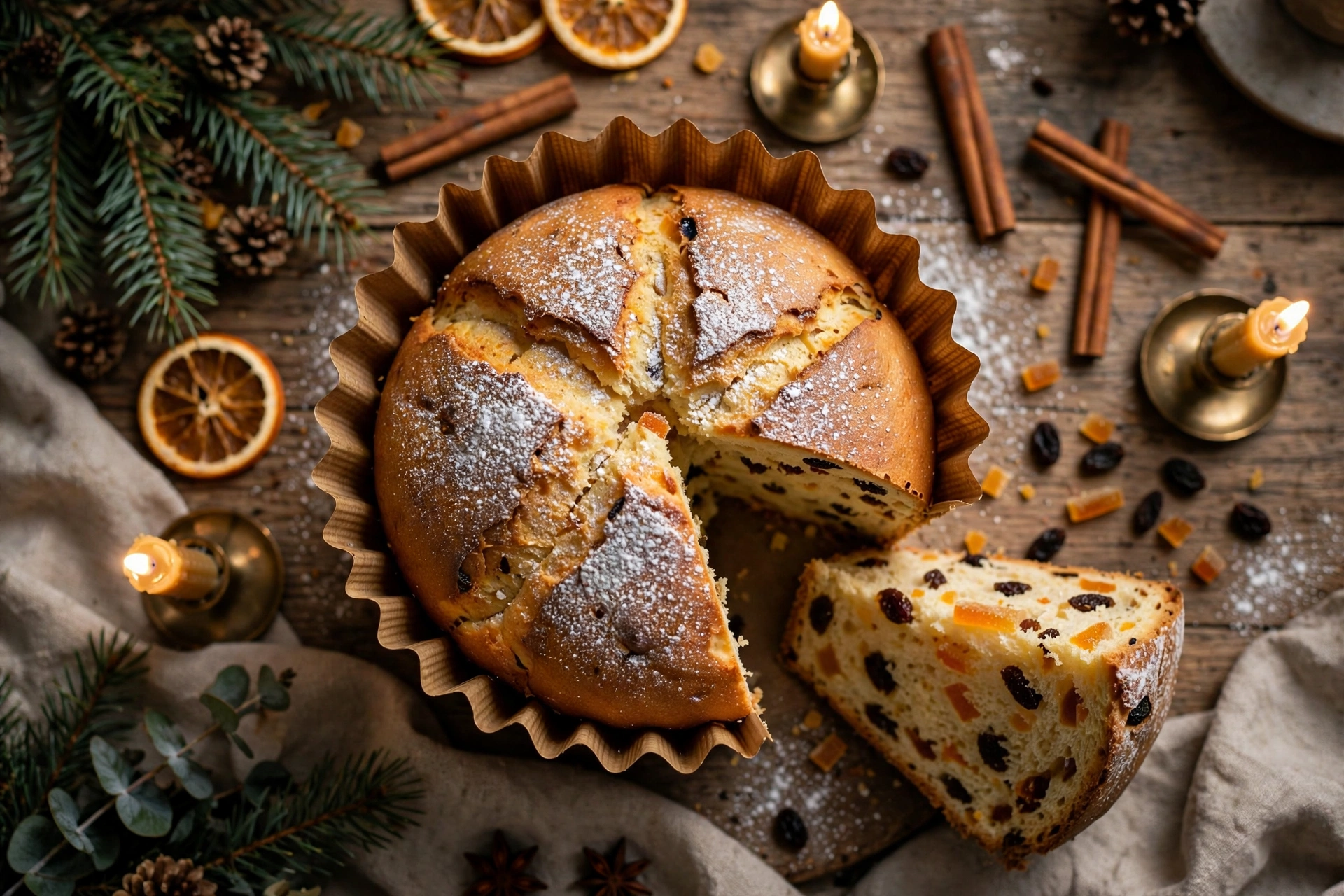
Homemade panettone is the Christmas loaf that makes a kitchen smell like an Italian bakery: butter, orange zest, vanilla, and warm raisins drifting from the oven for hours. It rises tall in its fluted paper mold, domes like a chef’s hat, and tears into long, feathery strands that stretch instead of crumbling.
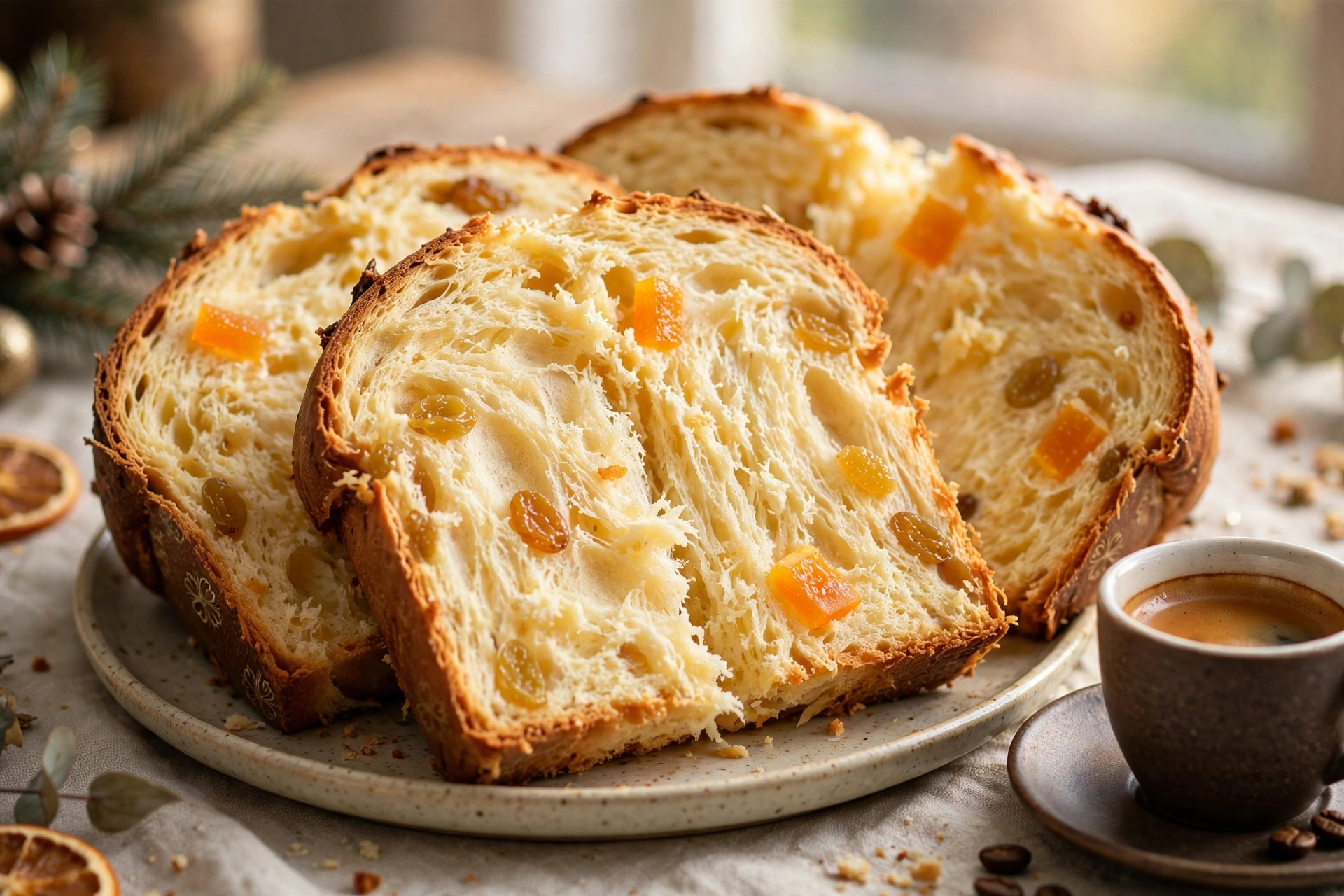
The first slice tells you why bakers guard this recipe. The crumb is pale gold and almost weightless, yet rich enough to taste like cake, and every strand carries a jewel of candied orange or a plump golden raisin. Toasted the next morning, it turns crisp at the edges and stays custardy in the middle.
This version respects the tradition without demanding a professional kitchen. An overnight starter builds the flavor, the butter goes in slowly so the dough stays silky, and the loaf cools upside down so the dome never falls. It is a weekend project, mostly waiting, and the waiting is the recipe.
Why This Homemade Panettone Rises So Tall
Homemade panettone rises tall for three reasons, and none of them is luck. The dough starts with a living starter that has had all night to build strength and flavor. The butter is added after the gluten forms, so the dough can stretch instead of tearing. And the finished loaf cools hanging upside down, which locks the dome in place while the crumb sets.
Most quick versions skip at least two of those steps, and the loaf tells on them: squat shape, tight crumb, a top that caves in by morning. Panettone dough is one of the richest doughs in baking, loaded with yolks, sugar, and butter, all of which fight the rise. The method has to defend the rise at every stage.
The fruit is defended too. Raisins and candied peel are soaked, drained, and dried before they meet the dough, then folded in at the very end of mixing. Dry fruit drinks moisture from the crumb and heavy wet fruit sinks; fruit that is plump but surface dry stays suspended in the strands like ornaments on a tree.
There is also the matter of patience between the rises. This dough cannot be rushed into a warm corner and bullied upward in an hour; a slow, steady rise at cool room temperature builds a finer network of bubbles and a deeper flavor than a fast, hot one. Tall loaves are not made in a hurry, and panettone least of all.
An Overnight Starter Does the Heavy Lifting
The starter is a ten minute job the night before: flour, cool water, and a pinch of yeast, stirred into a shaggy paste and left on the counter. By morning it is bubbled, domed, and smelling faintly like green apples. That quiet jar is where the panettone gets its depth, the gentle tang that keeps a sweet bread from tasting flat.
A starter also buys structure. The flour hydrates for hours before the real mixing begins, so the gluten network forms faster and stronger the next day. You will feel it in the bowl: the dough turns elastic sooner, holds the butter more gracefully, and stretches into the famous windowpane without a fight.
There is a scheduling gift here as well. Because the starter works overnight, baking day itself is relaxed: one morning mix, two unhurried rises, and an afternoon bake. Serve slices on Christmas morning beside something like an eggnog french toast casserole and the whole table tastes planned, even if it came together across two calm days.
If your starter looks sleepy in the morning, give it an honest check before blaming it. It should be webbed with bubbles, risen noticeably, and smell pleasantly fruity rather than sharp. A cold kitchen can slow it to a crawl; move the jar somewhere warmer for an hour or two and it usually wakes. If it smells like nail polish and never bubbled at all, start it again with fresh yeast and lose only a day.
Butter Goes In Last, a Spoonful at a Time
Fat is gluten’s enemy when it arrives too early. If the butter went in with the flour, it would coat every protein strand and the dough would never build the elastic web that traps gas. So the dough is mixed and kneaded first, until it is smooth and stretchy, and only then does the butter join, one soft spoonful at a time.
Each addition has to disappear completely before the next one lands. The dough will look alarming midway, glossy and loose, almost like a batter misbehaving. Keep the mixer running and trust the process: within minutes the dough pulls itself back together, silkier than before, slapping softly against the bowl.
The butter itself matters. Use a good unsalted butter, soft enough to dent with a finger but never melted. Melted butter separates and greases the dough; soft butter emulsifies into it. That emulsion is the difference between a crumb that tastes rich and tender and one that tastes greasy.
Ingredients for Homemade Panettone
For the overnight starter:
- 3/4 cup (95 g) bread flour
- 1/3 cup (80 ml) cool water
- 1/4 teaspoon instant yeast
For the fruit:
- 3/4 cup (110 g) golden raisins
- 1/2 cup (80 g) candied orange peel, finely diced
- Warm water or orange juice, for soaking
For the dough:
- All of the overnight starter
- 2 1/4 cups (280 g) bread flour, plus more for shaping
- 1/3 cup (65 g) granulated sugar
- 1 teaspoon fine salt
- 1 teaspoon instant yeast
- 3 large egg yolks, at room temperature
- 1 large egg, at room temperature
- 1/4 cup (60 ml) warm milk
- 2 teaspoons pure vanilla extract
- Finely grated zest of 1 orange and 1 lemon
- 8 tablespoons (115 g) unsalted butter, soft, cut into pieces
- 1 tablespoon soft butter, for the top
- Powdered sugar, for dusting (optional)
Mixing, Rising and Baking the Panettone
The night before, stir the starter ingredients into a thick paste, cover, and leave at room temperature for 10 to 12 hours, until bubbled and risen. On baking morning, this is where the homemade panettone comes together, in unhurried stages.
- Cover the raisins and candied peel with warm water or orange juice. Soak 30 minutes, then drain well and pat completely dry on a clean towel.
- In the bowl of a stand mixer, combine the starter, flour, sugar, salt, and yeast. Add the yolks, the whole egg, warm milk, vanilla, and both zests.
- Mix with the dough hook on low until a rough dough forms, then knead 8 to 10 minutes, until smooth, elastic, and pulling into a thin windowpane.
- With the mixer running, add the soft butter one spoonful at a time, waiting for each to vanish before adding the next, about 10 minutes in total. Knead 3 minutes more, until the dough is glossy and silky.
- Add the drained fruit and mix on the lowest speed just until evenly distributed, about 1 minute.
- Scrape the dough into a lightly buttered bowl, cover, and rise in a warm place for 1 1/2 to 2 hours, until doubled and puffy.
- Turn the dough onto a bare counter, shape it into a tight round ball with the seam underneath, and set it seam down in a 6 to 7 inch panettone paper mold.
- Cover and rise again for 2 to 3 hours, until the dome of dough just crests the rim of the mold.
- Heat the oven to 350°F (175°C). Score a shallow cross on top of the loaf and lay the tablespoon of soft butter in the center of the cross.
- Bake 10 minutes, then reduce the heat to 325°F (165°C) and bake 25 to 30 minutes more, until deep golden and an instant read thermometer in the center reads 190 to 195°F. Tent with foil if the top browns early.
- Push two long skewers through the base of the loaf, flip it, and hang it upside down between two pots or a tall stockpot rim. Cool at least 2 hours, ideally overnight, before slicing.
No Paper Mold? Three Pans That Work
The fluted paper mold is traditional and cheap, but it is not a gatekeeper. A clean 2 pound coffee can, the old fashioned trick, gives the same tall walls; line it with a parchment collar that rises 2 inches above the rim. A deep springform or charlotte pan works the same way, with the collar doing the climbing for the dough.
The one pan to avoid is a standard loaf tin. Panettone needs height, not length: in a loaf pan the same dough spreads wide, bakes dense, and never forms the dome. If a loaf pan is all you own, divide the dough between two small pans and shorten the bake by 10 minutes.
Whatever pan you choose, the dough ball should fill it about one third full before the final rise. King Arthur Baking, whose test kitchen bakes panettone every season, uses that same one third rule across their panettone recipe testing, and it is the most reliable predictor of a loaf that crests instead of spilling.
Sunken Dome, Runaway Fruit: Fixes That Save the Loaf
A dome that sinks almost always skipped the upside down cooling. The crumb of a rich loaf is still setting when it leaves the oven, and its own weight compresses it as it cools upright. Skewer and hang the loaf while it is hot, every single time, and the strands set stretched instead of squashed.
Fruit at the bottom of the slice means the fruit went in wet or the dough was under kneaded. Soaked fruit must be patted truly dry, and a dough that passes the windowpane test has the strength to hold fruit in suspension. A tablespoon of flour tossed through the dried fruit before folding adds insurance.
A dough that tears and turns greasy during the butter stage is usually too warm. Yolks, milk, and butter should be cool room temperature, never warm, and if the bowl feels warm to the touch, rest the dough in the refrigerator for 15 minutes mid incorporation. Cold dough forgives; warm dough separates.
Finally, a pale, soft crust signals an underbake, no matter how golden the dome looks. Trust the thermometer, not the color: 190°F at the center is the line between a crumb that slices into strands and one that gums the knife.
Dark Chocolate, Espresso Soak and Other Variations
Once the classic loaf behaves, the homemade panettone becomes a canvas. The best known variation swaps the raisins for 1 cup of dark chocolate chunks and keeps the candied orange, a combination that tastes like a chocolate orange in bread form. Freeze the chunks for 20 minutes so they hold their shape in the warm dough.
For a gentler loaf, replace the candied peel with dried cherries and add 1/2 teaspoon of almond extract with the vanilla. For a coffee lover’s version, brush the cooled loaf with a light espresso syrup and dust with cocoa instead of powdered sugar. Our chocolate yule log cake covers the full chocolate end of the Christmas table if you want a two dessert strategy.
Nutritionally, panettone is a celebration bread and dresses like one: a generous slice (one twelfth of the loaf) brings roughly 390 calories, 13 g fat, 58 g carbohydrates, and 7 g protein, with the fruit contributing fiber and the yolks a little richness that keeps the crumb moist for days.
Wrap It, Freeze It, Gift It
Wrapped tightly in plastic and kept at room temperature, panettone stays soft for 5 to 7 days, a small miracle of the enriched dough and the fruit. Never refrigerate it: the cold dries the crumb faster than the counter does. A 10 second warm in the microwave or a minute in a low oven brings day four slices back to life.
For longer keeping, freeze the whole cooled loaf, double wrapped, for up to 2 months, or freeze thick slices in a single layer for toast on demand. Thaw at room temperature still wrapped, so the moisture returns to the crumb instead of the air.
As a gift, the loaf travels beautifully in its own mold: slide it into a cellophane bag, tie it with ribbon, and add a tag with the slicing advice, wedges, never horizontal rounds. Pair it with another make ahead bake from our dessert collection, such as the gingerbread layer cake, and you have a host gift that looks like a bakery box set.
When the loaf finally meets the knife, treat it gently. A long serrated blade, a sawing motion with almost no downward pressure, and thick wedges cut from the top down keep the crumb from compressing. Day old slices belong in the toaster or a buttered skillet, where the edges go lacy and crisp while the center stays soft; it is, quietly, the best breakfast of the whole season.
Conclusion
Homemade panettone asks for patience and pays it back in height, fragrance, and those long, pullable strands no store loaf can match. Start the starter tonight, let the butter go in slowly, hang the loaf without mercy, and Christmas morning will smell like Milan. Some recipes are errands; this one is a small ceremony, and it is worth every quiet hour.
FAQ
Can I skip the overnight starter and make panettone in one day?
You can, and the loaf will still be good, but it will be shorter and milder. Without the starter, increase the yeast in the dough to 2 teaspoons, expect a slightly tighter crumb, and know that the keeping quality drops from a week to about three days.
Why does panettone have to cool upside down?
The hot crumb is still setting and the loaf is heavy with butter and fruit, so cooling upright lets gravity compress the dome into a dense base. Hanging the loaf on skewers keeps the strands stretched while they set, which preserves the tall shape and the feathery pull.
My raisins all sank to the bottom. What went wrong?
The fruit was either wet when it went in or the dough was under kneaded. Pat soaked fruit completely dry, toss it with a spoonful of flour, and make sure the dough passes the windowpane test before the fruit is folded in at the very end of mixing.
I do not have a panettone mold. What can I use instead?
A clean 2 pound coffee can or a deep cake pan lined with a parchment collar that rises about 2 inches above the rim works well. Fill the pan only one third full before the final rise so the dough has room to crest instead of spill.
How long does homemade panettone stay fresh?
Wrapped tightly, it keeps 5 to 7 days at room temperature and freezes well for up to 2 months. Keep it out of the refrigerator, which dries the crumb, and refresh slices with 10 seconds in the microwave or a minute in a low oven.
Homemade Panettone
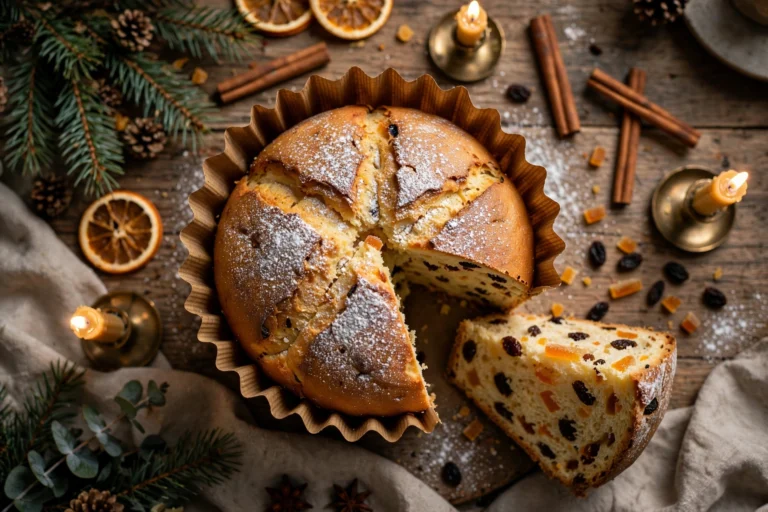
A tall homemade panettone built on an overnight starter: feathery, pull apart crumb with golden raisins and candied orange, butter worked in slowly, and the loaf cooled upside down so the dome never falls. The Christmas loaf, done the patient way.
- Total Time: 14 hours
- Yield: 12 slices 1x
Ingredients
- 3/4 cup (95 g) bread flour, for the starter
- 1/3 cup (80 ml) cool water, for the starter
- 1/4 teaspoon instant yeast, for the starter
- 3/4 cup (110 g) golden raisins
- 1/2 cup (80 g) candied orange peel, finely diced
- Warm water or orange juice, for soaking the fruit
- 2 1/4 cups (280 g) bread flour, plus more for shaping
- 1/3 cup (65 g) granulated sugar
- 1 teaspoon fine salt
- 1 teaspoon instant yeast
- 3 large egg yolks, at room temperature
- 1 large egg, at room temperature
- 1/4 cup (60 ml) warm milk
- 2 teaspoons pure vanilla extract
- Finely grated zest of 1 orange and 1 lemon
- 8 tablespoons (115 g) unsalted butter, soft, cut into pieces
- 1 tablespoon soft butter, for the top
- Powdered sugar, for dusting (optional)
Instructions
- The night before, stir the starter flour, cool water, and 1/4 teaspoon yeast into a thick paste. Cover and leave at room temperature for 10 to 12 hours, until bubbled and risen.
- Cover the raisins and candied peel with warm water or orange juice. Soak 30 minutes, then drain well and pat completely dry on a clean towel.
- In the bowl of a stand mixer, combine the starter, flour, sugar, salt, and 1 teaspoon yeast. Add the yolks, the whole egg, warm milk, vanilla, and both zests.
- Mix with the dough hook on low until a rough dough forms, then knead 8 to 10 minutes, until smooth, elastic, and pulling into a thin windowpane.
- With the mixer running, add the soft butter one spoonful at a time, waiting for each to vanish before adding the next, about 10 minutes in total. Knead 3 minutes more, until glossy and silky.
- Add the drained fruit and mix on the lowest speed just until evenly distributed, about 1 minute.
- Scrape the dough into a lightly buttered bowl, cover, and rise in a warm place for 1 1/2 to 2 hours, until doubled and puffy.
- Shape the dough into a tight round ball with the seam underneath, and set it seam down in a 6 to 7 inch panettone paper mold.
- Cover and rise again for 2 to 3 hours, until the dome of dough just crests the rim of the mold.
- Heat the oven to 350°F (175°C). Score a shallow cross on top and lay the tablespoon of soft butter in the center of the cross.
- Bake 10 minutes, then reduce the heat to 325°F (165°C) and bake 25 to 30 minutes more, until deep golden and the center reads 190 to 195°F. Tent with foil if the top browns early.
- Push two long skewers through the base, flip the loaf, and hang it upside down between two pots. Cool at least 2 hours, ideally overnight, before slicing into wedges.
- Prep Time: 40 minutes
- Cook Time: 40 minutes