In this article:
- Why This Gingerbread Cheesecake Never Cracks
- Molasses First, Then the Warm Spice Bloom
- A Steam Bath Instead of a Water Bath
- Ingredients for Gingerbread Cheesecake
- Building the Cheesecake, Pan to Oven
- Gingersnap, Gingerbread Men or Speculoos: Picking the Crust
- Little Fixes for a Flawless Top
- Lighter Twists and a Gluten Free Crust
- Freeze It Now, Thank Yourself at Christmas
- Conclusion
- FAQ
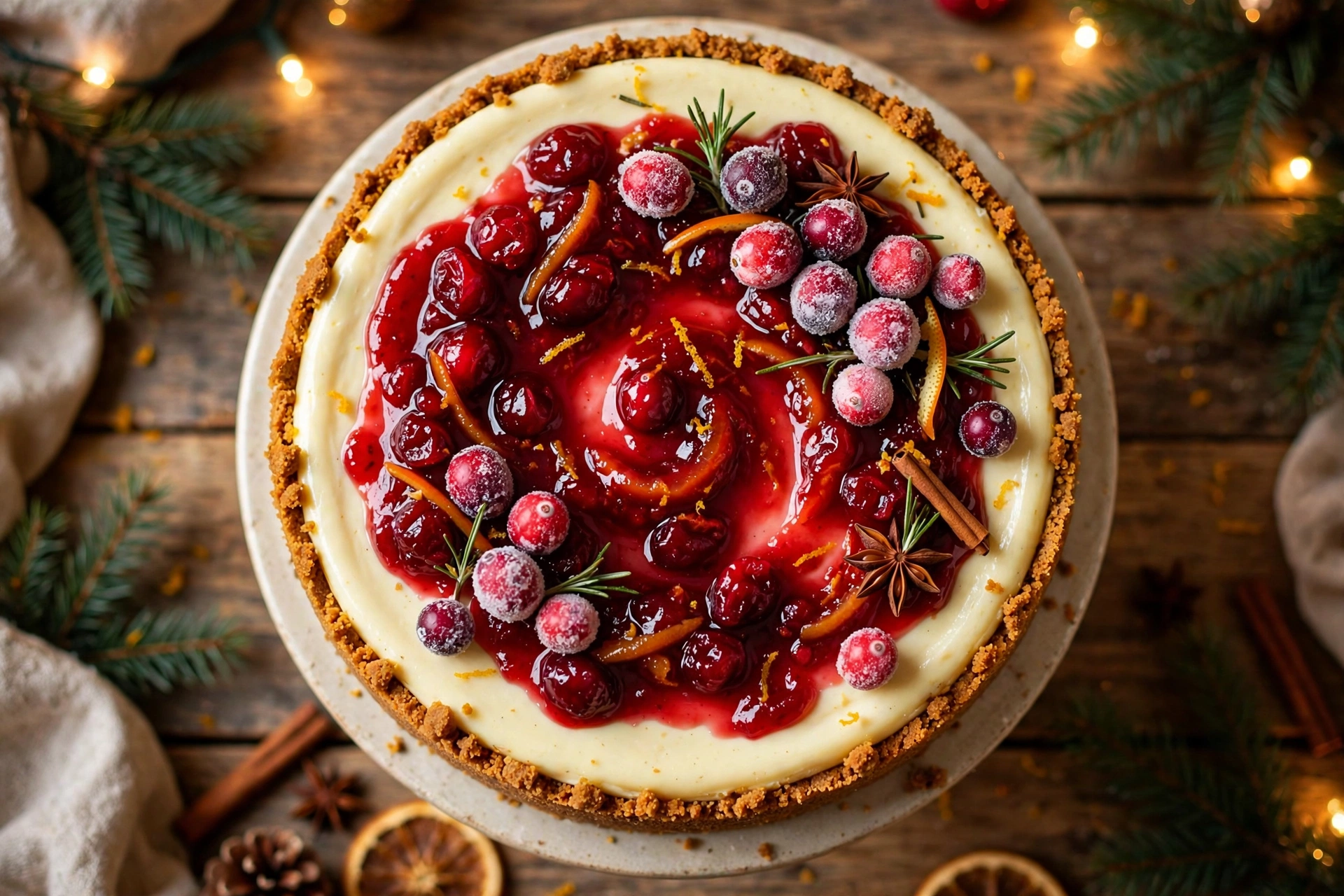
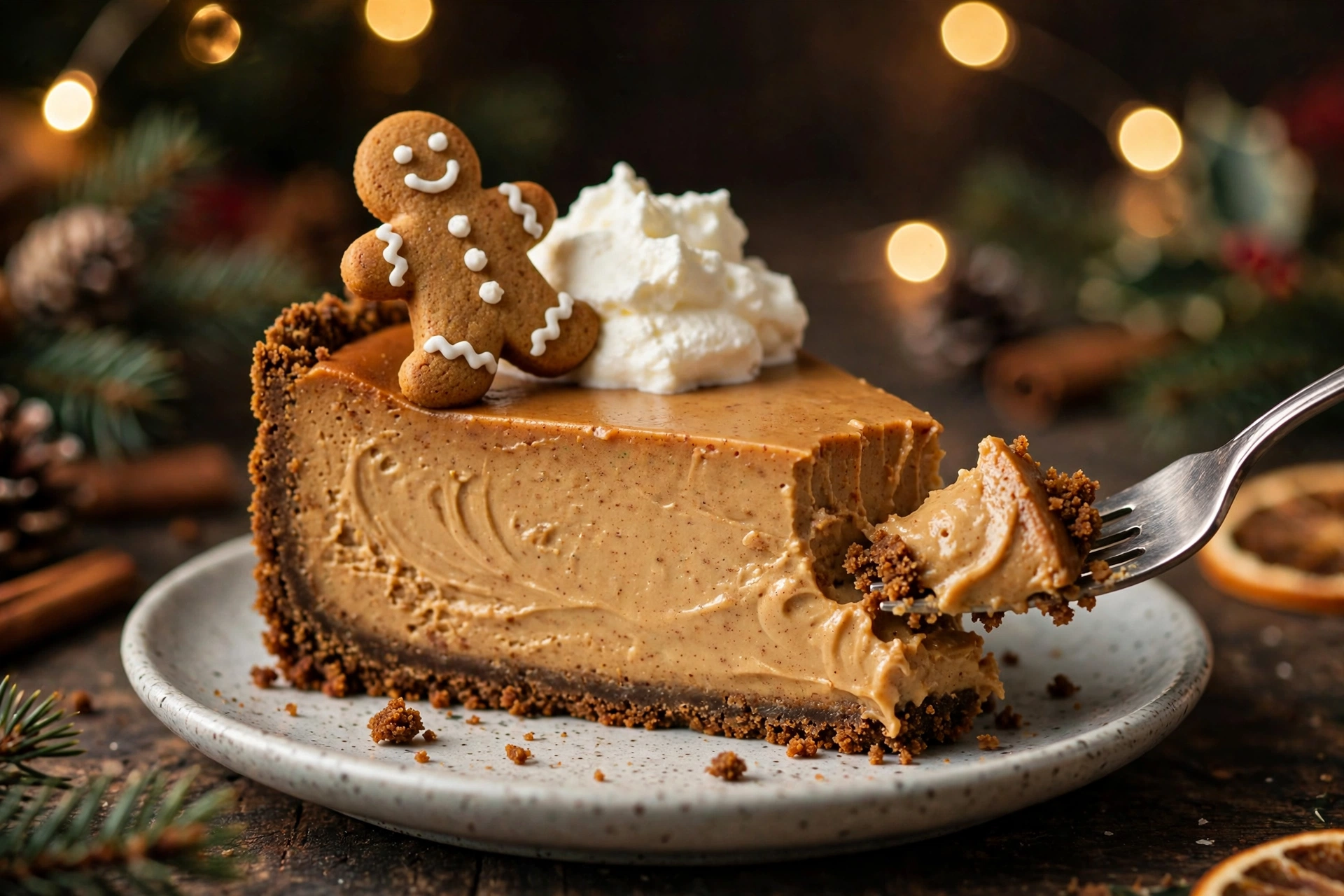
Gingerbread cheesecake is the dessert that finally gives December a centerpiece with real presence: a dark, snapping gingersnap crust under a filling the color of warm caramel, spiced like the inside of a gingerbread house. It slices into clean, dense wedges that taste like the holidays decided to sit down and stay awhile.
The first bite is all contrast. The crust crunches, almost like a cookie you would eat on its own, and then the filling arrives soft, cool, and silky, carrying molasses depth before the ginger heat blooms at the back of the tongue. Cinnamon rounds it out, nutmeg and clove whisper underneath, and nothing shouts.
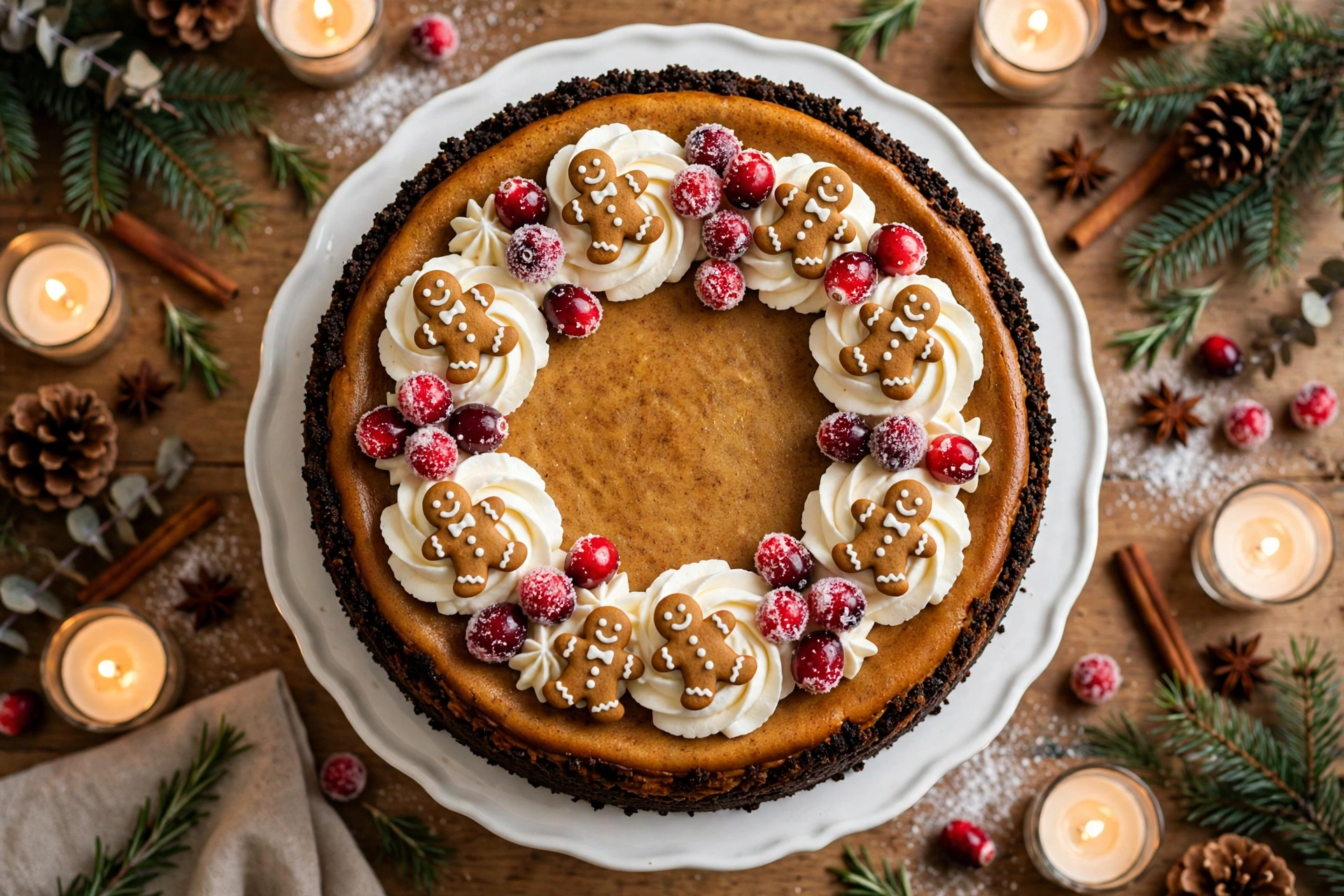
This is also a planner’s dessert. It wants to be made ahead, it freezes without complaint, and it comes to the table wearing whipped cream swirls, tiny gingerbread men, and cranberries frosted like they were caught in the first snow. One cake, twelve generous slices, zero last minute drama in a kitchen that already has plenty.
Why This Gingerbread Cheesecake Never Cracks
Gingerbread cheesecake cracks for the same three reasons every cheesecake cracks: the batter was beaten full of air, the oven dried the surface faster than the center could set, and the cake cooled too quickly and pulled itself apart. This recipe is built to remove all three causes before they can start.
The mixing stays slow and low. Cream cheese and sugar are beaten just until smooth, the eggs go in one at a time on the lowest speed, and nothing is whipped. Air pockets are what rise, expand, and collapse into craters and fissures, so a batter that was never aerated has nothing to collapse.
The oven gets humidity without the fuss of a water bath. A roasting pan of boiling water on the rack below the cake fills the oven with gentle steam, which keeps the surface supple while the center sets. No foil wrapped pans sitting in water, no leaks, no soggy crust surprises when you unmold.
Finally, the cooling is a staircase, not a cliff. The oven turns off, the door cracks open, and the cake drifts down in temperature for a full hour before it ever meets room air. Cheesecake is a custard wearing a crust, and custards reward patience with a top as smooth as a frozen pond.
Molasses First, Then the Warm Spice Bloom
Molasses is the soul of this filling, and the kind matters more than any other choice in the recipe. Use mild, unsulphured molasses, the everyday baking kind with the red or gold label. It brings round caramel depth and a gentle bitterness that reads as richness against the tang of the cheese.
Robust and blackstrap molasses are a different ingredient entirely. They are concentrated, mineral heavy, and assertive enough to bully cream cheese into something that tastes almost savory. Save them for barbecue sauce. If your jar says blackstrap, cut it half and half with honey to bring it back into dessert territory.
The spices are layered the way a good gingerbread layers them. Ground ginger leads at one and a half teaspoons, because gingerbread that does not taste of ginger is just spice cake. Cinnamon supports, nutmeg adds warmth, and a quarter teaspoon of clove gives that deep, old fashioned finish people recognize without naming.
Two tablespoons of flour disappear into the batter as quiet insurance. They stabilize the custard, forgive small temperature swings, and make the slices cut like a bakery case cake. You will not taste them, and your future self, holding a knife over a flawless top, will not miss their absence.
A Steam Bath Instead of a Water Bath
Set a kettle on to boil while the crust bakes. When the filled pan goes into the oven, pour the boiling water into a roasting pan on the lowest rack, about an inch deep. The steam rises around the springform for the whole bake, and the top of the cake stays glossy and relaxed.
This method dodges the classic water bath failures. There is no foil seam to wick water into the crust, no sloshing pan to haul out of a hot oven, and no guessing whether the bath was deep enough. A 9 inch springform, a kettle, and a roasting pan are the entire equipment list.
The bake itself runs at 325°F for 60 to 70 minutes. You are not watching the clock so much as the jiggle: the outer two inches should look set and matte, while the center, about the width of a tennis ball, still trembles as one piece when the rack is nudged. That trembling center finishes setting as the cake cools.
If you own an instant read thermometer, the center should sit near 150°F when the oven goes off. Carryover heat and the long rest do the rest. Pulling a cheesecake at a firm center is how good bakers end up with a dry one, so trust the wobble.
Ingredients for Gingerbread Cheesecake
For the gingersnap crust:
- 2 cups (200 g) finely crushed gingersnap cookies
- 2 tablespoons granulated sugar
- 6 tablespoons (85 g) unsalted butter, melted
- Pinch of fine salt
For the filling:
- 32 oz (900 g) full fat cream cheese, four blocks, at room temperature
- 1 cup (200 g) granulated sugar
- 1/4 cup (60 ml) mild unsulphured molasses
- 1/2 cup (120 g) sour cream, at room temperature
- 2 teaspoons pure vanilla extract
- 1 1/2 teaspoons ground ginger
- 1 teaspoon ground cinnamon
- 1/2 teaspoon ground nutmeg
- 1/4 teaspoon ground cloves
- 1/4 teaspoon fine salt
- 2 tablespoons all-purpose flour
- 4 large eggs, at room temperature
To finish:
- 1 cup (240 ml) heavy cream, whipped to soft peaks
- Mini gingerbread cookies, for decorating
- Sugared cranberries, for decorating
Building the Cheesecake, Pan to Oven
- Heat the oven to 325°F (165°C). Lightly butter a 9 inch springform pan and line the base with a round of parchment. Set a kettle of water on to boil for the steam pan.
- Stir the gingersnap crumbs, sugar, salt, and melted butter until the mixture looks like wet sand. Press it firmly and evenly across the bottom of the pan, using the flat base of a measuring cup, and bake 10 minutes. Cool on a rack while you mix the filling.
- Beat the cream cheese and sugar on low to medium speed for about 2 minutes, just until completely smooth and free of lumps. Scrape the bowl well, including the bottom.
- Beat in the molasses, sour cream, and vanilla until the batter turns an even caramel color. Add the ginger, cinnamon, nutmeg, cloves, salt, and flour, and mix until they disappear.
- Add the eggs one at a time on the lowest speed, mixing only until each yolk streak vanishes. Overmixing here is the crack maker, so stop early rather than late.
- Pour the filling over the cooled crust and smooth the top. Tap the pan on the counter twice to release any large bubbles, and pop surface bubbles with a toothpick.
- Pour boiling water into a roasting pan on the lowest oven rack. Set the cheesecake on the middle rack and bake 60 to 70 minutes, until the edges look set and the center still trembles as one piece.
- Turn the oven off, crack the door with a wooden spoon, and leave the cake inside for 1 hour. Then move it to a rack and cool to room temperature, about 1 hour more.
- Cover and refrigerate at least 6 hours, overnight if you can. Run a thin knife around the edge before releasing the springform ring.
- Pipe or spoon whipped cream swirls around the border, perch a mini gingerbread cookie on each swirl, scatter sugared cranberries between them, and slice with a hot, wiped knife.
Gingersnap, Gingerbread Men or Speculoos: Picking the Crust
Gingersnaps are the classic for a reason. They are hard, dry, and fiercely spiced, so they grind into a crust that stays crisp under a heavy filling and echoes the ginger in every bite. If your snaps are the soft, chewy kind, dry the crumbs in a low oven for five minutes before adding butter.
Homemade gingerbread men make a softer, cake spiced crust with a deeper molasses note. It is the move when a tray of cookies is already on the counter, and kids consider it the superior option on principle. Reduce the butter by a tablespoon, since cookie crumbs carry more moisture than snaps.
Speculoos biscuits bring caramelized sugar and a gentler spice, closer to a graham crust with a European accent. The result is milder and very elegant, a good choice when the cheesecake will share the table with other strong desserts. Whichever crumb you choose, the ratio holds: two cups of crumbs to six tablespoons of butter.
And if your December plans include a whole spread, this cake anchors it beautifully next to something crunchy and bright. Our homemade peppermint bark takes ten minutes of real work, and the red and white shards look like they were styled to sit beside this cheesecake.
Little Fixes for a Flawless Top
Room temperature ingredients are not a suggestion. Cold cream cheese beats into lumps that no amount of mixing fully erases, and cold eggs can seize the batter into curds. Set everything out for a full hour, or warm the sealed cheese blocks in a bowl of warm water for fifteen minutes.
If a crack appears anyway, it is a decorating problem, not a disaster. Warm a small offset spatula under hot water, dry it, and gently press the crack closed while the cake is still warm. Once chilled, the whipped cream border covers a multitude of sins, which is precisely what it is for.
A sunken center means the cake was pulled too late or cooled too fast, and a puffed, browned top means the oven ran hot. Cheesecake ovens lie often enough that a cheap oven thermometer pays for itself in one holiday season. The cake forgives flavor wise either way; only the mirror finish is at stake.
For slices that look cut by a professional, dip a long thin knife in hot water, wipe it dry, make one cut, and repeat the dip and wipe for every slice. The warm blade glides through the custard instead of dragging it, and each wedge keeps its sharp, deli case edge.
Lighter Twists and a Gluten Free Crust
A lighter batch swaps one of the four cream cheese blocks for an equal weight of Greek yogurt, drained for an hour in a sieve. The tang rises a little, the texture stays silky, and nobody at the table will file a complaint. Keep the sour cream as written, since it carries the classic flavor.
For a gluten free crust, use certified gluten free gingersnaps and skip the two tablespoons of flour in the filling, adding one extra egg yolk instead for stability. The bake runs about five minutes longer, and the jiggle test stays exactly the same.
Dairy free bakers can use the firm, block style plant based cream cheese and a coconut cream swap for the sour cream. Choose a brand that slices cold rather than scooping soft, because structure is the whole game in a baked cheesecake. The spices are bold enough to carry the change gracefully.
Freeze It Now, Thank Yourself at Christmas
Gingerbread cheesecake might be the most freezer friendly dessert in the entire December repertoire. Chill the undecorated cake overnight first, then wrap the whole cake, still on its base, in two layers of plastic and one of foil. It keeps its texture and spice for a full month.
Thaw it in the refrigerator, still wrapped, for a full day before serving. Condensation lands on the wrapping instead of the surface, and the top stays as smooth as the day it was baked. Decorate only after thawing, since whipped cream does not freeze and revive with its dignity intact.
One caution from experience: freeze the cake undecorated and uncut whenever you can. Cutting first multiplies the exposed surfaces that can dry out or pick up freezer flavors, and a whole cake thaws into slices that look freshly cut. The freezing guides from the National Center for Home Food Preservation give the same advice for rich baked goods: wrap tight, freeze fast, and thaw slow in the refrigerator.
Leftover slices freeze individually on a parchment lined tray, then get wrapped and bagged for up to two months. A slice thaws on the counter in about an hour, which turns an ordinary January Tuesday into something considerably better. For more make ahead centerpieces, browse our dessert collection, and pair a baking day with our gingerbread crinkle cookies and a pan of snowball cookies while the oven is already warm.
Conclusion
Gingerbread cheesecake earns its place at the center of the table: a snapping spiced crust, a filling that tastes like molasses and firelight, and a top smooth enough to reflect the candles. Make it days ahead, freeze it if December gets loud, and decorate it like you mean it. Some desserts are traditions waiting to happen, and this one arrives ready.
FAQ
My gingerbread cheesecake cracked. Can I still serve it?
Absolutely. Chill the cake first, then cover the crack with the whipped cream border, which is part of the decoration anyway. For a crack that appears while the cake is still warm, press it gently closed with a hot, dry offset spatula and it often seals as it cools.
I only have blackstrap molasses. Will it ruin the filling?
Blackstrap is much more bitter and mineral than mild baking molasses and can overwhelm the cream cheese. Use half blackstrap and half honey to land close to the mild molasses flavor, and keep the total amount at 1/4 cup.
Can I make this cheesecake without a springform pan?
Yes. Bake it in a deep 9 inch pie dish and serve it straight from the dish, or line a regular 9 inch cake pan with two crossed strips of parchment so the chilled cake can be lifted out. The bake time stays about the same.
How do I know the center is done if it still jiggles?
Nudge the oven rack: the outer two inches should look set while the center trembles as one piece, like set gelatin. An instant read thermometer in the center should read near 150°F. The jiggle disappears completely as the cake cools and chills.
Why did my gingersnap crust crumble when I sliced the cake?
The crumbs were either packed too loosely or ground too coarse. Press the crust firmly with the flat base of a measuring cup, grind the snaps fine, and make sure every crumb is moistened with butter. Chilling the baked crust for ten minutes before filling also helps it set.
Gingerbread Cheesecake
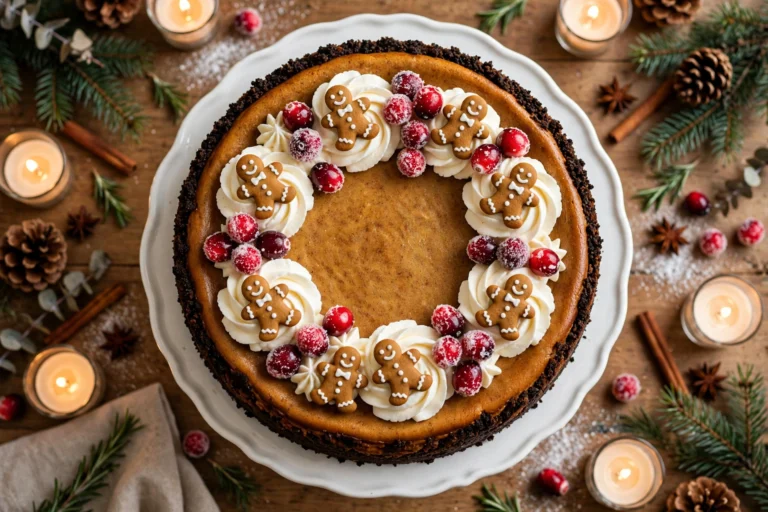
A baked gingerbread cheesecake on a snapping gingersnap crust: silky molasses spiced filling, a steam bath instead of a water bath so the top never cracks, and a whipped cream border with mini gingerbread men and sugared cranberries. Made to be baked ahead and frozen for Christmas.
- Total Time: 7 hours 40 minutes
- Yield: 12 slices 1x
Ingredients
- 2 cups (200 g) finely crushed gingersnap cookies
- 2 tablespoons granulated sugar
- 6 tablespoons (85 g) unsalted butter, melted
- Pinch of fine salt
- 32 oz (900 g) full fat cream cheese, at room temperature
- 1 cup (200 g) granulated sugar
- 1/4 cup (60 ml) mild unsulphured molasses
- 1/2 cup (120 g) sour cream, at room temperature
- 2 teaspoons pure vanilla extract
- 1 1/2 teaspoons ground ginger
- 1 teaspoon ground cinnamon
- 1/2 teaspoon ground nutmeg
- 1/4 teaspoon ground cloves
- 1/4 teaspoon fine salt
- 2 tablespoons all-purpose flour
- 4 large eggs, at room temperature
- 1 cup (240 ml) heavy cream, whipped to soft peaks
- Mini gingerbread cookies and sugared cranberries, for decorating
Instructions
- Heat the oven to 325°F (165°C). Butter a 9 inch springform pan, line the base with parchment, and set a kettle of water on to boil.
- Stir the gingersnap crumbs, sugar, salt, and melted butter to wet sand. Press firmly into the pan base and bake 10 minutes. Cool on a rack.
- Beat the cream cheese and sugar on low to medium speed for about 2 minutes, just until smooth. Scrape the bowl well.
- Beat in the molasses, sour cream, and vanilla until evenly caramel colored. Mix in the ginger, cinnamon, nutmeg, cloves, salt, and flour.
- Add the eggs one at a time on the lowest speed, mixing only until each disappears. Do not whip air into the batter.
- Pour the filling over the crust, smooth the top, and tap the pan twice on the counter to release large bubbles.
- Pour boiling water into a roasting pan on the lowest oven rack. Bake the cheesecake on the middle rack for 60 to 70 minutes, until the edges are set and the center trembles as one piece, near 150°F.
- Turn the oven off, crack the door, and leave the cake inside for 1 hour. Cool to room temperature on a rack, about 1 hour more.
- Cover and refrigerate at least 6 hours or overnight. Run a thin knife around the edge before releasing the springform ring.
- Decorate with whipped cream swirls, a mini gingerbread cookie on each swirl, and sugared cranberries. Slice with a hot, wiped knife.
- Prep Time: 30 minutes
- Cook Time: 1 hour 10 minutes