In this article:
- Why This Eggnog Bread Pudding Bakes Up So Custardy
- The Overnight Soak Is the Whole Strategy
- Choosing the Bread: Brioche, Challah, or Leftover Panettone
- Ingredients for Eggnog Bread Pudding
- Mixing, Soaking and Baking the Pudding
- A Warm Vanilla Eggnog Sauce, Poured at the Table
- Soggy Center, Scorched Top: Fixes for Eggnog Bread Pudding
- White Chocolate, Orange Zest and Other Variations
- Chill It, Freeze It, Reheat It Gently
- Conclusion
- FAQ
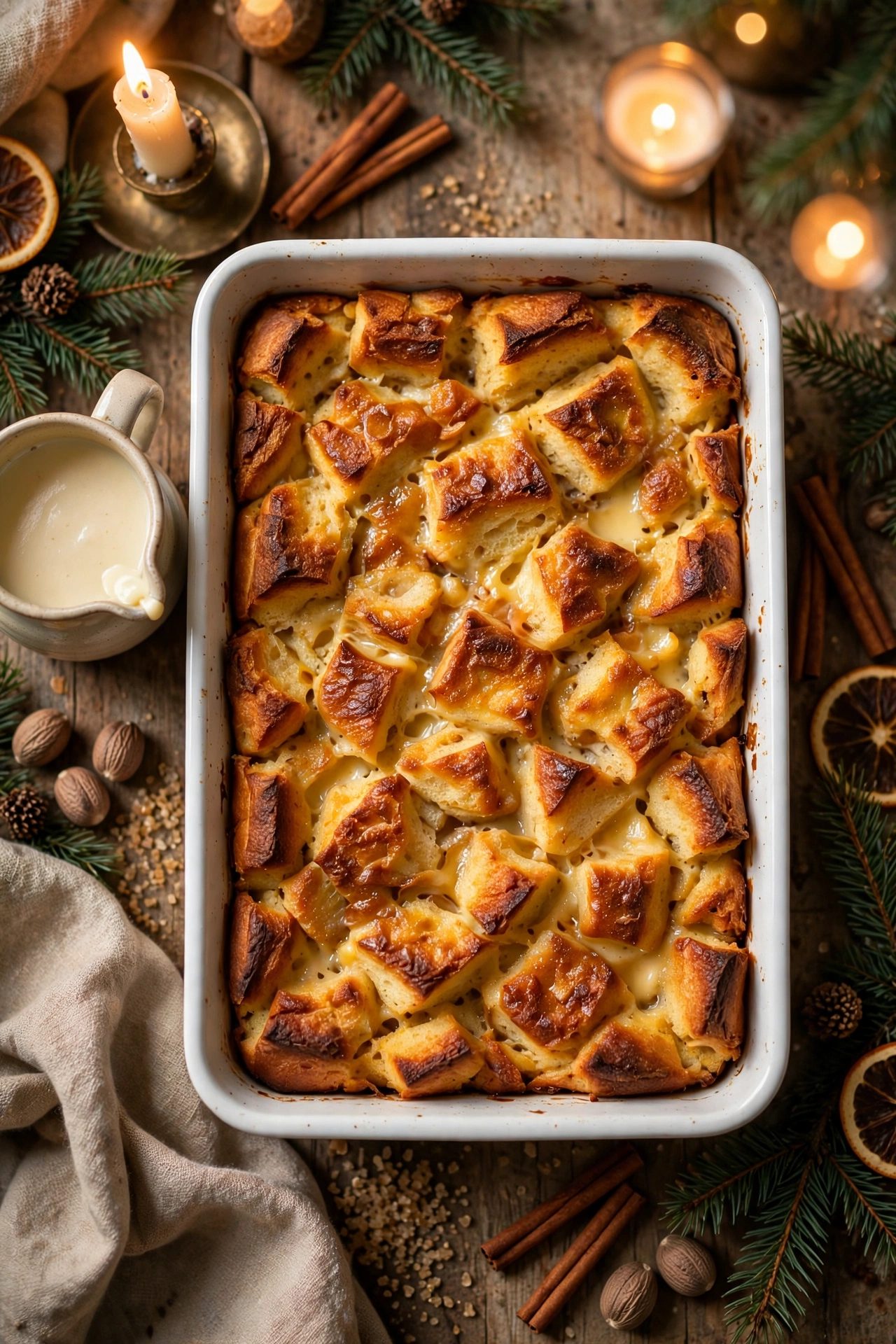
Eggnog bread pudding is the Christmas dessert that asks almost nothing of you on the day it is served: cubes of brioche soaked overnight in spiced eggnog custard, baked until the top turns crisp and golden, then flooded with a warm vanilla sauce at the table.
The contrast is the whole pleasure. The edges caramelize and crunch, the middle stays soft and custardy, and every bite carries cinnamon, nutmeg, and that unmistakable eggnog warmth. Served warm from a white baking dish, it looks like a celebration without a minute of decorating.
This version is built for real December schedules. The soaking happens while you sleep, the baking is one dish and one temperature, and the sauce takes five minutes on the stove. There is no alcohol anywhere in it, so the whole family eats from the same dish.
Why This Eggnog Bread Pudding Bakes Up So Custardy
Eggnog bread pudding succeeds or fails on one ratio: how much custard the bread can hold before it collapses. Eggnog is already a custard base, rich with egg and cream, so the bread needs less added liquid than a classic pudding. Ten cups of dried cubes to three cups of liquid is the balance that sets silky instead of soggy.
The eggs do quiet, structural work. Four whole eggs set the custard firmly enough to slice, while the fat in the eggnog keeps the crumb tender. Sugar is kept moderate, half a cup plus a little brown sugar for depth, because the sauce brings the final sweetness at serving time.
Heat management matters just as much. The pudding bakes at a steady 350°F, hot enough to puff the custard and crisp the exposed cubes, gentle enough that the center sets before the edges dry out. A slightly wobbling center at the oven door is correct; it finishes setting as it rests.
Finally, the bread itself is dried before it ever meets the custard. Dry cubes drink deeply and evenly, so every cube bakes to the same texture. Fresh, soft bread turns gummy at the surface and leaves pockets of raw custard underneath, which is where most homemade puddings go wrong.
The Overnight Soak Is the Whole Strategy
Most recipes treat soaking as a pause. Here it is the method. When the cubes rest in the custard overnight, the eggnog reaches the center of every cube, the spices bloom, and the starches relax. The pudding that comes out of the oven tastes seasoned all the way through, not just on the surface.
The soak also removes the clock from Christmas day. Assemble the dish after dinner on the 24th, cover it, and refrigerate. The next day it goes from fridge to oven with thirty minutes on the counter first, and dessert is handled before the main course is even carved.
A same day version works when time is short. Dry the bread well, soak for a full hour, pressing the cubes down twice so the top layer drinks too, and bake as written. The flavor will be a little less deep, but the texture stays honest, and nobody at the table will complain.
One caution: the dish must be cold going into the soak and covered tightly. Eggnog custard is dairy and egg, and the refrigerator is part of the recipe, not a suggestion. The folks at FoodSafety.gov give the general rule for egg dishes: refrigerate within two hours, every time.
Watch the level of the mixture as you assemble, too. The cubes swell as they drink, so a dish filled to the brim at night can creep over the edge by morning. Fill the dish to about half an inch below the rim and the soak stays tidy. A sheet pan under the dish in the refrigerator is cheap insurance.
Choosing the Bread: Brioche, Challah, or Leftover Panettone
Brioche is the richest choice, and the most forgiving. Its butter and egg crumb melts into the custard and gives the pudding a cake-like softness. If the loaf is very fresh, dry the cubes in a low oven for ten minutes so they can absorb properly instead of dissolving.
Challah is the balanced option, sturdy, golden, and just sweet enough. It holds its cube shape through the long soak, so the finished pudding shows distinct, tender pieces. Day old challah needs no oven drying at all, which makes it the weeknight baker’s friend.
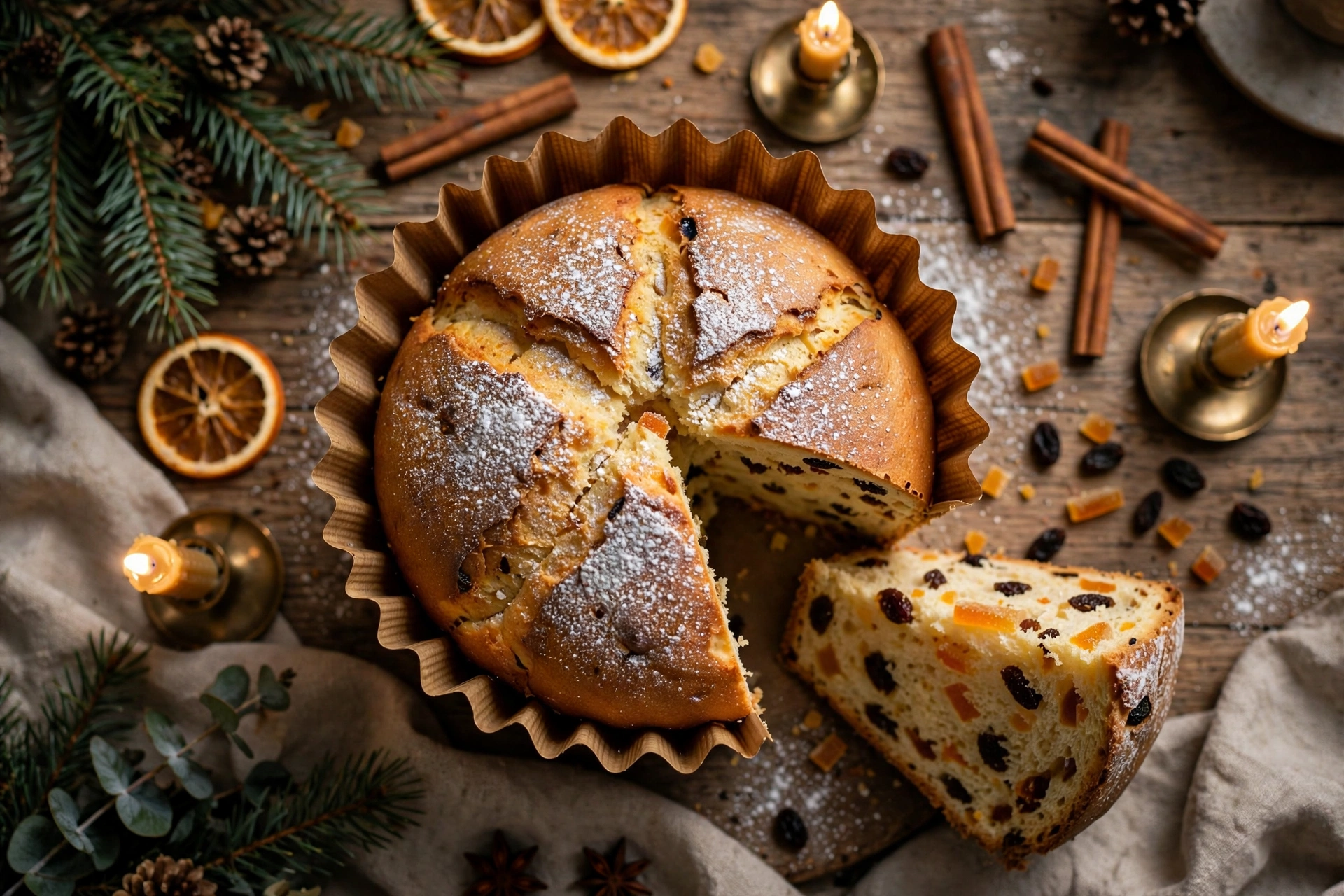
Leftover panettone is the festive shortcut, and a very good one. Its candied orange and raisins season the whole dish for free. If you baked our homemade panettone earlier in the season, this pudding is where the last third of the loaf wants to end up.
Plain white sandwich bread works in a pinch, cut thick and dried well. Avoid anything flavored, seeded, or savory; garlic and rosemary have no place under a vanilla sauce. Whatever you choose, weigh the cubes if you can: about one pound of bread is the target for this custard.
Stale is a texture, not a date. Bread that has sat out a day is ideal because its crumb is dry at the surface and still tender inside. Bread from the freezer works too, thawed and then dried in the oven. What you want to avoid is a loaf so hard it could be used as a doorstop; cubes that dry shatter instead of soaking.
Ingredients for Eggnog Bread Pudding
- 10 cups brioche or challah cubes, about 1 pound of bread, cut in 1 inch pieces and dried
- 2 1/2 cups (600 ml) eggnog, well shaken
- 1/2 cup (120 ml) whole milk
- 4 large eggs, at room temperature
- 1/2 cup (100 g) granulated sugar
- 1/4 cup (50 g) packed brown sugar
- 2 teaspoons pure vanilla extract
- 1 teaspoon ground cinnamon
- 1/2 teaspoon freshly grated nutmeg, plus more for serving
- 1/4 teaspoon fine salt
- 4 tablespoons (55 g) unsalted butter, melted, plus more for the dish
- 3/4 cup (110 g) golden raisins (optional)
- Powdered sugar, for dusting (optional)
- 1 cup (240 ml) eggnog, for the sauce
- 1/4 cup (50 g) granulated sugar, for the sauce
- 1 tablespoon cornstarch, for the sauce
- 1 large egg yolk, for the sauce
- 2 tablespoons unsalted butter, for the sauce
- 1 teaspoon pure vanilla extract, for the sauce
Mixing, Soaking and Baking the Pudding
- Cut the bread into 1 inch cubes. Spread them on a baking sheet and dry in a 300°F (150°C) oven for 10 minutes, until the surfaces feel papery but the centers are still soft. Cool completely.
- Butter a 9 by 13 inch baking dish. Tip in the dried cubes and scatter the raisins over them, if using, tucking a few down between the cubes.
- In a large bowl, whisk the eggs, both sugars, and the salt until smooth and slightly pale. Whisk in the eggnog, milk, vanilla, cinnamon, and nutmeg, then the melted butter.
- Pour the custard evenly over the bread. Press every cube down gently with the back of a spoon until all the tops are wet.
- Cover the dish tightly and refrigerate overnight, at least 8 hours and up to 24. For the same day version, soak 1 full hour at room temperature, pressing the cubes down again halfway.
- Set the dish on the counter for 30 minutes while the oven heats to 350°F (175°C). Uncover and bake 45 to 50 minutes, until the top is deeply golden, the edges are puffed, and the center reads 170 to 175°F and trembles only slightly when the dish is nudged.
- While the pudding rests, make the sauce. Whisk the sauce sugar and cornstarch in a small saucepan, then whisk in the eggnog. Cook over medium heat, whisking, until it barely simmers and thickens, about 4 minutes.
- Whisk the egg yolk in a small bowl. Ladle in a spoonful of the hot sauce, whisking fast, then return everything to the pan. Cook 1 minute more on low, never boiling. Off the heat, stir in the butter and vanilla.
- Rest the pudding 15 minutes. Dust with powdered sugar and a whisper of fresh nutmeg, cut into squares, and serve warm with the sauce poured over at the table.
A Warm Vanilla Eggnog Sauce, Poured at the Table
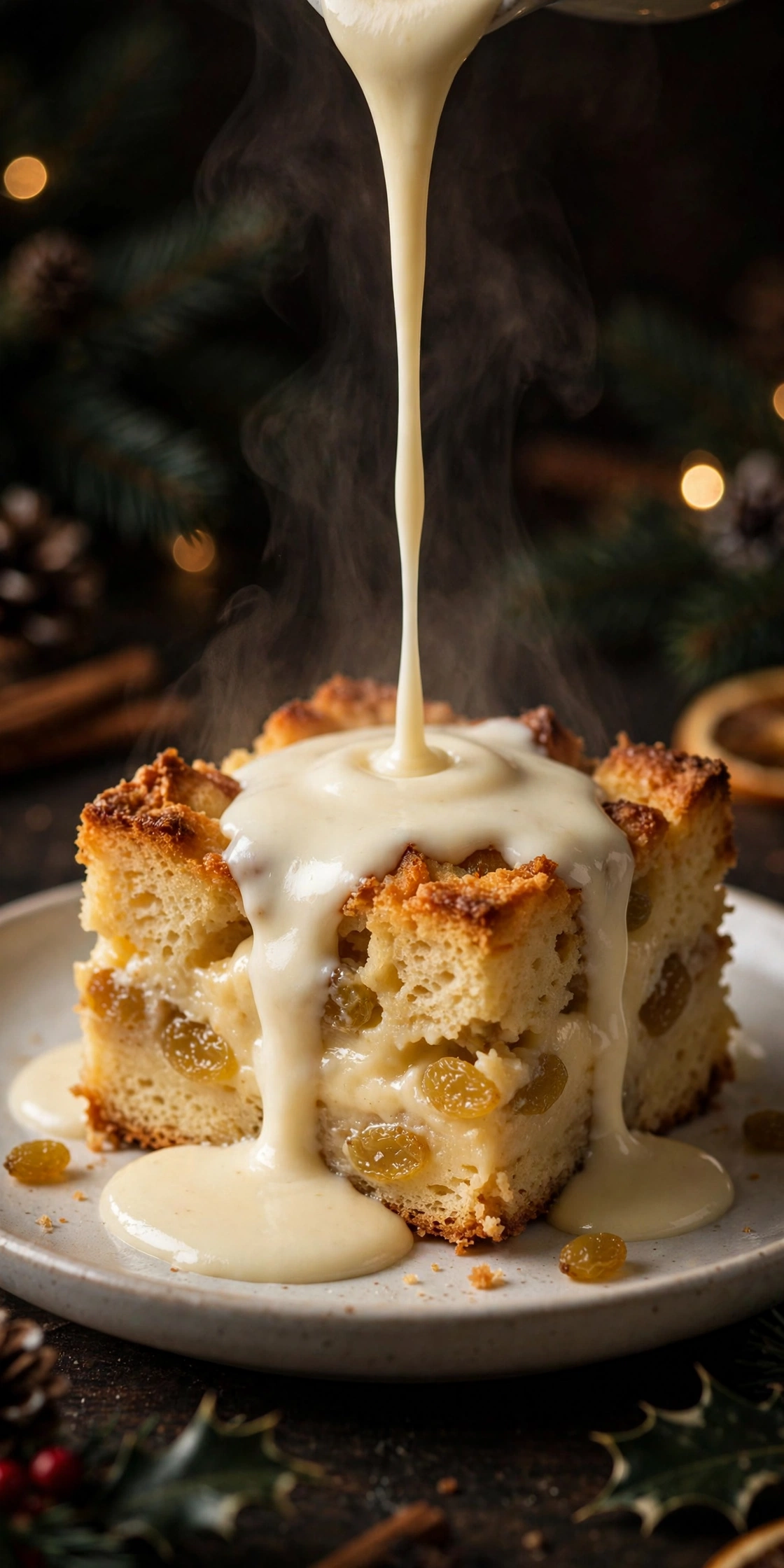
The sauce is what turns a good eggnog bread pudding into the one people ask about. It is a thin, pourable custard, flavored with vanilla and a second measure of eggnog, and it is served warm so it seeps into the crisp top and pools around the soft center.
Tempering the yolk is the only delicate moment. Hot sauce goes into the yolk a spoonful at a time, never the other way around, and the pan stays below a simmer once the yolk is in. Boiling would scramble it; gentle heat gives you silk.
Make the sauce while the pudding rests, not before. It thickens as it stands, and fifteen minutes is exactly right. If it does sit too long, whisk in a spoonful of warm milk and it pours like new. Leftover sauce keeps three days in the refrigerator and is remarkable over plain cake.
Serve the sauce in a small warm jug and let people pour their own. Some want a polite drizzle; some want their square swimming. A gentle snowfall of powdered sugar and a fresh grating of nutmeg over each serving finishes the plate without any fuss, and the jug going around the table becomes part of the ritual.
Soggy Center, Scorched Top: Fixes for Eggnog Bread Pudding
If the center is still liquid at 50 minutes, the usual cause is bread that was too fresh or a soak that left the top layer dry and the bottom drowned. Cover the dish with foil and give it 10 more minutes. The covered heat finishes the custard without darkening the top further.
A top that browns too fast is simpler: tent it loosely with foil at the 30 minute mark. Dark golden is the goal; deep brown edges taste bitter against the delicate custard. Moving the dish to the lower middle rack also evens things out.
A pudding that puffs proudly and then sinks was almost certainly underbaked in the middle, whatever the top claimed. Trust the thermometer, 170 to 175°F at the center, over color. And let it rest the full 15 minutes; cutting early releases steam that the crumb still needs.
Sauce troubles are quick to fix. Too thick: warm milk, a spoonful at a time. Too thin: another minute of gentle heat and constant whisking. Grainy: it boiled, and the honest fix is to strain it and serve it anyway, because strained warm vanilla sauce over this pudding forgives almost anything.
White Chocolate, Orange Zest and Other Variations
White chocolate is the natural partner here. Scatter half a cup of chips over the cubes before the custard goes on; they melt into pale, sweet pockets that contrast with the spice. A teaspoon of orange zest in the custard brightens the whole dish and nods to the candied peel in our eggnog French toast casserole, its breakfast cousin.
For a fruit forward version, trade the raisins for dried cranberries, which echo the season and add a tart snap. Chopped pecans sprinkled on top for the last 15 minutes of baking give a praline-like crunch. A spoonful of maple syrup in place of the brown sugar leans the flavor toward a cozy, woodsy sweetness.
Individual puddings work beautifully for a dinner party. Divide the soaked mixture among eight buttered ramekins, set them on a tray, and bake 28 to 32 minutes. Each guest gets crisp edges on all sides, and the sauce is passed in a warm jug for everyone to pour their own.
Chill It, Freeze It, Reheat It Gently
Leftovers keep four days in the refrigerator, covered, and the flavor deepens overnight as the spices settle into the crumb. Cold slices are dense and almost fudge like; warm slices are the original dessert again. Both are worth knowing.
Reheat single servings in a low oven, 300°F, covered with foil and a spoonful of eggnog or milk sprinkled over the top, for about 15 minutes. The microwave works for one square at half power, but the oven keeps the crisp top that makes this pudding itself.
The baked pudding freezes for up to two months, wrapped tightly, sauce frozen separately in a small container. Thaw overnight in the refrigerator and reheat as above. The unbaked, soaked dish should not be frozen; the custard weeps and the texture suffers.
Conclusion
Eggnog bread pudding earns its place on the Christmas table by being generous twice: once in flavor, rich, spiced, and sauced, and once in effort, which is nearly all done the night before. Dry bread, a patient soak, a watched oven, and warm sauce. That is the entire secret, and now it is yours.
FAQ
Can I make eggnog bread pudding the same day instead of soaking it overnight?
Yes. Dry the bread cubes well, soak them for one full hour at room temperature, and press the cubes down twice so the top layer absorbs custard too. Bake as written; the texture stays custardy and only the spice depth is slightly lighter.
How do I know the center of the pudding is set and not still liquid?
Use a thermometer at the center: 170 to 175°F means the custard is set. The surface should look matte, the edges puffed, and the middle should tremble just slightly when the dish is nudged, like set jelly rather than liquid.
Why did my eggnog bread pudding sink after it came out of the oven?
A sunken middle almost always means the center was underbaked, even if the top looked dark. It can also happen when the bread was too fresh and released steam as it cooled. Bake to temperature, not color, and rest the full 15 minutes before cutting.
Can I use low fat eggnog in this bread pudding?
You can, and it will still set, but the crumb will be leaner and less silky. To compensate, replace the milk with half and half or add two tablespoons of heavy cream to the custard. Keep the bake temperature and timing the same.
How do I reheat leftover bread pudding without drying it out?
Cover the portion with foil, sprinkle a spoonful of eggnog or milk over the top, and warm it in a 300°F oven for about 15 minutes. The added liquid steams the crumb back to softness while the foil protects the crisp top.
Eggnog Bread Pudding
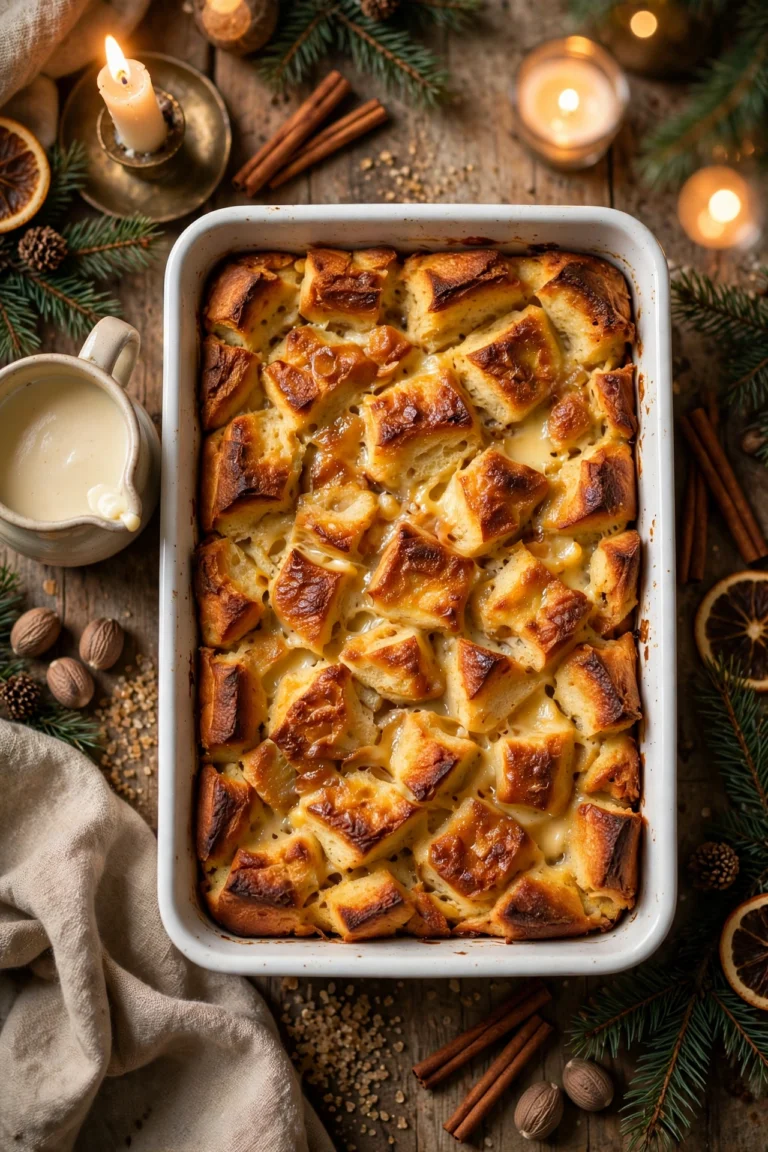
Eggnog bread pudding built on an overnight soak: brioche cubes drink spiced eggnog custard while you sleep, bake up crisp on top and custardy in the middle, and get flooded with a warm vanilla eggnog sauce at the table. Completely alcohol free, so everyone eats from the same dish.
- Total Time: 13 hours
- Yield: 8 servings 1x
Ingredients
- 10 cups brioche or challah cubes, about 1 pound of bread, cut in 1 inch pieces and dried
- 2 1/2 cups (600 ml) eggnog, well shaken
- 1/2 cup (120 ml) whole milk
- 4 large eggs, at room temperature
- 1/2 cup (100 g) granulated sugar
- 1/4 cup (50 g) packed brown sugar
- 2 teaspoons pure vanilla extract
- 1 teaspoon ground cinnamon
- 1/2 teaspoon freshly grated nutmeg, plus more for serving
- 1/4 teaspoon fine salt
- 4 tablespoons (55 g) unsalted butter, melted, plus more for the dish
- 3/4 cup (110 g) golden raisins (optional)
- Powdered sugar, for dusting (optional)
- 1 cup (240 ml) eggnog, for the sauce
- 1/4 cup (50 g) granulated sugar, for the sauce
- 1 tablespoon cornstarch, for the sauce
- 1 large egg yolk, for the sauce
- 2 tablespoons unsalted butter, for the sauce
- 1 teaspoon pure vanilla extract, for the sauce
Instructions
- Cut the bread into 1 inch cubes. Spread them on a baking sheet and dry in a 300°F (150°C) oven for 10 minutes, until the surfaces feel papery but the centers are still soft. Cool completely.
- Butter a 9 by 13 inch baking dish. Tip in the dried cubes and scatter the raisins over them, if using, tucking a few down between the cubes.
- In a large bowl, whisk the eggs, both sugars, and the salt until smooth and slightly pale. Whisk in the eggnog, milk, vanilla, cinnamon, and nutmeg, then the melted butter.
- Pour the custard evenly over the bread. Press every cube down gently with the back of a spoon until all the tops are wet.
- Cover the dish tightly and refrigerate overnight, at least 8 hours and up to 24. For the same day version, soak 1 full hour at room temperature, pressing the cubes down again halfway.
- Set the dish on the counter for 30 minutes while the oven heats to 350°F (175°C). Uncover and bake 45 to 50 minutes, until the top is deeply golden, the edges are puffed, and the center reads 170 to 175°F and trembles only slightly when the dish is nudged.
- While the pudding rests, make the sauce. Whisk the sauce sugar and cornstarch in a small saucepan, then whisk in the eggnog. Cook over medium heat, whisking, until it barely simmers and thickens, about 4 minutes.
- Whisk the egg yolk in a small bowl. Ladle in a spoonful of the hot sauce, whisking fast, then return everything to the pan. Cook 1 minute more on low, never boiling. Off the heat, stir in the butter and vanilla.
- Rest the pudding 15 minutes. Dust with powdered sugar and a whisper of fresh nutmeg, cut into squares, and serve warm with the sauce poured over at the table.
- Prep Time: 20 minutes
- Cook Time: 50 minutes