Christmas Monkey Bread With Caramel, Toasted Pecans and a Christmas Eve Assembly
In this article:
- Everything is assembled on Christmas Eve
- A soft dough that forgives a busy December
- Caramel in two layers, pecans in every bite
- The slow refrigerator rise, and why it beats the counter
- Ingredients
- From dough balls to a full bundt pan
- Golden on top, cooked through the middle
- Ten minutes, then the flip
- Christmas morning service and warm leftovers
- Questions about Christmas monkey bread
- A wreath you eat with your hands
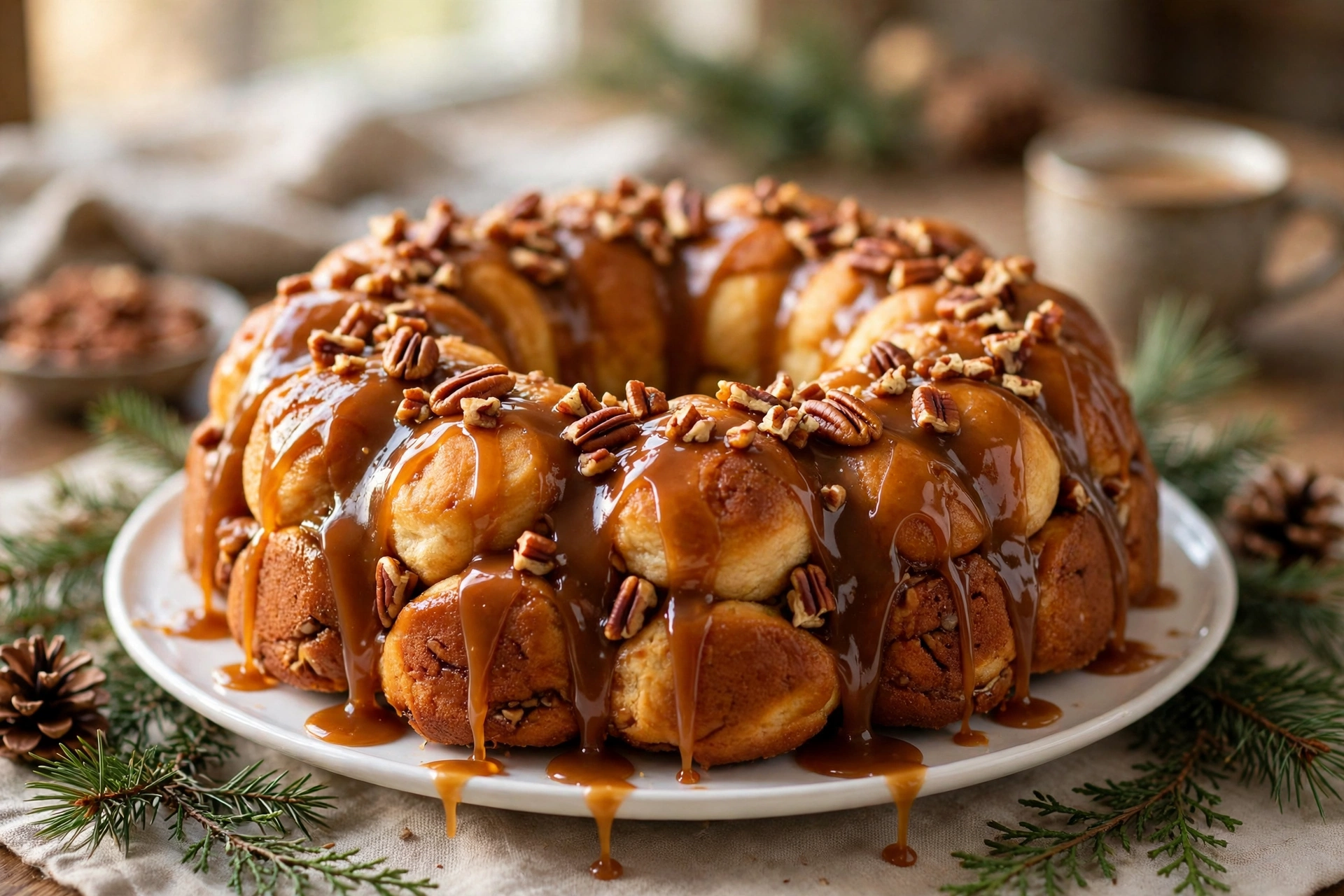
Christmas monkey bread is the pull apart wreath that appears on the table while the coffee is still brewing: soft balls of yeast dough rolled in cinnamon sugar, layered with toasted pecans and caramel, baked until the whole pan turns deep amber and glossy.
The promise of this version is in the schedule. The dough is made, shaped and assembled entirely on Christmas Eve, then the filled pan sleeps in the refrigerator. On Christmas morning there is nothing to roll, dip or layer; the oven does the only work left.
Most recipes make you choose between a homemade dough shaped at dawn and a shortcut pan of frozen rolls sweetened with a pudding mix. This one refuses the choice: real dough, real caramel, and a slow cold rise that improves both the flavor and the morning.
When the pan flips onto the plate, the caramel that collected at the bottom pours down over the wreath and every piece comes away sticky, warm and ready to pull. It is breakfast, dessert and centerpiece in one pan.
Everything Is Assembled on Christmas Eve
Christmas monkey bread earns its place in this kitchen because the work lands on the day that has room for it. Christmas Eve afternoon has a natural pause in it; Christmas morning does not. Moving every task to the Eve is the recipe’s first technique.
The sequence is calm: dough mixed and kneaded, one hour of rising, then shaping. Forty small balls are dipped in butter, rolled in cinnamon sugar and layered into the pan with the pecans and caramel in one unhurried session.
Nothing about the evening work is fragile. The dough is soft and cooperative, the caramel takes three minutes on the stove, and the assembled pan waits under cover without any attention at all. A helper can roll balls beside you and the pan fills faster.
Compare the morning this replaces: no flour on the counter, no timers competing with stockings and coffee, no second rise holding up breakfast. The pan goes from the refrigerator to the oven, and the house smells like caramel before anyone asks what is for breakfast.
A Soft Dough That Forgives a Busy December
The dough is an enriched, milk based dough in the family of our gingerbread cinnamon rolls, softened with eggs and butter so the baked balls stay tender for hours. It kneads in under ten minutes and asks for nothing exotic from the pantry.
Warm milk at about 110 degrees wakes the instant yeast without harming it. If the milk feels comfortably warm on the wrist, it is right; if it feels hot, wait a minute. Eggs at room temperature keep the dough supple instead of tight.
The kneaded dough should be smooth, elastic and only slightly tacky. A dough that tears when stretched needs two more minutes; a dough that sticks hard to the bowl needs a spoonful of flour at a time.
Divide the risen dough into roughly forty pieces and roll each between your palms into a ball of about an inch and a quarter. Perfect uniformity is not the goal; a slight variety of sizes is what makes the finished wreath craggy and easy to pull apart.
Caramel in Two Layers, Pecans in Every Bite
A single pour of caramel, whether it lands on the bottom or the top, leaves the middle of the pan plain. This recipe divides the caramel: half goes into the greased pan with half the pecans, the rest is poured over the first layer of dough balls before the second layer goes on.
The caramel itself is a three minute sauce: butter, brown sugar and a little cream boiled just until glossy. Vanilla and orange zest go in off the heat. The zest is the Christmas note, quiet but unmistakable, and it brightens a sauce that can otherwise taste only sweet.
Toast the pecans before they meet the pan. Eight minutes in a dry skillet or a moderate oven wakes up their oils, and toasted nuts stay distinct inside the soft bread instead of steaming into the background. Roughly chopped, they distribute through every layer.
During the bake, the bottom layer becomes the glaze when the pan flips, and the middle layer melts down through the balls, so the center pieces are as coated as the top ones.
The Slow Refrigerator Rise, and Why It Beats the Counter
Many overnight monkey breads rise on the counter, where a warm kitchen can push the dough past its peak by morning: over risen, faintly sour and ready to collapse in the oven. The refrigerator rise in this christmas monkey bread is slower, steadier and far more forgiving of a long night.
Cold fermentation does quiet flavor work while the pan rests. The dough develops a gentle depth that plain overnight counter dough rarely has, and the butter in the balls stays firm, so the layers bake up distinct rather than melting together into a single mass.
The timing is generous: eight hours is the minimum, twelve is comfortable, and the pan tolerates a slow morning without losing anything.
It shares its logic with the eggnog French toast casserole that anchors our Christmas brunch table: assemble under no pressure the night before, bake in the morning, and let the oven make the house smell festive while nobody is working.
Ingredients
- 3/4 cup warm whole milk, about 110 degrees F
- 2 1/4 teaspoons instant yeast (1 packet)
- 1/4 cup granulated sugar, for the dough
- 2 large eggs, at room temperature
- 4 tablespoons unsalted butter, melted, for the dough
- 3 1/2 cups all-purpose flour, plus more for shaping
- 1 teaspoon fine salt
- 1 cup granulated sugar, for the coating
- 2 teaspoons ground cinnamon
- 1/4 teaspoon ground nutmeg
- 6 tablespoons unsalted butter, melted, for dipping
- 6 tablespoons unsalted butter, for the caramel
- 3/4 cup packed light brown sugar
- 1/4 cup heavy cream
- 1 teaspoon vanilla extract
- 1 teaspoon finely grated orange zest
- 1 pinch of fine salt, for the caramel
- 1 1/4 cups pecan halves, toasted and roughly chopped
From Dough Balls to a Full Bundt Pan
- Make the dough on Christmas Eve. Whisk the warm milk, yeast and a pinch of the dough sugar in a large bowl and rest 5 minutes until foamy. Whisk in the eggs and melted butter, then stir in the flour, the rest of the dough sugar and the salt to a shaggy dough.
- Knead for 7 to 8 minutes until smooth and elastic. Cover and rise at room temperature for 1 hour, until roughly doubled.
- Stir the coating sugar, cinnamon and nutmeg in a shallow bowl. Set the dipping butter in a second bowl. Divide the dough into about 40 small pieces and roll each into a ball of about 1 1/4 inches. Dip each ball in butter, roll in the cinnamon sugar, and set on a tray.
- Make the caramel. Melt the caramel butter in a small saucepan, add the brown sugar and cream, and boil gently for 2 minutes, stirring, until glossy. Off the heat, stir in the vanilla, orange zest and the pinch of salt.
- Grease a 10 cup bundt pan very well. Scatter half the pecans in the pan and pour in half the caramel. Add half the dough balls in an even layer. Scatter the remaining pecans, pour in the remaining caramel, and finish with the rest of the dough balls.
- Cover the pan tightly and refrigerate for 8 to 12 hours. The balls will puff slowly and fill the pan by morning.
- On Christmas morning, place the cold pan in a cold oven if your mornings are rushed, or let it stand 20 minutes while the oven heats to 350 degrees F. Bake for 32 to 35 minutes, until deeply golden and the center reads 190 degrees F; tent loosely with foil for the last 10 minutes if the top colors fast.
- This step matters: rest the pan for exactly 10 minutes. Set a warm serving plate over the pan and invert in one confident motion. Lift the pan away and spoon any caramel left inside over the top. Serve warm and pull apart.
Golden on Top, Cooked Through the Middle
The classic failure of monkey bread is a beautiful top over a doughy center, because the middle balls are insulated by all the others. Color alone cannot tell you the center is done, so this recipe bakes to a temperature: 190 degrees F read at the center of the pan.
An instant read thermometer slid between the center balls settles the question in seconds. Below 185 degrees, the middle will still taste of raw dough; at 190 to 195, the crumb is set, soft and fully baked without drying at the edges.
If the top races ahead of the center, tent the pan loosely with foil for the last ten minutes. The caramel at the edges darkens quickly once the sugars are hot, and the foil keeps the finish deep amber instead of scorched.
Pull the pan a minute early rather than late if you must choose; the bread finishes setting during its short rest.
Ten Minutes, Then the Flip
The rest before inverting is timed, and both directions of error have a cost. Flip at two minutes and the caramel is still liquid: it runs off the bread and pools on the plate. Flip at thirty and the caramel has set inside the pan, gluing the wreath to the metal.
Ten minutes is the window where the caramel is thick, hot and still moving. Set a timer when the pan leaves the oven, warm the serving plate so the sauce does not seize on cold ceramic, and flip in one confident motion with both hands protected.
Lift the pan slowly after a few seconds. If a few balls cling inside, lift them out with a spoon and tuck them back into the wreath; the caramel hides every repair. Spoon any sauce left in the pan over the top so nothing good is wasted.
Serve the bread on the plate it flipped onto, in the middle of the table. It is a pull and pass food; keep the wreath whole until the first hands reach in.
Christmas Morning Service and Warm Leftovers
Set the wreath beside the coffee pot and let people pull pieces as they pass. On a full brunch table it pairs naturally with the overnight hash brown breakfast casserole for the savory side and something bright and cold, like citrus segments, to cut the caramel.
For a smaller household, halve the dough and caramel and bake in a loaf pan, checking the center temperature from about 25 minutes.
If the table wants a second sweet bake for a crowd, the cranberry orange bundt cake is the make ahead companion: it bakes days earlier, slices cleanly, and its tart glaze contrasts with the monkey bread’s deep caramel.
Leftovers keep two days, covered at room temperature for the first day and refrigerated after. Warm pieces in a 300 degree oven for 6 to 8 minutes, or in short bursts in the microwave, until the caramel softens again. Wrapped portions freeze for a month and reheat from thawed the same way.
Questions About Christmas Monkey Bread
Can I really assemble christmas monkey bread the night before with homemade dough?
Yes, and that is the design of this recipe. The dough is shaped, coated and layered on Christmas Eve, then the filled pan rises slowly in the refrigerator for 8 to 12 hours. In the morning it goes straight into the oven with no shaping or second rise.
Why not let the assembled pan rise on the counter overnight?
A warm kitchen can push the dough past its peak while you sleep, leaving it over risen, faintly sour and prone to collapse. The refrigerator rise is slower and steadier, tastes better, and holds its timing even if your morning starts late.
The center of my monkey bread was still doughy. How do I fix that?
Bake to temperature, not color: the center of the pan should read 190 degrees F. If the top browns early, tent the pan with foil and keep baking. Also check that the dough balls were evenly sized, since oversized center balls are the usual reason a middle stays raw.
What if the dough has barely risen by Christmas morning?
A cold kitchen or a cold refrigerator slows the rise. Set the covered pan in a warm, draft free spot for 30 to 45 minutes before baking and give it those minutes without worry; a slow morning costs the bread nothing.
Can I use canned biscuit dough in a year with no time?
Yes. Use about 2 pounds of refrigerated biscuit dough, cut each biscuit into quarters, and keep the same coating, caramel and layering. Skip the cold rise: assemble, rest 20 minutes, and bake as directed, checking the center temperature from 28 minutes.
How do I keep the caramel from sticking in the pan?
Grease the pan generously, including the center tube, rest the baked bread for exactly 10 minutes, and flip while the caramel is still fluid. A pan released too late is the usual cause; if it happens, warm the pan bottom briefly over low heat and flip again.
A Wreath You Eat With Your Hands
Christmas monkey bread closes the gap between baking project and holiday ritual: an evening of easy, sociable work, a quiet night of rising, and a morning where the oven perfumes the house before anyone has asked you to cook.
The details that make it reliable are small ones: caramel in two layers, a thermometer at the center, a ten minute rest and a confident flip. None of them is hard, and together they turn a pan of dough balls into the dish the table gathers around.
Put the plate down warm, let the caramel shine, and do not bring serving utensils. The wreath is meant to disappear piece by piece, pulled apart by the people it was baked for.
Nutrition per serving, estimated for 12 servings: Calories 525, Total Fat 27 g, Saturated Fat 11 g, Unsaturated Fat 15 g, Trans Fat 0 g, Carbohydrates 66 g, Fiber 2 g, Sugar 38 g, Protein 6 g, Sodium 160 mg, Cholesterol 80 mg. Flour weights and dough temperatures follow the references of King Arthur Baking.
Print
Christmas Monkey Bread, Caramel Pecan and Make Ahead
Christmas monkey bread assembled completely on Christmas Eve: homemade yeast dough balls rolled in cinnamon sugar, layered with toasted pecans and a two layer orange scented caramel, slow risen in the refrigerator overnight and baked straight from the cold on Christmas morning. Rest it exactly 10 minutes, invert, and pull apart.
- Total Time: 1 hour 15 minutes, plus an overnight rise
- Yield: 12 servings 1x
Ingredients
- 3/4 cup warm whole milk, about 110 degrees F
- 2 1/4 teaspoons instant yeast (1 packet)
- 1/4 cup granulated sugar, for the dough
- 2 large eggs, at room temperature
- 4 tablespoons unsalted butter, melted, for the dough
- 3 1/2 cups all-purpose flour, plus more for shaping
- 1 teaspoon fine salt
- 1 cup granulated sugar, for the coating
- 2 teaspoons ground cinnamon
- 1/4 teaspoon ground nutmeg
- 6 tablespoons unsalted butter, melted, for dipping
- 6 tablespoons unsalted butter, for the caramel
- 3/4 cup packed light brown sugar
- 1/4 cup heavy cream
- 1 teaspoon vanilla extract
- 1 teaspoon finely grated orange zest
- 1 pinch of fine salt, for the caramel
- 1 1/4 cups pecan halves, toasted and roughly chopped
Instructions
- Make the dough on Christmas Eve. Whisk the warm milk, yeast and a pinch of the dough sugar in a large bowl and rest 5 minutes until foamy. Whisk in the eggs and melted butter, then stir in the flour, the rest of the dough sugar and the salt to a shaggy dough.
- Knead for 7 to 8 minutes until smooth and elastic. Cover and rise at room temperature for 1 hour, until roughly doubled.
- Stir the coating sugar, cinnamon and nutmeg in a shallow bowl. Set the dipping butter in a second bowl. Divide the dough into about 40 small pieces and roll each into a ball of about 1 1/4 inches. Dip each ball in butter, roll in the cinnamon sugar, and set on a tray.
- Make the caramel. Melt the caramel butter in a small saucepan, add the brown sugar and cream, and boil gently for 2 minutes, stirring, until glossy. Off the heat, stir in the vanilla, orange zest and the pinch of salt.
- Grease a 10 cup bundt pan very well. Scatter half the pecans in the pan and pour in half the caramel. Add half the dough balls in an even layer. Scatter the remaining pecans, pour in the remaining caramel, and finish with the rest of the dough balls.
- Cover the pan tightly and refrigerate for 8 to 12 hours. The balls will puff slowly and fill the pan by morning.
- On Christmas morning, place the cold pan in a cold oven if your mornings are rushed, or let it stand 20 minutes while the oven heats to 350 degrees F. Bake for 32 to 35 minutes, until deeply golden and the center reads 190 degrees F; tent loosely with foil for the last 10 minutes if the top colors fast.
- This step matters: rest the pan for exactly 10 minutes. Set a warm serving plate over the pan and invert in one confident motion. Lift the pan away and spoon any caramel left inside over the top. Serve warm and pull apart.
- Prep Time: 40 minutes, plus an overnight rise
- Cook Time: 35 minutes
Nutrition
- Serving Size: 3
- Calories: 525
- Sugar: 38
- Sodium: 160
- Fat: 27
- Saturated Fat: 11
- Unsaturated Fat: 15
- Trans Fat: 0
- Carbohydrates: 66
- Fiber: 2
- Protein: 6
- Cholesterol: 80