

In this article:
Custard, Not Casserole
Corn pudding works when you treat it as what it actually is: a baked custard that happens to be full of corn. This version is built entirely from scratch, with no boxed mix anywhere near it, because the mix versions bake up like sweet cornbread while a true pudding should scoop like something between a souffle and a spoon bread, trembling and golden.
The texture trick is a split batch of corn. Half of the creamed corn is blended until completely smooth, so it melts into the eggs and cream and gives the pudding its silk. The other half, plus a can of whole kernels, stays intact, so every spoonful still pops with real corn. You taste custard and corn at the same time, in every single bite.
Balance is the third leg of the stool. Corn is naturally sweet, and most recipes push it further with a heavy hand of sugar until the dish tastes like dessert wearing a side dish costume. Here the sugar is measured, the salt is deliberate, and a little black pepper and nutmeg keep the pudding firmly on the savory side of the Thanksgiving plate.
It is also, quietly, one of the most forgiving dishes on the holiday table. The batter waits in the fridge, the bake tolerates a crowded oven, and the leftovers reheat like a dream. Put it next to our Southern cornbread dressing and the turkey has two very different corn traditions keeping it company.
Golden Top, Trembling Center
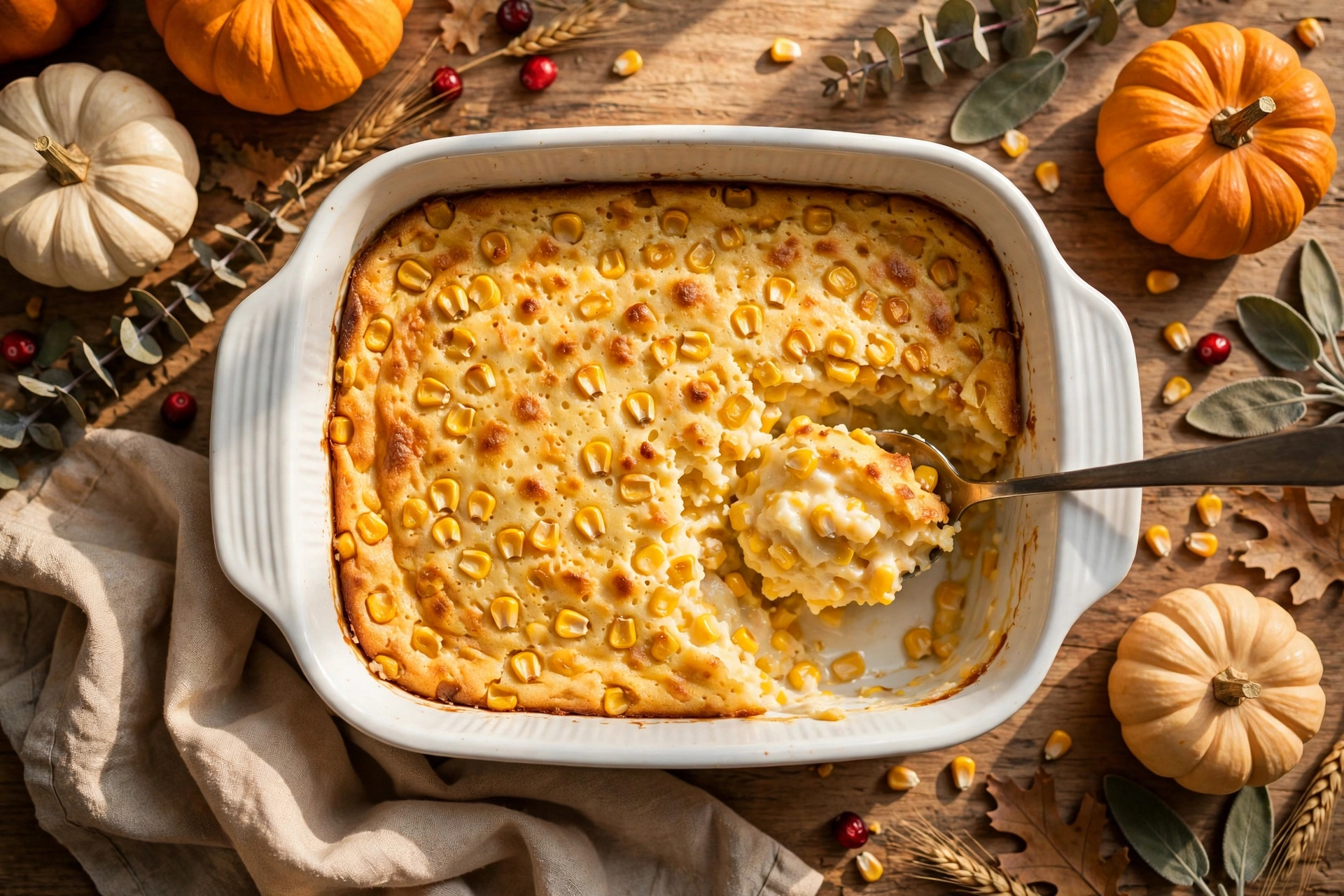
The top bakes to a deep, even gold, freckled where individual kernels rise and toast at the surface. It looks set and confident, almost like a crust, and it gives the spoon its first small moment of resistance. Underneath, the interior stays pale, glossy, and barely holding together.
That contrast is the whole pleasure of the dish. A spoonful should slump slowly, not slice, and the kernels should suspend in the custard rather than sink into a dense bottom layer. If your past puddings ate like cake, they were overbaked or over floured, and both problems are fixed below.
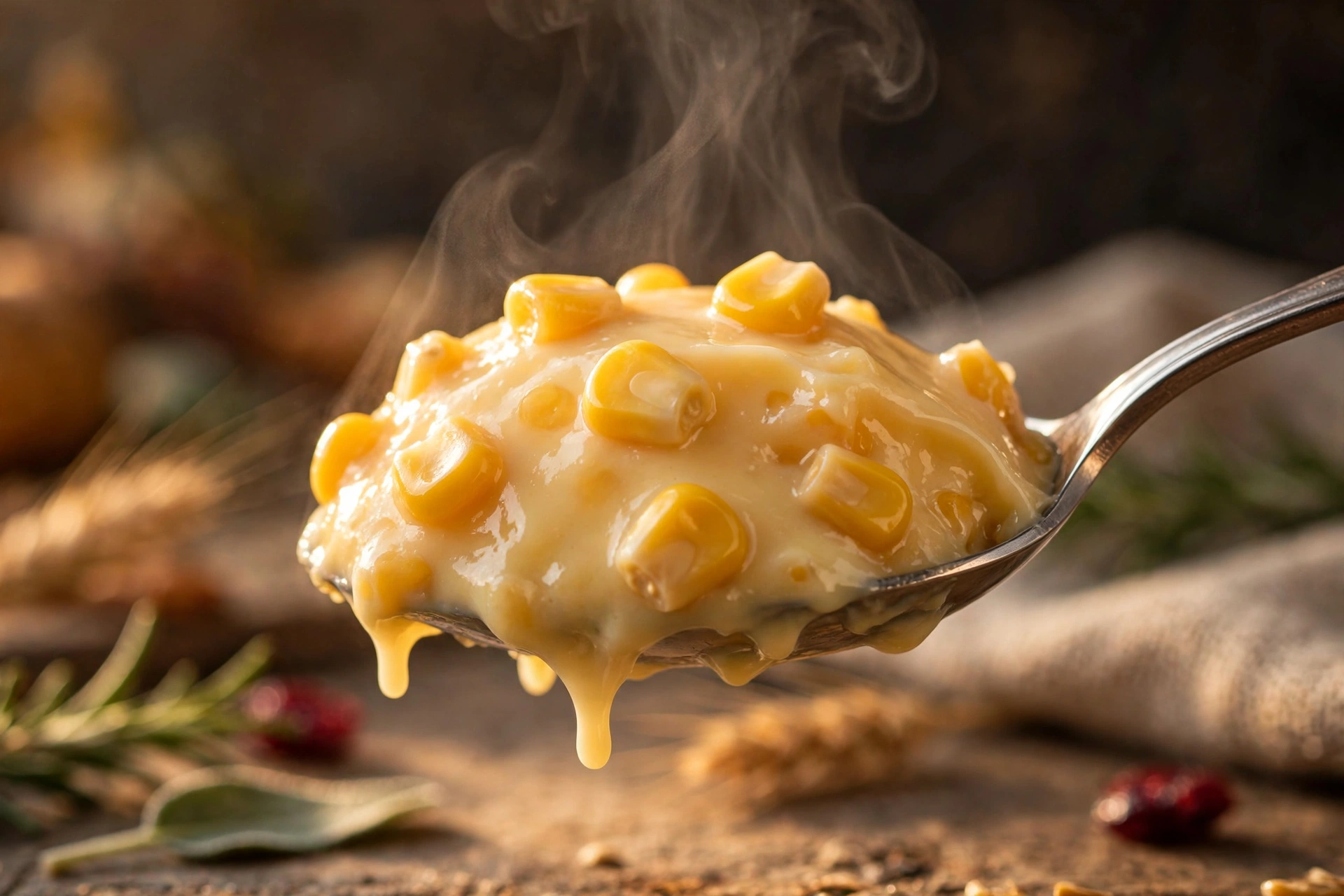
The flavor is corn turned up on itself: sweet kernels, the milky depth of creamed corn, butter rounding everything out. Eggs and cream do not announce themselves, they simply make the corn taste more like corn, the way a good sauce makes its main ingredient taste more like itself.
Served warm, it perfumes the whole table with buttered corn. It is the side dish that non cooks always assume took effort, which makes it a generous thing to bring: ten minutes of whisking, dressed up as a family heirloom. Our green bean casserole plays the same trick on the same table.
The Jiggle Test and the Long Rest
Every corn pudding recipe tells you to bake until the center jiggles slightly, and almost none explain what that actually looks like. Shake the dish gently: the edges should be completely still, and the center should wobble in one slow, unified circle about the size of a coin. If the whole surface ripples like soup, it needs more time. If nothing moves at all, it has already gone too far.
The science is simple. Egg proteins set gradually between about 160 and 180 degrees Fahrenheit, and a custard pulled at a center temperature of 170 to 175 degrees keeps cooking gently from its own heat as it rests. That carryover is not a flaw in the plan, it is the plan: the pudding finishes setting on the counter, silky instead of rubbery.
Overbaking is where corn pudding goes to die. Push a custard past its setting point and the protein network squeezes tight, weeping liquid and turning the texture grainy and curdled. Most watery corn puddings were not underbaked at all; they were overbaked, then blamed on the corn.
So the rest is mandatory, not a serving suggestion. Fifteen full minutes on a rack lets the center finish, the steam settle, and the texture turn from loose to lush. Scoop earlier and the first servings will slump and pool, no matter how perfectly you baked it.
Ingredients for Corn Pudding
- 2 cans (15 oz / 425 g each) creamed corn, divided
- 1 can (15 oz / 425 g) whole kernel corn, drained very well
- 4 large eggs, room temperature
- 1 cup (240 ml) heavy cream
- 1/2 cup (113 g) unsalted butter, melted and slightly cooled, plus more for the dish
- 1/4 cup (50 g) granulated sugar
- 1/4 cup (30 g) all-purpose flour
- 2 tablespoons (16 g) cornstarch
- 1 teaspoon baking powder
- 1 teaspoon fine salt
- 1/4 teaspoon black pepper
- 1/8 teaspoon ground nutmeg
The flour and cornstarch pair is doing the job a boxed mix usually does, giving the custard just enough structure to hold a spoon line without turning it bready. Drain the whole kernel corn like you mean it, in a colander for a full 5 minutes, because its canning liquid is the number one cause of a soupy result. Room temperature eggs blend smoothly into the cream instead of streaking, a small thing that shows in the final texture.
Whisk, Fold, Bake
- Heat the oven to 350°F (175°C). Butter a 2 quart baking dish (an 8×8 inch or 9 inch round both work) and set it on a rimmed sheet pan for easy handling.
- Blend half of the creamed corn (about 1 can) until completely smooth, 30 to 45 seconds. This is your silk base. Leave the rest of the corn exactly as it is.
- In a large bowl, whisk the flour, cornstarch, sugar, baking powder, salt, pepper, and nutmeg until no lumps remain.
- In a second bowl, whisk the eggs until uniform, then whisk in the cream and the melted butter.
- Pour the wet mixture into the dry and whisk just until combined. A few tiny lumps are fine; a smooth, overworked batter is not the goal.
- Fold in the blended corn, the remaining creamed corn, and the drained whole kernels until evenly distributed.
- Scrape the batter into the prepared dish and smooth the top. It should fill the dish about three quarters full.
- Bake for 45 to 55 minutes, until the edges are deep gold and set, the top is evenly golden, and the center wobbles in one small, slow circle when you nudge the dish. A thermometer at the center should read 170 to 175°F.
- Rest on a wire rack for a full 15 minutes before scooping. The pudding finishes setting as it rests and will serve in soft, custardy spoonfuls.
Why Your Corn Pudding Weeps
Liquid pooling in the dish has three usual suspects, and undrained corn is only the first. The second is dish size: spread this batter into a wide 9×13 and it bakes thin, sets fast at the edges, and cracks and weeps at the center. It wants depth, so keep it in a 2 quart dish where the custard can stay thick.
The third suspect is the one nobody suspects: overbaking. A custard cooked past its setting point tightens and squeezes out liquid as it cools, so a pudding can look perfect in the oven and weep on the table. Pull it at the jiggle, trust the thermometer, and let the rest do the rest.
A grainy texture tells the same story from the other side, eggs pushed too hot too fast. If your oven runs hot, drop the temperature by 25 degrees and add 5 minutes. A pudding baked gently will always beat a pudding baked quickly, and the difference is visible in the very first spoonful.
Finally, seasoning. A flat tasting corn pudding is rarely missing sugar; it is missing salt. The full teaspoon here is calibrated against two cans of creamed corn, and cutting it makes the whole dish taste oddly sweet and one note. Taste the batter before it goes in, the way you would our slow cooker mashed potatoes, and adjust while you still can.
Fresh, Frozen or Canned Corn
Canned corn is the reliable backbone of this recipe, available in November when fresh corn is a memory, consistent in sweetness, and already tender. The creamed cans do double duty as both corn and sauce, which is why this pudding works any month of the year. Drain the whole kernels thoroughly and canned is not a compromise at all.
Frozen corn works beautifully with one adjustment: thaw it fully, drain it, and pat it dry with a clean towel before it goes anywhere near the batter. Frozen kernels carry surface ice that melts into the custard, and undried frozen corn is the quiet cause of many loose puddings. Swap it one for one with the whole kernel can.
Fresh corn is the summer glory version, worth making in August when the ears are sweet. Cut the kernels from 6 to 7 ears to replace the whole kernel can, and scrape the cobs with the back of the knife to catch the milky juices. Keep the creamed cans as they are; fresh creamed corn is a project of its own. Corn data in USDA FoodData Central shows sweet corn brings modest fiber and natural sugars, which is exactly why this dish needs so little added sugar.
Whichever corn you choose, keep the total volume the same, about 5 cups across all three components. Custards forgive flavor swaps cheerfully, but they keep strict accounts on liquid, and volume is where a forgiving recipe turns strict.
Make It Yours: Sweet, Savory, Spicy
The cheddar route is the most requested variation, and it is a good one: fold in 1 cup of shredded sharp cheddar and scatter a little more over the top for the final 10 minutes. It nudges the pudding toward the Nantucket style and pairs especially well with ham. Keep the sugar as written; cheese and corn sweetness like each other.
For gentle heat, add a small can of diced green chiles, drained, or a finely minced jalapeno with the seeds removed. The pudding stays family friendly, and the green note cuts the richness in a way adults notice and children tolerate. A pinch of smoked paprika over the top finishes it.
The dessert leaning version raises the sugar to 1/3 cup, adds a teaspoon of vanilla, and drops the pepper. It eats almost like a corn souffle pudding and has a long history at Southern church suppers. Serve it warm with barely sweetened whipped cream and watch people ask for the recipe.
Lighter tweaks exist too: half and half can replace the cream with a slightly looser set, and two of the eggs can become one egg plus two whites for a leaner custard, at about 230 calories a serving instead of 285. For a classic partner on the table, our sweet potato casserole with pecan streusel keeps the same golden, custardy spirit.
Two Roads to Make Ahead
Road one is assemble ahead. Whisk the batter completely, pour it into the buttered dish, cover, and refrigerate for up to 24 hours. Bake it straight from the fridge, adding 8 to 10 minutes, and nobody will ever know it was not mixed that morning. This is the road to take when oven space is planned but your morning is not.
Road two is bake ahead. Bake the pudding fully the day before, cool it, cover it, and refrigerate. Reheat it covered with foil at 300°F for 25 to 30 minutes, until steaming at the center, then uncover for 5 minutes to refresh the top. The texture survives remarkably well, a rare gift among custards.
Leftovers keep 3 to 4 days in the fridge and reheat in the microwave in soft spoonfuls. Freezing is possible for up to 2 months, but be honest with yourself: the custard weeps a little on thawing and never quite returns to its Thanksgiving glory. Bake two smaller dishes instead, and freeze one unbaked.
My own Thanksgiving timeline runs like this: batter mixed Wednesday night, dish in the oven while the turkey rests, pudding on the table in the same golden hour as everything else. It shares the oven politely with our classic pumpkin pie, which also prefers a cook who plans ahead.
Conclusion
Corn pudding deserves better than the boxed mix treatment. Built from scratch, with half the corn blended silky and half left whole, it bakes into a custard that is golden on top, trembling at the center, and unmistakably corn from the first spoonful to the last.
Remember the three things that decide it: drain the corn, pull it at the jiggle, and give it the full 15 minute rest. Everything else is whisking. Make it once for Thanksgiving and it will quietly become the dish people ask about before they ask about the turkey.
FAQ
Can I make corn pudding without Jiffy mix?
Yes, and this recipe is built exactly that way. A small amount of flour and cornstarch replaces the structure the mix usually provides, while eggs and cream make a true custard instead of a cornbread texture. The result scoops softly and tastes more like corn, less like cake.
How do I know when corn pudding is done if the center still jiggles?
The jiggle is the sign, not a warning. The edges should be set and golden while the center wobbles in one small, slow circle when nudged, and a thermometer reads 170 to 175°F at the center. The pudding finishes setting during its 15 minute rest.
Why did my corn pudding turn out watery?
Three causes cover almost every case: whole kernel corn that was not drained long enough, a dish that was too wide so the custard baked thin, or overbaking, which makes the eggs squeeze out liquid as they cool. Drain for a full 5 minutes, use a 2 quart dish, and pull it at the jiggle.
Can I make corn pudding in a slow cooker?
Yes. Pour the batter into a greased slow cooker, cover the lid with a clean towel to catch condensation, and cook on low for 3 to 3 1/2 hours, until the edges are set and the center just trembles. You lose the golden top, but the custard stays exceptionally silky.
Can corn pudding be frozen?
It can, for up to 2 months, but the custard weeps slightly on thawing and the texture never fully returns. A better plan is to freeze the unbaked batter in its dish, thaw it overnight in the fridge, and bake it fresh. Baked leftovers are best kept refrigerated for 3 to 4 days instead.
Corn Pudding
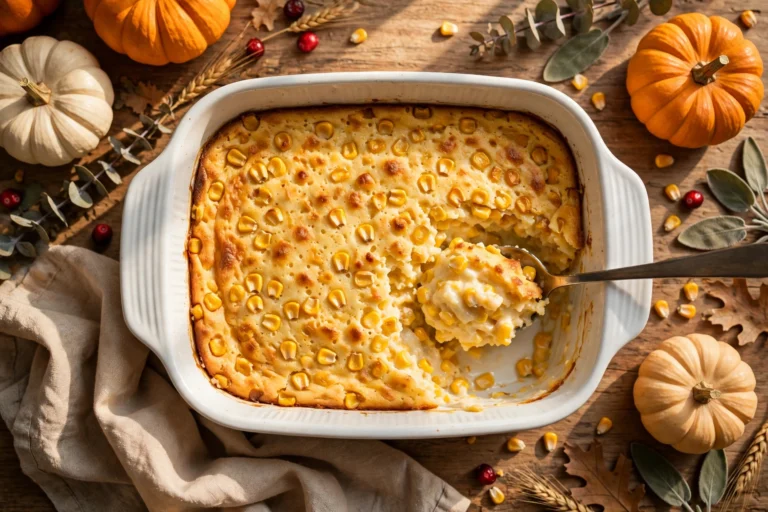
Corn pudding built from scratch with no boxed mix: half the creamed corn blended silky, half left whole, baked until the edges are golden and the center just trembles. A true custard for the Thanksgiving table.
- Total Time: 1 hour 5 minutes
- Yield: 8 servings 1x
Ingredients
- 2 cans (15 oz / 425 g each) creamed corn, divided
- 1 can (15 oz / 425 g) whole kernel corn, drained very well
- 4 large eggs, room temperature
- 1 cup (240 ml) heavy cream
- 1/2 cup (113 g) unsalted butter, melted and slightly cooled, plus more for the dish
- 1/4 cup (50 g) granulated sugar
- 1/4 cup (30 g) all-purpose flour
- 2 tablespoons (16 g) cornstarch
- 1 teaspoon baking powder
- 1 teaspoon fine salt
- 1/4 teaspoon black pepper
- 1/8 teaspoon ground nutmeg
Instructions
- Heat the oven to 350°F (175°C). Butter a 2 quart baking dish and set it on a rimmed sheet pan.
- Blend half of the creamed corn (about 1 can) until completely smooth, 30 to 45 seconds. Leave the rest of the corn as is.
- In a large bowl, whisk the flour, cornstarch, sugar, baking powder, salt, pepper, and nutmeg until no lumps remain.
- In a second bowl, whisk the eggs until uniform, then whisk in the cream and the melted butter.
- Pour the wet mixture into the dry and whisk just until combined. A few tiny lumps are fine.
- Fold in the blended corn, the remaining creamed corn, and the drained whole kernels until evenly distributed.
- Scrape the batter into the prepared dish and smooth the top. It should fill the dish about three quarters full.
- Bake for 45 to 55 minutes, until the edges are deep gold and set and the center wobbles in one small, slow circle when nudged. A thermometer at the center should read 170 to 175°F.
- Rest on a wire rack for a full 15 minutes before scooping. The pudding finishes setting as it rests.
- Prep Time: 15 minutes
- Cook Time: 50 minutes


