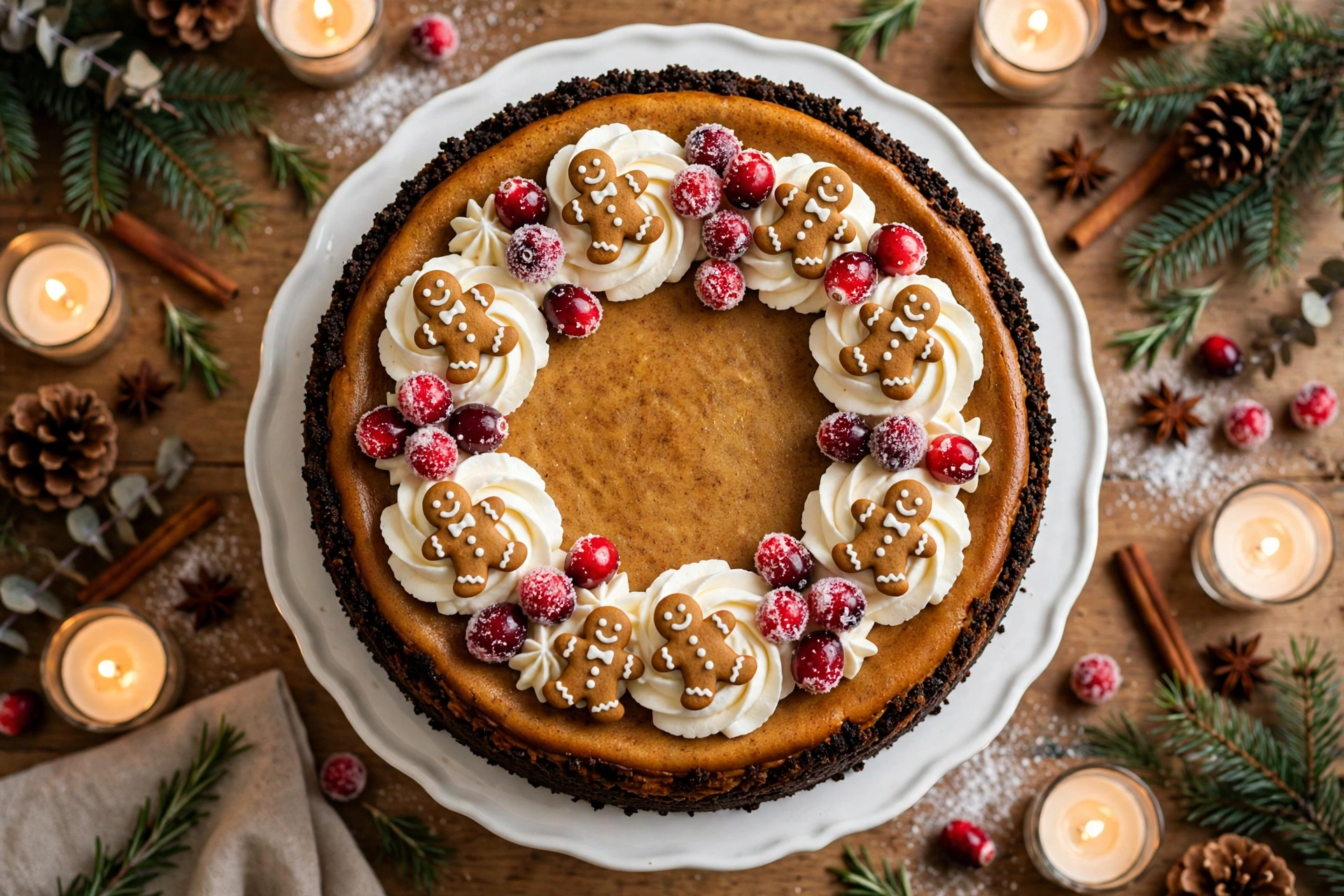
Eggnog Cheesecake With a Gingersnap Graham Crust and a Crack Free Top
In this article:
- Why reducing the eggnog changes everything
- A graham and gingersnap crust that stays crisp
- Choosing eggnog and cream cheese that bake well
- Ingredients
- Building the cheesecake, water bath and all
- The slow cool, how this cheesecake never cracks
- Whipped cream, fresh nutmeg and serving day
- Bake it days ahead, the Christmas week plan
- Mini cheesecakes and a plain graham swap
- Questions about this cheesecake
- The slice everyone asks about
Eggnog cheesecake carries the whole flavor of the season in one slice: custard spices, rich cream and that unmistakable nog warmth. Baked well, it is the dessert Christmas guests talk about on the drive home.
Most versions taste faintly of eggnog and lean on a splash of something strong to fake depth. This one does the opposite. The eggnog simmers down before it ever meets the cheese, so the flavor concentrates honestly.
The result is a dense, silky filling with clear nutmeg and cinnamon notes, set over a crust that splits the difference between graham crackers and gingersnaps. It slices clean, holds its edge and never cracks.
It is also a planners dessert. The cheesecake bakes up to a month ahead and freezes whole, which means Christmas week needs nothing from you except a slow thaw and a cloud of whipped cream.
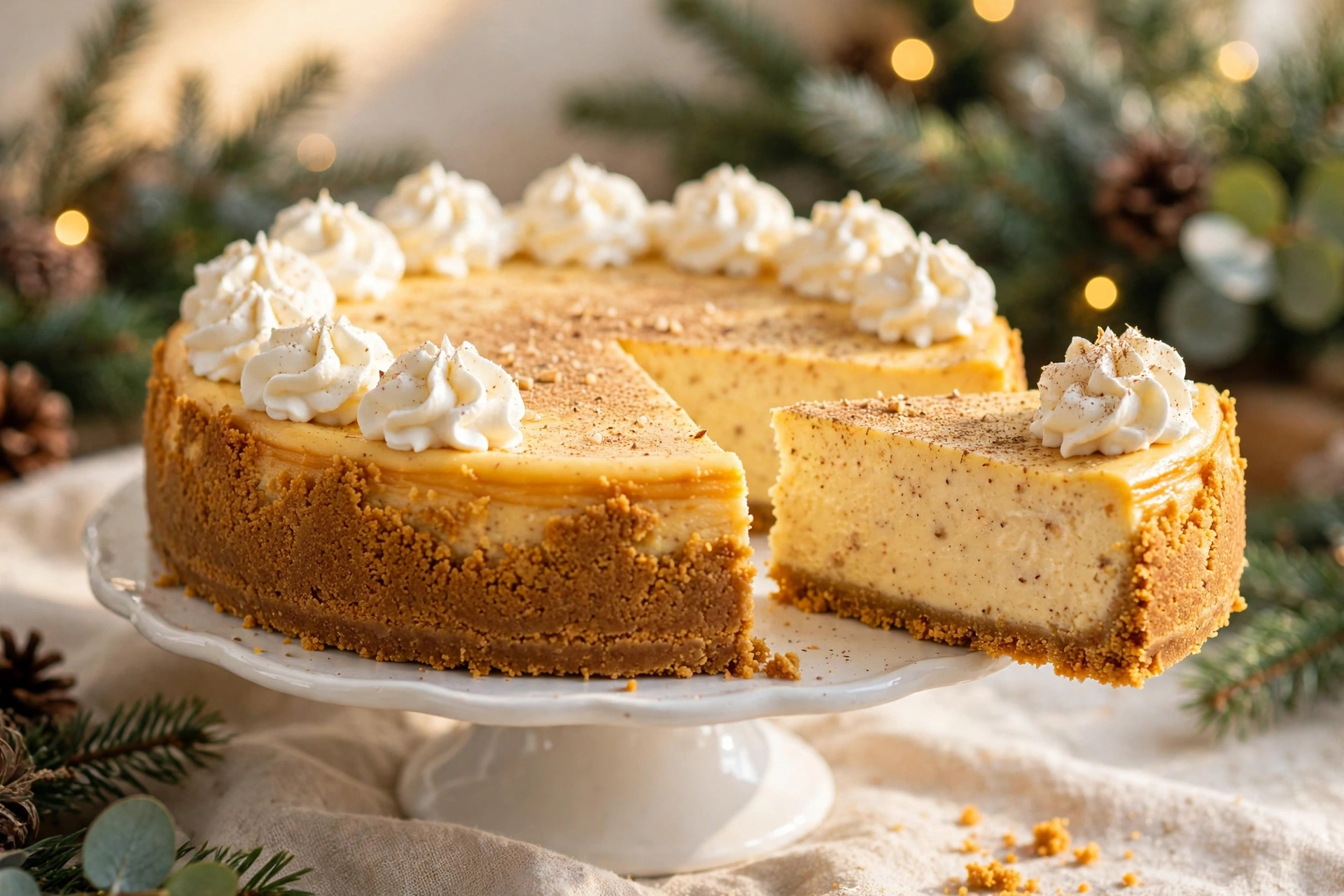
Why Reducing the Eggnog Makes This Eggnog Cheesecake Taste Like Christmas
Store bought eggnog is mostly milk, which is why so many nog cheesecakes taste like plain cheesecake wearing a costume. The custard spices are there, but a cup of nog in four blocks of cheese dilutes them.
Simmering 1 1/2 cups of eggnog down to 1 cup changes the math. Water leaves, the spices and the cooked custard flavor stay, and the filling gets the same intensity with less liquid to destabilize the set.
Less free liquid also protects the texture. Cheesecake cracks and weeps when excess water turns to steam and escapes; a reduced base bakes calmer, with a tighter, creamier crumb from edge to center.
Vanilla does the supporting work here. Two teaspoons round out the spices and give the finish a soft sweetness that reads as richness, so nothing in the slice tastes flat or one note.
A Graham and Gingersnap Crust That Stays Crisp
The crust blends graham crumbs with gingersnap crumbs, half and half. Graham brings the buttery base note, gingersnap brings warm spice and a firmer snap that stands up to a creamy filling.
A pinch of cinnamon in the crumbs ties the crust to the filling, and two tablespoons of sugar help it set into a sliceable shell during its short prebake.
Press the crumbs firmly and evenly, up the sides about an inch. A flat bottomed measuring cup packs them tighter than fingers can, and a tight pack is what keeps the crust from crumbling at slicing time.
Ten minutes in the oven firms the crust before the filling goes in. Skipping that prebake is the most common reason a cheesecake crust turns soft and gummy under a wet filling.
Choosing Eggnog and Cream Cheese That Bake Well
Eggnog quality decides the ceiling of this cake. Choose a full fat, refrigerated eggnog with a short ingredient list and real spice in it. Thin, shelf stable versions reduce into a weak, overly sweet syrup that no technique can rescue.
If your store carries a local dairy nog in a glass bottle, that is the one to bake with. Richer nog reduces faster, tastes deeper, and the finished slices carry the kind of flavor guests describe as tasting like Christmas morning.
For the cheese, buy full fat blocks, never the whipped tubs and never a low fat version. Blocks give the dense, sliceable set cheesecake is known for, while whipped products hold air that expands in the oven and collapses into cracks later.
Set the cream cheese, eggs and sour cream on the counter a full hour before mixing. Ingredients at the same temperature blend at low speed without lumps, and low speed is what keeps the batter dense instead of puffy.
Ingredients
- 1 1/2 cups (170 g) graham cracker crumbs
- 1/2 cup (60 g) gingersnap cookie crumbs
- 2 tablespoons granulated sugar
- 1/2 teaspoon ground cinnamon
- 6 tablespoons (85 g) unsalted butter, melted
- 1 1/2 cups (360 ml) full fat eggnog
- 32 ounces (900 g) cream cheese, at room temperature
- 1 cup (200 g) granulated sugar
- 3 tablespoons all purpose flour
- 4 large eggs plus 1 egg yolk, at room temperature
- 1/2 cup (120 g) sour cream, at room temperature
- 2 teaspoons vanilla extract
- 3/4 teaspoon freshly grated nutmeg, plus more for the top
- 1/2 teaspoon ground cinnamon
- 1/4 teaspoon fine salt
- 1 cup (240 ml) heavy cream, for serving
- 2 tablespoons powdered sugar, for serving
Room temperature ingredients are not a suggestion with cheesecake. Cold cream cheese beats into lumps that no amount of mixing fully smooths, and extra mixing is exactly what loads the batter with crack causing air.
Building the Cheesecake, Water Bath and All
- Pour the eggnog into a small saucepan and simmer gently over medium low heat for 12 to 15 minutes, stirring now and then, until it reduces to 1 cup. Set it aside to cool to room temperature.
- Heat the oven to 325 degrees F. Stir the graham crumbs, gingersnap crumbs, sugar and cinnamon together, pour in the melted butter, and mix until the crumbs look like wet sand.
- Press the crumb mixture firmly into the bottom and about 1 inch up the sides of a 9 inch springform pan. Bake the crust for 10 minutes, then cool it on a rack while you make the filling.
- Wrap the outside of the springform pan in two layers of heavy duty foil, or set it inside a slightly larger cake pan. This barrier keeps the water bath out of the crust.
- Beat the cream cheese and sugar on low speed until completely smooth, scraping the bowl twice. Add the flour and salt and mix just until combined.
- Pour in the cooled reduced eggnog, sour cream, vanilla, nutmeg and cinnamon. Mix on low until the batter is uniform and glossy, scraping the bowl and the beater.
- Add the eggs and the yolk one at a time, mixing on the lowest speed only until each one disappears. Stop the moment the last streak of yolk is gone.
- Pour the filling over the crust and smooth the top. Set the pan in a deep roasting pan and pour in hot water to reach halfway up the sides of the springform.
- Bake for 55 to 65 minutes, until the edges look set and matte while the center, about the size of a small plate, still wobbles softly when the pan is nudged.
- Turn the oven off, crack the door with a wooden spoon, and leave the cheesecake inside for 1 full hour. Then move it to a rack, run a thin knife around the edge, and cool it completely.
- Cover and refrigerate the eggnog cheesecake for at least 6 hours, and overnight if you can. Whip the heavy cream with the powdered sugar to soft peaks, spread or pipe it over the top, and finish with freshly grated nutmeg.
The Slow Cool: How This Cheesecake Never Cracks
Cracks are a temperature problem, not a luck problem. A cheesecake that goes from a hot oven to a cool counter contracts at the surface faster than the center, and the top splits to relieve the stress.
The water bath is the first defense: it caps the temperature around the pan and keeps the edges from racing ahead of the middle. The hour in the switched off oven is the second, letting everything descend together.
Running a knife around the edge before chilling is the third defense. As the cake cools it shrinks slightly, and a released edge lets it contract without tearing the surface.
And if a small crack ever does appear, remember the finish. Whipped cream and a snowfall of nutmeg cover a multitude of sins, and nobody has ever sent back a slice over a hidden crack.
Whipped Cream, Fresh Nutmeg and Serving Day
Serve the cheesecake well chilled, straight from the fridge. Cold slices cut cleaner, and the contrast between the cool, dense filling and the spiced crust is the whole pleasure of the dessert.
For tidy slices, dip a long knife in hot water and wipe it between every cut. The blade glides instead of dragging, so each of the twelve slices keeps a sharp face like the ones on our cranberry orange bundt cake.
Freshly grated nutmeg matters more than it sounds. Pre ground nutmeg loses its top notes within weeks, while a whole nutmeg grated over the cream at serving time perfumes the whole plate instantly.
The cheesecake sits happily beside the other eggnog baking on the site. A Christmas brunch table can carry our eggnog French toast casserole in the morning and this cheesecake after dinner, with no flavor fatigue between them.
Bake It Days Ahead: the Christmas Week Plan
Cheesecake improves with rest, which makes it the rare holiday dessert that rewards early work. Bake it three days before serving and the flavors meld while the texture firms into its creamiest state.
For a longer lead, freeze the whole baked cheesecake, unwrapped, until firm, then wrap it in two layers and freeze for up to one month. Thaw it overnight in the fridge, still wrapped, so condensation forms on the wrap and not on the cake.
Keep the whipped cream off until serving day in both plans. Cream pipes best fresh, and a freshly finished top makes a make ahead cake look like it was baked that morning.
Leftovers keep for five days in the fridge, tightly covered. Slices also freeze individually, which turns one December baking session into quiet January desserts, much like our eggnog pancakes turn extra nog into a second recipe.
Mini Cheesecakes and a Plain Graham Swap
Mini cheesecakes suit a cookie swap or a dessert buffet. Line a muffin pan, press a tablespoon of crumbs into each cup, divide the filling, and bake in a shallow water bath for 18 to 22 minutes.
If gingersnaps are not your thing, use a full 2 cups of graham crumbs and add a quarter teaspoon of ground ginger. The crust stays simpler while the filling keeps its full spice profile.
For a deeper caramel note, swap a quarter cup of the granulated sugar in the filling for brown sugar. The change is subtle, but it leans the whole slice toward toffee, a nice match for the gingerbread cinnamon rolls on the same table.
Questions About Eggnog Cheesecake
Why did my cheesecake crack on top?
Usually it cooled too fast or baked too long. Use the water bath, pull the cake while the center still wobbles softly, and let it cool for a full hour inside the switched off oven with the door cracked.
Do I really need to reduce the eggnog first?
It is the step that separates a strong eggnog flavor from a whisper. Simmering 1 1/2 cups down to 1 cup concentrates the custard spices and removes water that would otherwise loosen the filling and invite cracks.
Can I freeze the whole baked cheesecake?
Yes, for up to one month. Freeze it unwrapped until firm, wrap it well, and thaw it overnight in the refrigerator before adding the whipped cream. The texture stays dense and silky after thawing.
What if water leaks into my springform pan?
Double foil helps, but a leakproof trick is better: set the springform inside a slightly larger regular cake pan, then place both in the water bath. No foil seam can let water reach the crust that way.
Why did butter leak from my springform in the oven?
A small leak usually means the crumbs were packed too loosely or the pan seam sits unevenly. Pack the crust firmly with a flat measuring cup, prebake it for the full ten minutes, and set the pan on a rimmed sheet to catch drips.
How far ahead can I make it for Christmas?
Three days in the fridge is the sweet spot, and a month in the freezer works if your schedule demands it. Either way, add the whipped cream and the fresh nutmeg on the day you serve it.
The Slice Everyone Asks About
A great eggnog cheesecake is really three small decisions done well: concentrate the nog, keep air out of the batter, and let the cake cool at its own pace. Each one is easy, and together they are the recipe.
The crust earns its place too. That gingersnap edge against the smooth filling is the bite people remember, and it photographs as beautifully as it eats, which never hurts at a holiday table.
Bake it early, finish it simply, and put your feet up while your guests assume you worked all day. That is the kind of Christmas dessert worth keeping in the yearly rotation.
Nutrition per serving, estimated for 12 servings: Calories 445, Total Fat 31 g, Saturated Fat 18 g, Unsaturated Fat 13 g, Trans Fat 0 g, Carbohydrates 35 g, Fiber 1 g, Sugar 27 g, Protein 7 g, Sodium 330 mg, Cholesterol 150 mg. Ingredient values are informed by USDA FoodData Central.
Print
Eggnog Cheesecake With a Gingersnap Graham Crust
Eggnog cheesecake built on eggnog simmered down by a third, so the custard spice flavor stays strong without any added spirits. A graham and gingersnap crust, a water bath and a slow cool in the oven keep the top smooth and crack free.
- Total Time: 8 hours 30 minutes
- Yield: 12 slices 1x
Ingredients
- 1 1/2 cups (170 g) graham cracker crumbs
- 1/2 cup (60 g) gingersnap cookie crumbs
- 2 tablespoons granulated sugar
- 1/2 teaspoon ground cinnamon
- 6 tablespoons (85 g) unsalted butter, melted
- 1 1/2 cups (360 ml) full fat eggnog
- 32 ounces (900 g) cream cheese, at room temperature
- 1 cup (200 g) granulated sugar
- 3 tablespoons all purpose flour
- 4 large eggs plus 1 egg yolk, at room temperature
- 1/2 cup (120 g) sour cream, at room temperature
- 2 teaspoons vanilla extract
- 3/4 teaspoon freshly grated nutmeg, plus more for the top
- 1/2 teaspoon ground cinnamon
- 1/4 teaspoon fine salt
- 1 cup (240 ml) heavy cream, for serving
- 2 tablespoons powdered sugar, for serving
Instructions
- Pour the eggnog into a small saucepan and simmer gently over medium low heat for 12 to 15 minutes, stirring now and then, until it reduces to 1 cup. Set it aside to cool to room temperature.
- Heat the oven to 325 degrees F. Stir the graham crumbs, gingersnap crumbs, sugar and cinnamon together, pour in the melted butter, and mix until the crumbs look like wet sand.
- Press the crumb mixture firmly into the bottom and about 1 inch up the sides of a 9 inch springform pan. Bake the crust for 10 minutes, then cool it on a rack.
- Wrap the outside of the springform pan in two layers of heavy duty foil, or set it inside a slightly larger cake pan, to keep the water bath out of the crust.
- Beat the cream cheese and sugar on low speed until completely smooth, scraping the bowl twice. Add the flour and salt and mix just until combined.
- Pour in the cooled reduced eggnog, sour cream, vanilla, nutmeg and cinnamon. Mix on low until the batter is uniform and glossy, scraping the bowl and the beater.
- Add the eggs and the yolk one at a time, mixing on the lowest speed only until each one disappears.
- Pour the filling over the crust and smooth the top. Set the pan in a deep roasting pan and pour in hot water to reach halfway up the sides of the springform.
- Bake for 55 to 65 minutes, until the edges look set and matte while the center still wobbles softly when the pan is nudged.
- Turn the oven off, crack the door with a wooden spoon, and leave the cheesecake inside for 1 full hour. Move it to a rack, run a thin knife around the edge, and cool it completely.
- Cover and refrigerate for at least 6 hours, and overnight if you can. Whip the heavy cream with the powdered sugar to soft peaks, spread or pipe it over the top, and finish with freshly grated nutmeg before slicing.
- Prep Time: 30 minutes
- Cook Time: 1 hour 5 minutes
Nutrition
- Serving Size: 1
- Calories: 445
- Sugar: 27
- Sodium: 330
- Fat: 31
- Saturated Fat: 18
- Unsaturated Fat: 13
- Trans Fat: 0
- Carbohydrates: 35
- Fiber: 1
- Protein: 7
- Cholesterol: 150