Overnight Cinnamon Rolls, Shaped on Christmas Eve, Baked While the Coffee Brews
In this article:
- The Night Before Does the Work
- Christmas Morning, Minute by Minute
- Flavor and Texture
- Ingredients
- Shaping the Overnight Cinnamon Rolls, Step by Step
- The Cream Pour and the 45 Minute Proof
- Swaps, Flavors and a Freezer Calendar
- Storage and Reheating
- Your Overnight Cinnamon Roll Questions, Answered
- Christmas Morning, Warm From the Oven
Overnight cinnamon rolls are the difference between watching Christmas morning and working through it. The dough, the filling, the slicing, even the frosting: all of it happens on Christmas Eve, at a calm hour, with music on.
What the fridge does overnight is more than storage. A slow, cold rise builds flavor that a fast rise never reaches, deepening the dough into something closer to brioche, while the cinnamon sugar settles into the spirals.
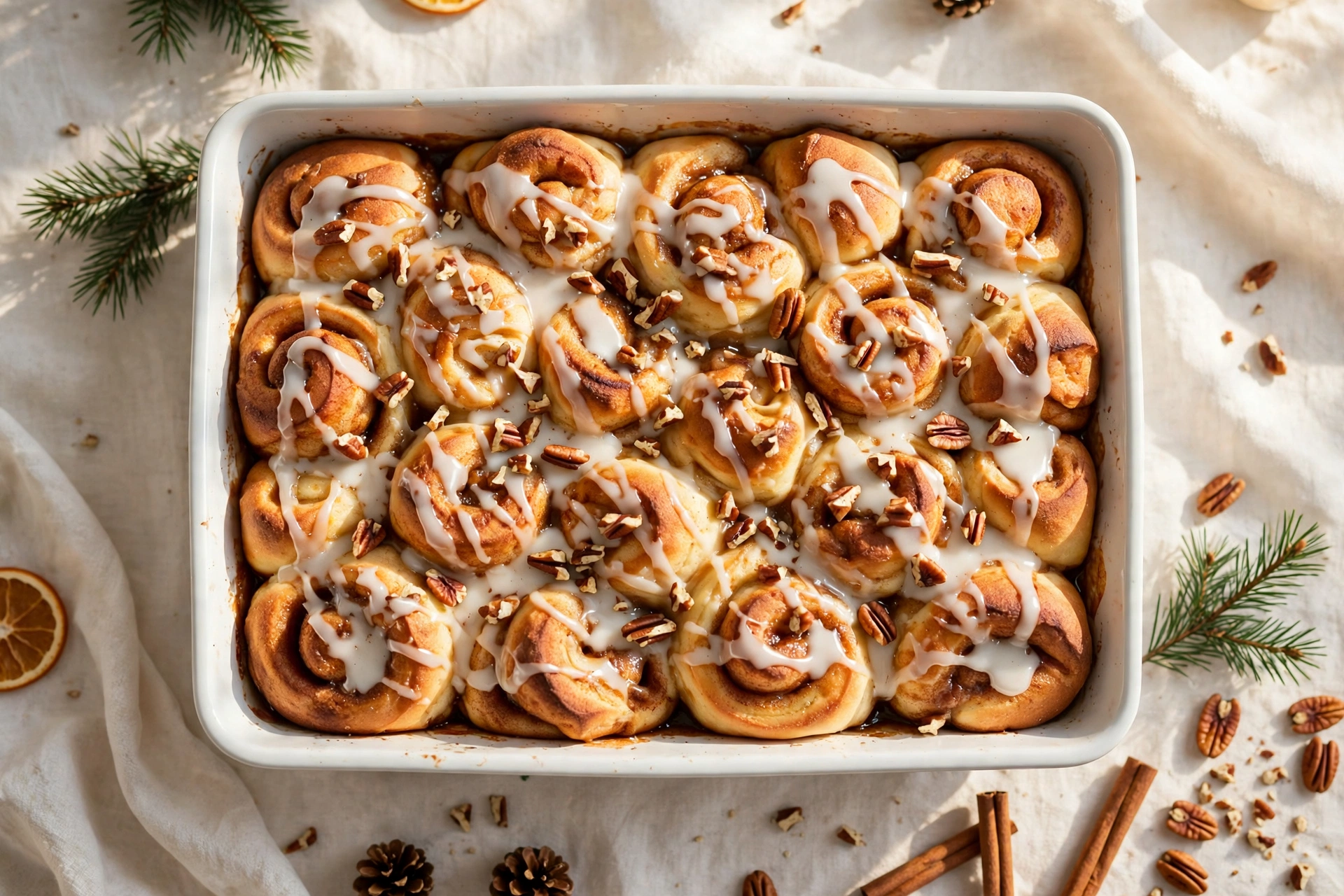
Christmas morning then asks almost nothing of you. The pan proofs in a warm, steamy oven that is still switched off, a pour of cream goes over the top, and the rolls bake while the first coffee brews.
This recipe also fixes the flaw in most overnight versions, the morning proof that drags on for two hours. Ours takes forty five minutes, on a schedule written out below, so the rolls land on the table while the morning still feels young.

The Night Before Does the Work
Overnight cinnamon rolls succeed because yeast is patient and the refrigerator is slow. Given eight to twelve cold hours, the dough ferments gently, producing the mild tang and deep wheat flavor that make a bakery roll taste like a bakery roll.
The dough itself is enriched but simple: milk, eggs, butter, a little sugar. Enrichment is what keeps the crumb soft on day two, and it is also what makes the dough forgiving. It kneads smooth, rolls flat without fighting, and slices cleanly.
Flour choice matters quietly here. A standard all purpose flour gives a tender roll; bread flour gives a chewier, taller one. The USDA nutrient database lists their protein close together, around 10 to 13 percent, so use what you have and judge the dough by feel, not by the bag.
The filling is a spread, not a sprinkle. Very soft butter goes on first, edge to edge, and the cinnamon sugar rides on top of it. As the log rests in the fridge, the butter firms and locks the sugar in place, so the spirals stay defined instead of leaking.
Slicing with unflavored dental floss is the last evening decision that pays off. A knife, even a sharp one, presses the log oval. Floss slides under, crosses over the top, and cuts straight down, leaving twelve round spirals with their layers intact.
Mark before you cut. Score the log at the halfway point, then each half in half again, then each quarter into thirds. Twelve rolls of the same thickness bake at the same speed, which is the whole secret to a pan with no pale centers and no dark edges.
Christmas Morning, Minute by Minute
Seven o’clock: the pan comes out of the fridge and goes into a cold oven. A pan of boiling water goes on the rack below it. Door closed, oven off. The steam and gentle warmth wake the dough without cooking it.
Seven forty five: the rolls are puffy and touching, their spirals pressed shoulder to shoulder. The pan comes out, the water pan comes out, and the oven finally turns on, to 350 degrees.
Seven fifty five: room temperature cream pours over the rolls, pooling between the spirals. The pan goes in. This is the moment to put the coffee on and call everyone to the kitchen, because the smell is about to do the waking up for you.
Eight twenty: the rolls are deep golden, the centers read 190 degrees, and the cream has turned the filling at the bottom of the pan into a glossy sauce. Ten minutes of rest, then frosting, spread thick while they are still warm.
Eight thirty: twelve frosted rolls on the table, and the cook sat down at the same time as everyone else. That is the whole point of the recipe, and it is worth protecting: no step on this schedule can ambush you.
Flavor and Texture
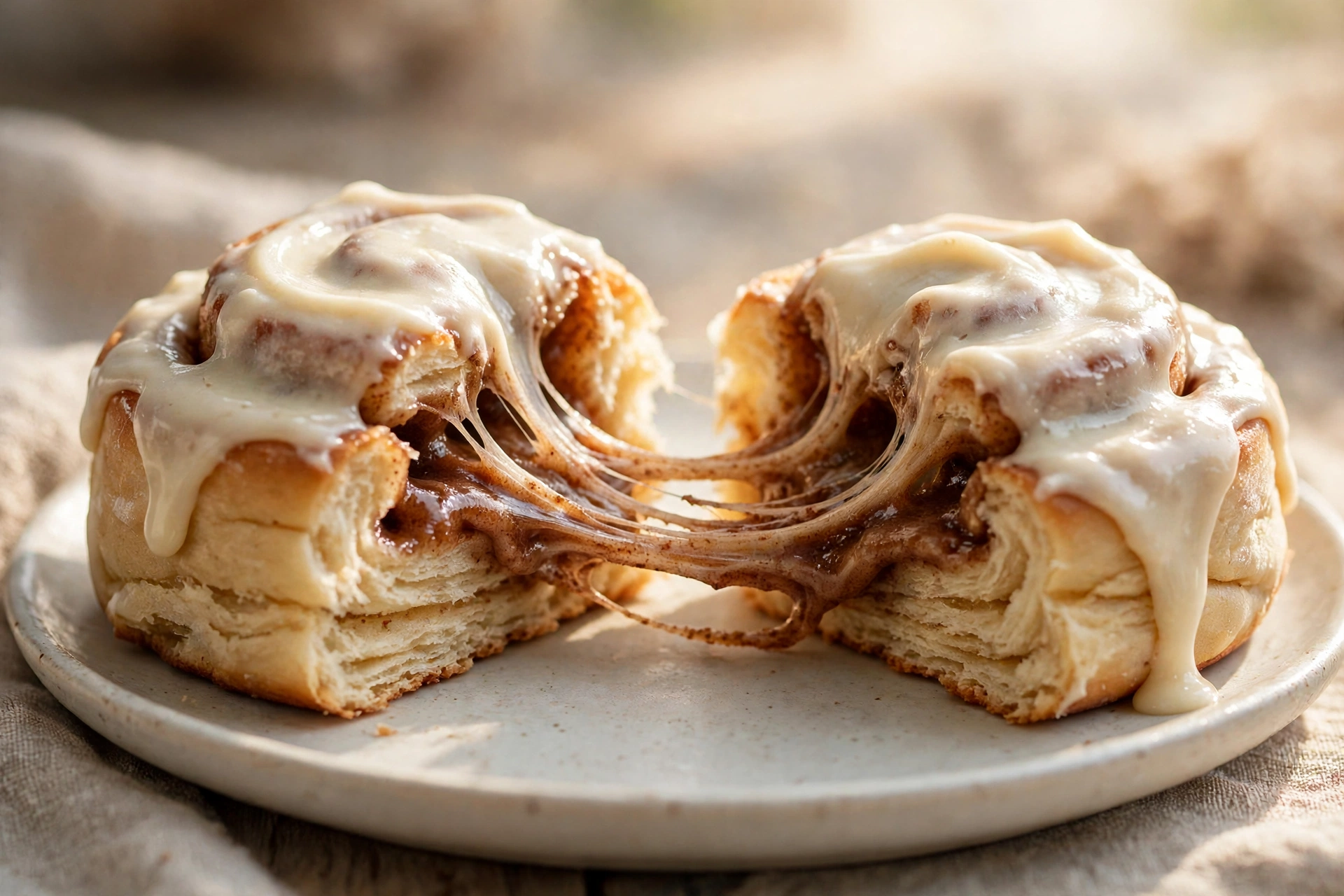
A great cinnamon roll is three textures in one bite. The top edge, touched by heat, turns faintly crisp under the frosting. The middle stays soft and layered, pulling apart in sheets. The bottom sits in the cream and cinnamon sauce, almost pudding soft.
The cinnamon should be warm, not harsh. Two tablespoons across twelve rolls is the balance point; more and the filling turns medicinal, less and it reads as plain sweet bread. Brown sugar brings a molasses depth that white sugar alone cannot give.
Cream cheese frosting is the classic for a reason: its tang cuts the sweetness of the filling and keeps the whole roll from tipping into candy. Spread on warm rolls, it melts into the spirals just at the surface, then sets into a soft cap as they cool.
The cream pour changes the centers most of all. Instead of drying at the edges of the pan, every roll bakes in a shallow bath that turns to sauce. The middle rolls, usually the palest, come out as gooey as the ones at the corners.
Ingredients
- 1 cup whole milk, warmed to about 110°F
- 2 1/4 teaspoons instant yeast (1 packet)
- 1/2 cup granulated sugar, divided
- 2 large eggs, at room temperature
- 6 tablespoons unsalted butter, melted, for the dough
- 1 teaspoon fine sea salt
- 4 cups all purpose flour, plus more for dusting
- 6 tablespoons unsalted butter, very soft, for the filling
- 3/4 cup packed light brown sugar
- 2 tablespoons ground cinnamon
- 1/4 teaspoon fine sea salt, for the filling
- 1/2 cup heavy cream, at room temperature, for the pan
- 4 ounces cream cheese, softened
- 4 tablespoons unsalted butter, softened, for the frosting
- 1 1/2 cups powdered sugar
- 1 teaspoon vanilla extract
- 2 to 3 tablespoons milk, as needed
- Pinch of fine sea salt, for the frosting
Shaping the Overnight Cinnamon Rolls, Step by Step
- Whisk the warm milk, the yeast and 1 tablespoon of the granulated sugar in a large bowl. Rest for 5 minutes, until foamy. Whisk in the eggs, the melted butter, the remaining granulated sugar and the salt.
- Stir in the flour until a shaggy dough forms, then knead by hand or with a dough hook for 8 to 10 minutes, until smooth, elastic and only slightly tacky. Add flour a spoonful at a time only if the dough sticks hard to the bowl.
- Cover the bowl and let the dough rise in a warm spot for about 1 hour, until doubled. Meanwhile stir the brown sugar, cinnamon and filling salt together in a small bowl.
- Roll the dough on a lightly floured surface into an 18 by 12 inch rectangle. Spread the very soft butter edge to edge, then sprinkle the cinnamon sugar evenly over it, leaving a 1/2 inch border on one long side.
- Starting from the filled long side, roll the dough into a tight log and pinch the seam closed. Mark the log in half, then in quarters, and cut 12 even rolls with unflavored dental floss or a serrated knife, using a sawing motion so the spirals stay round.
- Arrange the rolls cut side up in a buttered 9×13 inch pan. Cover the pan tightly and refrigerate for 8 to 12 hours. Mix the frosting now if you like: beat the cream cheese, softened butter, powdered sugar, vanilla, milk and salt until fluffy, cover and refrigerate.
- In the morning, set the pan in a cold oven and put a pan of boiling water on the rack below it. Close the door and proof for 45 minutes, until the rolls look puffy and are touching. Lift the pan out, remove the water pan, and preheat the oven to 350°F.
- Pour the room temperature heavy cream evenly over the rolls; it pools between the spirals and turns the centers gooey. Bake for 22 to 27 minutes, until deep golden on top and 190°F in the center of a middle roll.
- Rest the pan for 10 minutes. If the frosting was chilled, let it sit at room temperature while the rolls bake so it spreads easily. Spread it generously over the warm rolls and serve straight from the pan.
The Cream Pour and the 45 Minute Proof
Two small techniques carry this recipe, and both are about the morning. The first is the proof. Cold dough in a room temperature kitchen can take two hours to wake up, which quietly ruins the promise of an overnight recipe.
The switched off oven with a pan of boiling water below solves it. The enclosed space holds gentle heat and humidity, the dough’s surface stays supple instead of skinning over, and forty five minutes does what two hours on the counter would. Puffy and touching is the cue, not the clock.
The second technique is the cream pour, borrowed from coffee shop bakers. Half a cup of cream over the proofed rolls looks like a mistake for about ten seconds. Then it disappears between the spirals and goes to work.
In the oven, that cream mingles with the cinnamon sugar escaping the rolls and becomes a sauce in the bottom of the pan. It also insulates the rolls from the pan’s direct heat, so the bottoms stay tender instead of firming up.
Two cautions keep it foolproof. The cream should be at room temperature, never cold from the fridge, so it does not shock the proofed dough. And pour it after the proof, not before the fridge; overnight, it would soak in unevenly and soften the spirals.
Swaps, Flavors and a Freezer Calendar
The classic filling welcomes variations as long as the structure stays. Orange zest rubbed into the cinnamon sugar turns the pan bright and festive. A pinch of cardamom with the cinnamon reads Scandinavian and pairs beautifully with the cream cheese frosting.
For a nutty version, scatter half a cup of finely chopped pecans over the filling before rolling. Keep the pieces small; large chunks tear the dough when you slice and leave gaps in the spirals.
Our gingerbread cinnamon rolls follow the same overnight logic with molasses and spice, and our cinnamon roll casserole is the shortcut cousin for a crowd. For the rest of the morning table, our gingerbread pancakes and eggnog French toast casserole bake in the same warm oven window, and the Christmas monkey bread covers the pull apart eaters.
The freezer calendar stretches the recipe further. Shape and slice the rolls, freeze them solid on a tray, then pack them into a bag for up to a month. The night before baking, arrange them in the buttered pan and thaw in the fridge for twelve hours, then proof and bake exactly as written.
Fully baked and unfrosted rolls also freeze well, wrapped tightly, for a month. Thaw overnight, warm at 300 degrees for ten minutes, frost, and nobody will know they were not baked that morning.
Storage and Reheating
Frosted rolls keep at room temperature for one day, covered, because the cream cheese frosting should not sit out longer. Refrigerated, they hold for four days, and the crumb stays softer than most enriched doughs thanks to the eggs and butter.
Reheat a single roll in the microwave for twenty to thirty seconds, just until the frosting glistens. A whole pan goes back into a 300 degree oven, covered with foil, for twelve to fifteen minutes.
If the frosting has firmed up in the fridge, a five second microwave burst per roll brings back the soft, spreadable texture. Cold cinnamon rolls are a sad thing; thirty seconds of warmth is all that stands between them and their best selves.
Your Overnight Cinnamon Roll Questions, Answered
My rolls barely rose in the fridge. Are they ruined?
Not at all. A cold fridge slows the rise to almost nothing, and that is fine. The steamy oven proof in the morning does the real work. Judge them after the 45 minutes, puffy and touching, not straight from the fridge.
Can I skip the cream pour?
You can, and the rolls will still be good. The cream is what makes the centers gooey and the pan sauce form, so without it the texture is a little firmer and more bread like. Brush the tops with melted butter instead for shine.
Why did my rolls unravel in the pan?
The log was probably rolled a little loose, or the seam was not pinched shut. Roll snugly from the first turn, pinch the seam firmly, and set each roll seam side against its neighbor so the spirals hold each other in place.
Can the frosting really be made the night before?
Yes, and it should be. Beat it on Christmas Eve, cover and refrigerate. Set it on the counter when the rolls go into their morning proof, and it will be perfectly spreadable by the time they come out of the oven.
How far ahead can I freeze the shaped rolls?
Up to one month, frozen solid on a tray first so they keep their shape, then bagged. Move them to the buttered pan and thaw in the fridge for about twelve hours before the morning proof.
What if my dough feels sticky after kneading?
Slightly tacky is right; it should leave a faint fingerprint, not a layer of dough. Enriched doughs feel softer than lean ones. Add flour only a spoonful at a time, because an extra half cup is the difference between fluffy and dense.
Christmas Morning, Warm From the Oven
Overnight cinnamon rolls are a promise the cook makes to their future self: tomorrow morning, you get to be a person at Christmas, not staff. The recipe keeps that promise with a schedule, a steamy proof and a pan that goes from fridge to table in about ninety minutes.
Do the pleasant work tonight. Roll, slice, frost, tidy the kitchen, and let the fridge take the night shift. In the morning there is only proofing, pouring, baking, and the smell that will bring everyone downstairs.
Serve them warm, straight from the pan, with coffee going around and nowhere to be. Twelve rolls has a way of becoming ten before they ever reach the table, and that, too, is part of the tradition.
Print
Overnight Cinnamon Rolls for Christmas Morning
Christmas morning cinnamon rolls with all the work done on Christmas Eve: a soft enriched dough rolled around brown sugar and cinnamon, sliced with floss into twelve even spirals, and parked in the fridge overnight. In the morning a 45 minute proof in a steamy, switched off oven replaces the usual two hour wait, a pour of warm cream over the pan gives the gooey cafe style centers, and the cream cheese frosting is already mixed and waiting.
- Total Time: 10 hours 15 minutes
- Yield: 12 rolls 1x
Ingredients
- 1 cup whole milk, warmed to about 110°F
- 2 1/4 teaspoons instant yeast (1 packet)
- 1/2 cup granulated sugar, divided
- 2 large eggs, at room temperature
- 6 tablespoons unsalted butter, melted, for the dough
- 1 teaspoon fine sea salt
- 4 cups all purpose flour, plus more for dusting
- 6 tablespoons unsalted butter, very soft, for the filling
- 3/4 cup packed light brown sugar
- 2 tablespoons ground cinnamon
- 1/4 teaspoon fine sea salt, for the filling
- 1/2 cup heavy cream, at room temperature, for the pan
- 4 ounces cream cheese, softened
- 4 tablespoons unsalted butter, softened, for the frosting
- 1 1/2 cups powdered sugar
- 1 teaspoon vanilla extract
- 2 to 3 tablespoons milk, as needed
- Pinch of fine sea salt, for the frosting
Instructions
- Whisk the warm milk, the yeast and 1 tablespoon of the granulated sugar in a large bowl. Rest for 5 minutes, until foamy. Whisk in the eggs, the melted butter, the remaining granulated sugar and the salt.
- Stir in the flour until a shaggy dough forms, then knead by hand or with a dough hook for 8 to 10 minutes, until smooth, elastic and only slightly tacky. Add flour a spoonful at a time only if the dough sticks hard to the bowl.
- Cover the bowl and let the dough rise in a warm spot for about 1 hour, until doubled. Meanwhile stir the brown sugar, cinnamon and filling salt together in a small bowl.
- Roll the dough on a lightly floured surface into an 18 by 12 inch rectangle. Spread the very soft butter edge to edge, then sprinkle the cinnamon sugar evenly over it, leaving a 1/2 inch border on one long side.
- Starting from the filled long side, roll the dough into a tight log and pinch the seam closed. Mark the log in half, then in quarters, and cut 12 even rolls with unflavored dental floss or a serrated knife, using a sawing motion so the spirals stay round.
- Arrange the rolls cut side up in a buttered 9×13 inch pan. Cover the pan tightly and refrigerate for 8 to 12 hours. Mix the frosting now if you like: beat the cream cheese, softened butter, powdered sugar, vanilla, milk and salt until fluffy, cover and refrigerate.
- In the morning, set the pan in a cold oven and put a pan of boiling water on the rack below it. Close the door and proof for 45 minutes, until the rolls look puffy and are touching. Lift the pan out, remove the water pan, and preheat the oven to 350°F.
- Pour the room temperature heavy cream evenly over the rolls; it pools between the spirals and turns the centers gooey. Bake for 22 to 27 minutes, until deep golden on top and 190°F in the center of a middle roll.
- Rest the pan for 10 minutes. If the frosting was chilled, let it sit at room temperature while the rolls bake so it spreads easily. Spread it generously over the warm rolls and serve straight from the pan.
- Prep Time: 50 minutes
- Cook Time: 25 minutes
Nutrition
- Serving Size: 1
- Calories: 480
- Sugar: 38
- Sodium: 330
- Fat: 21
- Saturated Fat: 13
- Unsaturated Fat: 7
- Trans Fat: 0
- Carbohydrates: 68
- Fiber: 2
- Protein: 7
- Cholesterol: 85