Christmas Morning Strata, Spinach, Roasted Peppers and Gruyère, Built the Night Before
In this article:
- What Makes a Strata a Strata, and Why This One Loves the Night
- The Vegetables: Building Color and Keeping the Water Out
- Dry Bread, the Unglamorous Secret
- Ingredients
- Layering the Christmas Morning Strata on Christmas Eve, Step by Step
- The Soak Window: Eight Hours Minimum, Twenty Four Maximum
- Christmas Morning, Timed: Fridge, Oven, Table
- Freezing, Holding and the Second Brunch
- Swaps for Breads, Cheeses and Vegetables
- Your Christmas Morning Strata Questions, Answered
- The Morning Belongs to You Again
The first strata I ever served on Christmas morning was an accident of exhaustion. I had assembled it the night before because there was nothing left in me to cook with, and I remember standing in a quiet kitchen at seven, coffee in hand, while the oven did the morning’s only work.
That is the whole promise of a christmas morning strata: the cooking happens on Christmas Eve, when the kitchen is already a mess, and the morning itself asks almost nothing of you.
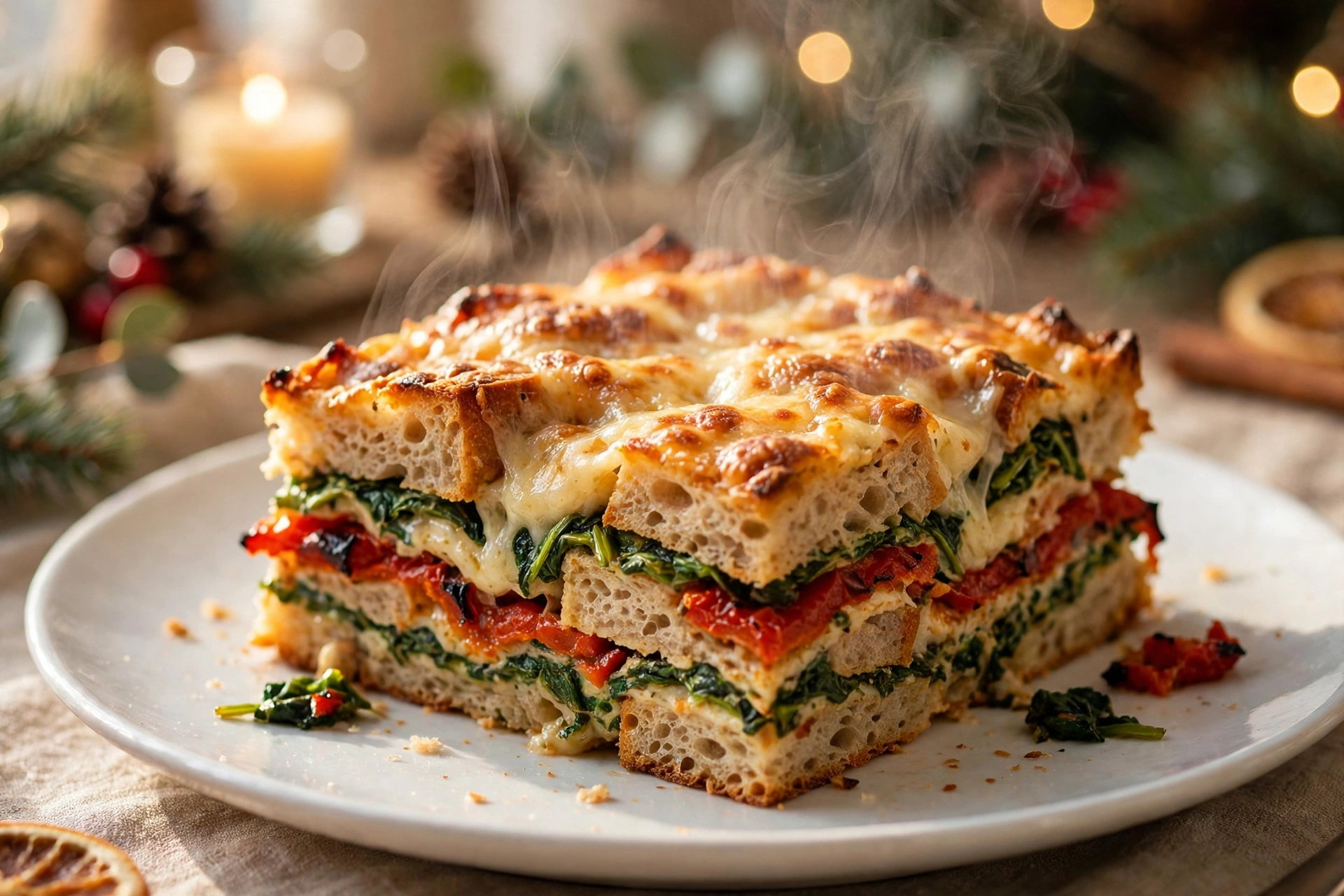
This one is built entirely from vegetables and cheese, no meat anywhere, and it is not a compromise. Spinach, roasted red peppers, mushrooms and caramelized onion bring the savor, Gruyère and sharp cheddar bring the richness, and the colors come out of the oven looking like the holiday itself.
The bread is sourdough, dried on purpose. The custard carries a spoonful of Dijon that nobody can identify and everybody misses when it is gone. By the time the dish puffs and turns deep gold, the coffee is ready and so are you.

What Makes a Strata a Strata, and Why This One Loves the Night
A strata is a savory bread pudding with architecture: distinct layers of bread, filling and cheese, bound by an egg custard and baked slowly enough to puff. A frittata is dense and sliceable thin; a strata stands tall, soft in the center, crisp at the edges.
The overnight rest is not a convenience trick, it is the technique. Dry bread cubes drink the custard slowly and evenly, so the finished dish bakes into a single tender mass instead of wet bread sitting in scrambled egg.
The ratio that holds everything together is ten eggs to three cups of dairy for one standard loaf of bread. Less custard and the center crumbles; more and the bottom turns to custard soup no matter how long it bakes.
Cheese works twice in a strata. Inside the layers it seasons and binds; on top it becomes the crust. This recipe splits Gruyère and cheddar across both jobs, so the top browns deeply while the interior stays melty.
Because the whole dish is assembled cold, the flavors marry in a way a morning casserole never manages. The onion sweetens the custard, the mustard blooms quietly, and the peppers thread their roasted flavor through every layer by morning.
The Vegetables: Building Color and Keeping the Water Out
Every vegetable in this strata is cooked before it meets the bread, and the reason is water. Spinach, mushrooms and onion all release liquid as they bake, and liquid released inside a strata has nowhere to go except the bottom of the dish.
The onion goes first and takes its time, eight to ten minutes, until the edges turn golden. That sweetness is the base note of the whole dish, the flavor people describe as cozy without knowing why.
Mushrooms need patience too: five or six minutes until their liquid cooks off and the edges brown. A mushroom that still looks wet will weep into your strata, so wait for the pan to sound dry again.
Spinach wilts last, in handfuls, for about two minutes. It should leave the pan bright green and just collapsed, then cool and give up its pooled liquid before layering. Squeeze the mixture gently if the pan looks soupy; this one step saves more stratas than any other.
The roasted red peppers come from a jar, drained and patted dry, because December is not the season to roast peppers from scratch for a breakfast casserole. Their sweetness against the Gruyère is the pairing the recipe is built around.
Dry Bread, the Unglamorous Secret
Strata fails more often from fresh bread than from any other cause. Fresh bread is already full of moisture, so it cannot absorb custard; it simply dissolves into it, and the dish bakes up heavy and gummy.
Day old sourdough is ideal: a firm crust, an open crumb, and enough structure to hold its cube shape through a night of soaking. If your loaf is fresh, cube it and dry it in a low oven for ten minutes; the recipe forgives the shortcut completely.
Cut the cubes at one inch. Smaller pieces dissolve into mush, larger ones leave dry pockets the custard never reaches. One inch bakes into distinct, tender layers you can see when the dish is sliced.
Crust on or off is a texture choice, not a rule. Kept on, the crust pieces at the top turn into the crispiest bites in the dish. This recipe keeps it on, because Christmas morning deserves that contrast.
Ingredients
- 1 tablespoon unsalted butter, for the baking dish
- 1 tablespoon olive oil
- 1 medium yellow onion, thinly sliced
- 8 ounces cremini mushrooms, sliced
- 3 garlic cloves, minced
- 5 ounces fresh baby spinach (about 5 packed cups)
- 1 loaf day old sourdough bread (about 14 ounces), cut into 1 inch cubes (about 10 cups)
- 1 cup roasted red peppers, drained and chopped
- 8 ounces Gruyere cheese, freshly grated (about 2 cups), divided
- 6 ounces sharp cheddar cheese, freshly grated (about 1 1/2 cups), divided
- 10 large eggs
- 2 1/2 cups whole milk
- 1/2 cup heavy cream
- 1 tablespoon Dijon mustard
- 1 1/4 teaspoons fine sea salt
- 1/2 teaspoon black pepper
- 1/4 teaspoon freshly grated nutmeg
- 2 tablespoons chopped fresh chives
Layering the Christmas Morning Strata on Christmas Eve, Step by Step
- Butter a 9×13 inch baking dish. Heat the olive oil in a large skillet over medium heat. Cook the onion with a pinch of the salt for 8 to 10 minutes, until soft and golden at the edges. Add the mushrooms and cook for 5 to 6 minutes, until they release their liquid and brown lightly. Stir in the garlic for 30 seconds, then add the spinach a handful at a time and cook just until wilted, about 2 minutes. Take the skillet off the heat and let the vegetables cool slightly; squeeze out any pooled liquid.
- Spread half of the bread cubes in the prepared dish. Cover with half of the vegetable mixture, half of the roasted red peppers and half of each cheese. Repeat with the remaining bread, vegetables, peppers and cheeses, finishing with cheese on top.
- Whisk the eggs, milk, cream, Dijon mustard, salt, pepper and nutmeg in a large bowl until fully combined. Pour the custard slowly and evenly over the layers, moving the dish gently so it reaches every corner. Press the top layer of bread down lightly with a spatula so it drinks up the custard.
- Cover the dish tightly and refrigerate for at least 8 hours and up to 24 hours.
- On Christmas morning, take the strata out of the fridge while the oven heats to 350°F, about 20 minutes. Bake uncovered for 50 to 55 minutes (add 10 minutes if it goes in straight from the cold fridge), until the center is puffed and set, the top is deep golden, and a knife inserted in the middle comes out clean.
- Rest for 10 minutes so the slices set. Scatter the chives over the top, cut into 10 generous squares and serve warm.
The Soak Window: Eight Hours Minimum, Twenty Four Maximum
Eight hours is the honest minimum. Before that, the center cubes are still dry at the core, and the strata bakes in two textures: custardy edges and bready middle. It is edible at four hours and genuinely good at eight.
The sweet spot for most loaves is twelve to sixteen hours, which is exactly a Christmas Eve assembly and a Christmas morning bake. The bread relaxes fully, the custard seasons it through, and the layers hold together when sliced.
Twenty four hours is the ceiling. Past that, sourdough begins to surrender its structure and the bottom layer compresses into paste. If your schedule slips, bake the dish and reheat it rather than letting it soak a second night.
The dish goes into the fridge within minutes of assembly, covered tightly. Egg custard is a friendly place for bacteria at room temperature, and the food safety guidance compiled from USDA data at fdc.nal.usda.gov starts from the same principle: cold food stays cold until the oven.
One small ritual helps: an hour into the soak, press the top layer down once more. The uppermost cubes sit above the custard line at first, and that single press is the difference between a dry top cube and a perfect one.
Christmas Morning, Timed: Fridge, Oven, Table
Here is the morning, minute by minute. At seven, take the dish out of the fridge and set the oven to 350°F. The strata loses its deepest chill while the oven heats, and that twenty minutes buys you an evenly set center.
At seven twenty, the dish goes in. At eight ten, start checking: the center should puff, the top should be deep gold, and a knife in the middle should come out clean. Most ovens finish between fifty and fifty five minutes.
The ten minute rest is not optional. A strata cut too soon slumps and weeps; rested, it slices into clean squares that hold their layers on the plate. Use the rest to make coffee and warm the plates if your house does that.
Around it, the rest of the table can stay simple. Our eggnog French toast casserole covers the sweet side from the same make ahead logic, and a pitcher of candy cane Christmas punch handles the drinks without a single bottle opened.
If your family opens gifts before breakfast, the baked strata holds happily at 200°F for thirty minutes. Serve it when the room is ready, with a tin of our buckeyes for the people who cannot wait.
Freezing, Holding and the Second Brunch
Freeze the strata unbaked for a calm January brunch. Assemble it in a freezer safe dish, wrap it twice, and freeze up to two months. Thaw overnight in the fridge, then bake as directed.
Baked leftovers keep four days in the fridge and reheat beautifully: single squares at 325°F for fifteen minutes, or the whole dish covered for twenty five. The microwave softens the top, so the oven is worth it when time allows.
For a brunch that runs in waves, bake the strata fully and hold it warm for the first seating; the last square, an hour later, is honestly as good as the first. Egg dishes with this much cheese are forgiving holders.
For a smaller house, halve the recipe into an 8 inch square dish and cut the bake to forty minutes. The soak stays the same, because bread and custard keep their own schedule regardless of pan size.
Swaps for Breads, Cheeses and Vegetables
The cheese pair is flexible inside one rule: one melter and one flavor cheese. Fontina melts like Gruyère with a milder voice; Monterey Jack works too. For the flavor seat, aged cheddar, Parmesan in smaller quantity, or a smoked Gouda all hold the line.
Vegetables swap by water content, not by wish. Kale behaves like spinach once its stems are removed and it wilts a minute longer. Broccoli must be blanched and chopped small. Asparagus, sautéed in short pieces, turns the dish toward spring without breaking it.
Frozen spinach is the one swap that needs arithmetic: thaw ten ounces, squeeze it until almost no liquid comes out, and use it in place of the fresh. Frozen spinach arrives pre wilted and very wet, and the squeezing is the recipe.
For a dairy lighter custard, replace the cream with more whole milk and accept a slightly firmer set. The dish still works, because the structure comes from eggs and bread, not from the cream, which is there for tenderness.
Gluten free loaves bake into a softer strata that slices best after a longer rest, fifteen minutes instead of ten. Choose a sturdy bakery loaf rather than a sandwich bread, and let the soak run the full twelve hours.
Your Christmas Morning Strata Questions, Answered
Can I assemble the strata in the morning and bake it the same day?
Yes, with a shorter soak of at least 2 hours, pressed twice, and a bake at the longer end of the range. The texture will be a little less unified than the overnight version, but on a busy morning it is a fair trade and still very good.
Why did the bottom of my strata turn soggy?
Almost always, the vegetables carried water in, or the bread was too fresh to absorb the custard. Cook the vegetables until the pan looks dry, squeeze the spinach mixture, and dry fresh bread cubes in a low oven for ten minutes before layering.
How do I know the center is fully set?
The center puffs and stops jiggling like liquid when the dish is nudged; it should move as one soft mass. A knife inserted in the middle comes out clean, and the very center reaches a gentle firmness when pressed with the back of a spoon.
Can I add the vegetables raw to save time?
Only the peppers, which arrive roasted. Raw onion stays sharp, raw mushrooms flood the dish, and raw spinach releases a surprising amount of water as it bakes. The ten minutes of skillet work on Christmas Eve is what buys the calm morning.
What size pan if I want to double it for a crowd?
Bake two 9×13 dishes side by side rather than one deep roasting pan. Doubled depth never sets in the middle before the edges overcook, and two dishes let one stay warm while the first is served.
Does the strata reheat for a second breakfast?
Beautifully. Squares reheat at 325°F for fifteen minutes and taste nearly fresh, which is why this recipe covers December 26 as well as December 25 in many houses.
The Morning Belongs to You Again
A christmas morning strata is less a recipe than a decision: the work happens the night before, and the morning is handed back to the people it belongs to. This one does it with vegetables, good cheese and bread that was dried on purpose.
Assemble it on Christmas Eve, let the fridge do the quiet work, and bake it while the coffee brews. When the dish comes out puffed and golden, red and green in every slice, you will be sitting down with everyone else, which is the entire point.