In this article:
- A Casserole with a Reputation to Defend
- Creamy Center, Shattering Top
- The From Scratch Cheese Sauce
- Ingredients for Funeral Potatoes
- Building Funeral Potatoes Layer by Layer
- Drying the Hashbrowns Is Not Optional
- Cornflakes or Crackers on Top?
- The Make Ahead Timeline for Thanksgiving Day
- Swaps Worth Knowing
- Leftovers, Reheating and Freezing
- Conclusion
- FAQ
A Casserole with a Reputation to Defend
Funeral potatoes are the cheesy hashbrown casserole that has anchored church suppers, potlucks, and holiday tables for generations, and the name, born from luncheons after funerals in Utah, undersells them completely. This is the side dish people hover around. It is the first pan emptied at Thanksgiving and the one whose recipe gets requested before dessert.
The formula sounds almost too plain to defend: shredded potatoes, a creamy sauce, a mountain of cheddar, and a buttery crisp top. But the magic is in the contrast. Under the crunch sits a sauce that eats like a cheese fondue, coating every shred, while the potatoes stay distinct instead of collapsing into mash.
This version makes one deliberate upgrade: the canned soup is gone. In its place, a ten minute stovetop sauce of butter, flour, milk, and broth, with cheddar melted in off the heat. It tastes like cheese and potatoes, not like a can, and it lets you control the salt, which canned soup never does.
Everything else stays faithfully classic. Frozen hashbrowns, sour cream for tang, and a cornflake top that shatters. If your table also wants the sweet and custardy side of Thanksgiving, our corn pudding is the natural partner pan.
Creamy Center, Shattering Top
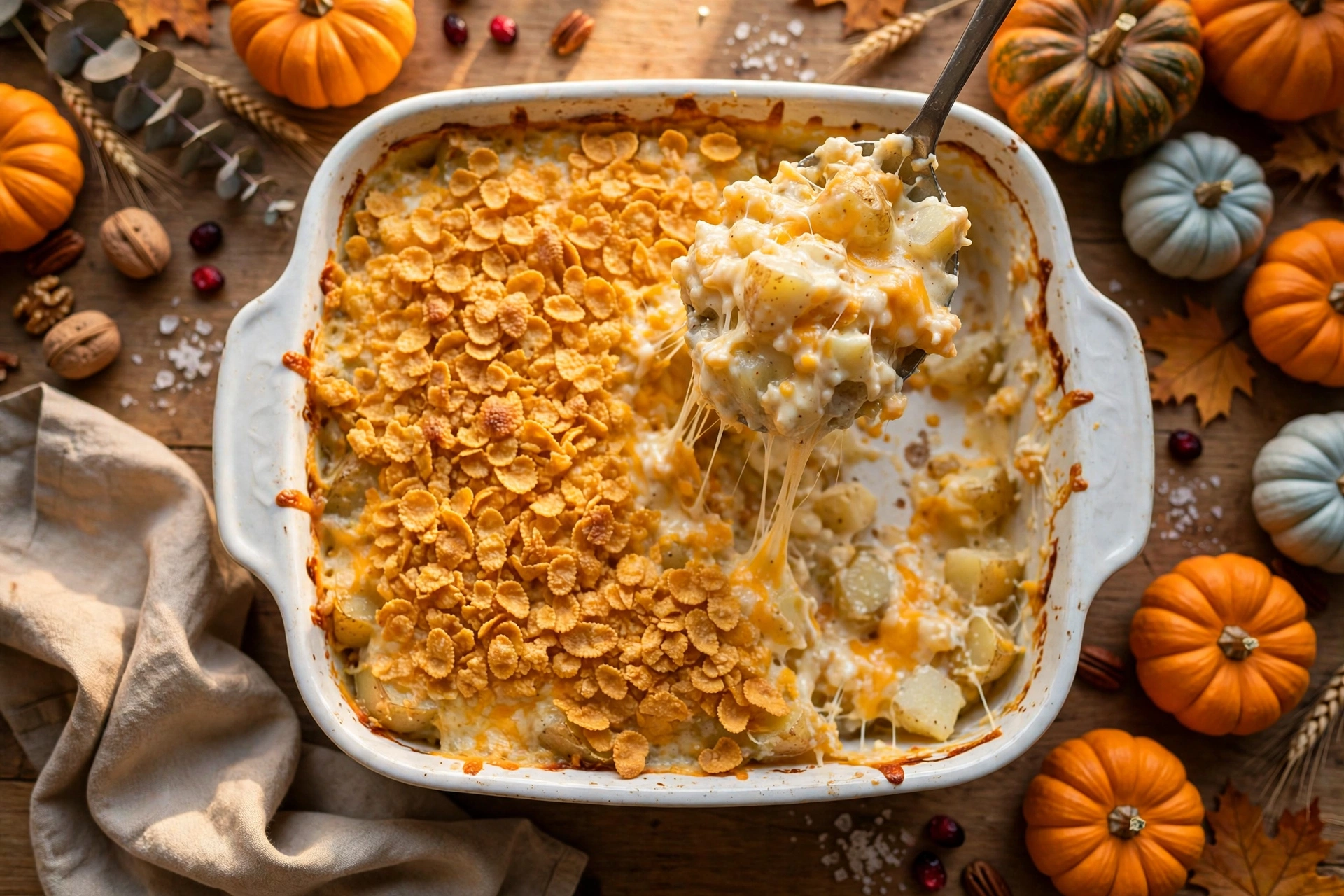
Texture is the whole argument of this dish. The top should crackle audibly when the spoon goes in. Underneath, the potatoes sit in a sauce that is thick enough to coat a spoon and loose enough to settle into every gap between shreds. A watery bottom layer is the one unforgivable flaw, and this recipe is built to prevent it.
Sharp cheddar is non negotiable for flavor. Mild cheddar melts politely and tastes of almost nothing against the potatoes. Sharp cheddar, freshly shredded, brings the salty, tangy backbone that makes people go back for a second scoop.
The onion is cooked before it goes in, which matters more than it sounds. Raw onion stays crunchy and sharp inside a creamy casserole; onion softened in butter first melts into the sauce and disappears, leaving only sweetness behind.
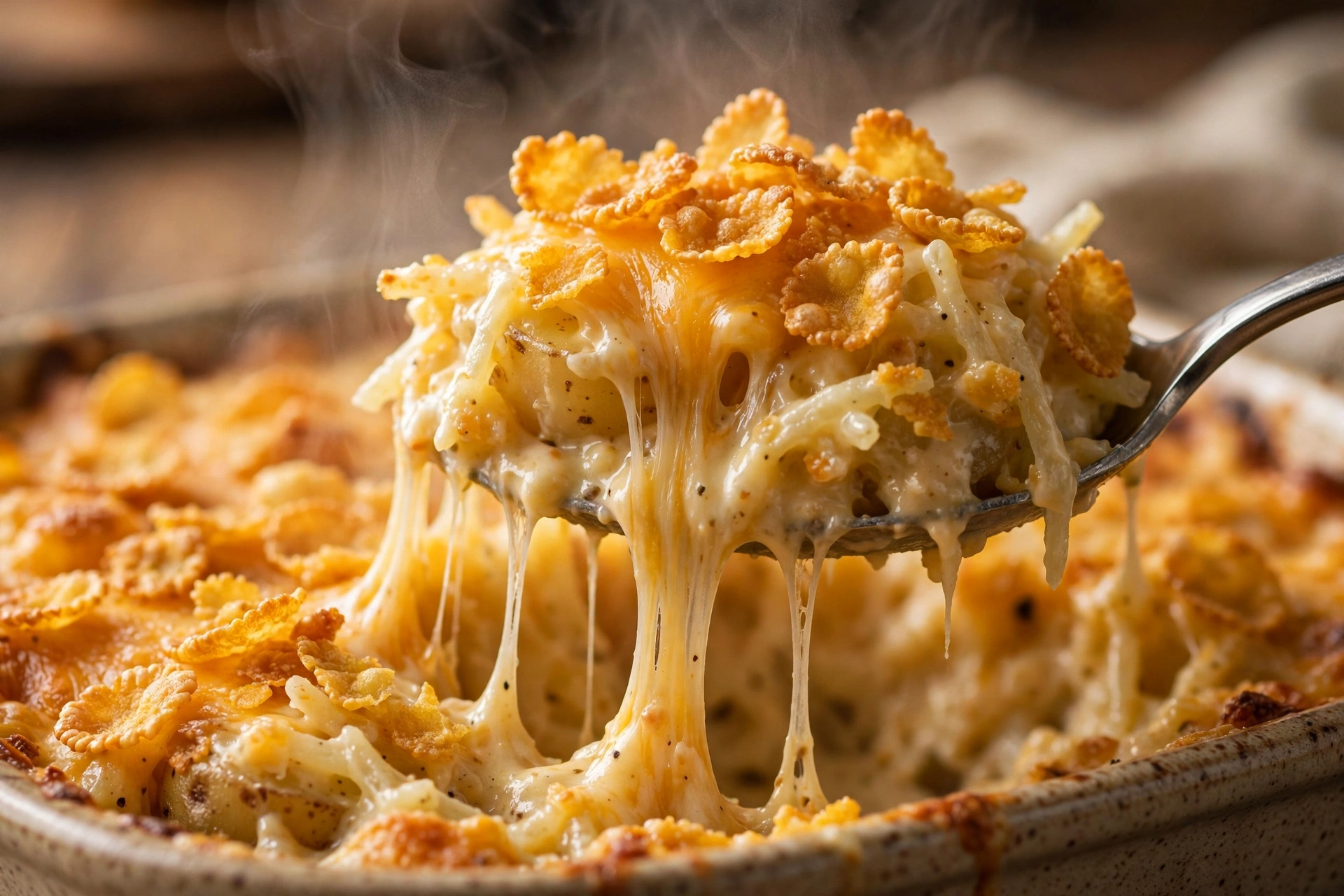
Served hot, the casserole holds a clean scoop for about ten seconds, then relaxes into creamy folds on the plate. That ten second window at the table, steam rising off a golden top, is exactly why this pan has outlived every trend thrown at it.
The From Scratch Cheese Sauce
The sauce is a classic roux, and it takes less time than opening two cans. Butter and softened onion first, then flour cooked for one full minute to lose its raw taste. Milk and chicken broth whisked in slowly, simmered until the sauce coats a spoon, then the pan comes off the heat before the cheese goes anywhere near it.
That last detail decides whether your sauce is silky or grainy. Cheese melted over direct heat, especially pre shredded cheese coated in anti caking starch, breaks into oily grit. Off the heat, with the sauce hot but not boiling, freshly shredded cheddar melts into a glossy blanket. The sour cream folds in last, off the heat as well, so it stays tangy instead of splitting.
The seasoning is simple because the cheddar does heavy lifting: fine salt, black pepper, onion powder for depth, and a pinch of paprika mostly for color in the sauce. Taste the sauce before the potatoes go in. It should be slightly saltier than you think, because two pounds of potato are about to dilute it.
For the numbers behind the ingredients, USDA FoodData Central lists sharp cheddar near 400 calories per 100 g, which is why this casserole satisfies in modest scoops and why a lighter version, given further down, works with part skim cheese and Greek yogurt.
Ingredients for Funeral Potatoes
- 30 oz (850 g) frozen shredded hashbrowns, thawed
- 4 tablespoons (56 g) unsalted butter, plus 3 tablespoons more, melted, for the topping
- 1 small yellow onion, finely diced, about 1 cup
- 2 garlic cloves, minced
- 1/4 cup (30 g) all-purpose flour
- 1 1/2 cups (360 ml) whole milk
- 1 cup (240 ml) low sodium chicken broth
- 1 cup (240 g) sour cream, at room temperature
- 3 cups (340 g) sharp cheddar, freshly shredded, divided
- 1 teaspoon fine salt
- 1/2 teaspoon black pepper
- 1/2 teaspoon onion powder
- 1 pinch sweet paprika
- 2 cups cornflakes, lightly crushed
Shredded hashbrowns are the classic cut for a reason: they drink up the sauce and bake into distinct, tender strands. Diced hashbrowns work in a pinch, with changes covered in the swaps section below.
Building Funeral Potatoes Layer by Layer
- Thaw the hashbrowns completely, at least 1 hour at room temperature or overnight in the refrigerator. Gather them in a clean kitchen towel and squeeze hard over the sink, twice, until almost no liquid drips out.
- Heat the oven to 350°F (175°C). Butter a 9×13 inch baking dish.
- Melt the 4 tablespoons of butter in a large saucepan over medium heat. Cook the onion for 4 to 5 minutes, until soft and sweet. Add the garlic for 30 seconds.
- Sprinkle in the flour and stir for 1 full minute. Pour in the milk and broth in a slow stream, whisking constantly, and simmer 3 to 4 minutes, until the sauce thickly coats a spoon.
- Take the pan off the heat. Stir in 2 cups of the shredded cheddar until melted and glossy. Fold in the sour cream, salt, pepper, onion powder, and paprika. Taste and adjust the salt.
- Fold the squeezed dry hashbrowns into the sauce until every shred is coated. Spread the mixture evenly in the prepared dish.
- Scatter the remaining 1 cup of cheddar over the top. Toss the crushed cornflakes with the 3 tablespoons of melted butter and cover the casserole evenly.
- Bake, uncovered, for 40 to 45 minutes, until the top is deep golden and the sauce bubbles thickly at the edges.
- Rest for 10 full minutes before scooping. The sauce sets as it stands, and the first scoop will hold its shape.
Drying the Hashbrowns Is Not Optional
A thawed bag of hashbrowns gives up close to a cup of water, and every spoonful of it ends up in your sauce if you let it. That is the entire mystery of the soupy casseroles that disappoint at potlucks. The sauce was fine. The potatoes were wet.
Squeezing in a towel feels excessive until you see the puddle in the sink. Work in two batches, twist hard, and shake the shreds loose between squeezes. The potatoes should feel dry and fluffy, almost like grated fresh potato. Dry shreds also crisp at the edges of the pan, giving you those coveted lacy corners.
Salt timing helps too. Never salt thawed hashbrowns while they wait; salt pulls more water out of them and into the mix. In this recipe all the salt lives in the sauce, which is whisked at the last moment, so the potatoes stay dry until the sauce claims them.
If you shred your own potatoes instead, the rule doubles: rinse, spin or squeeze, and use them immediately, because fresh shreds brown in the air. Frozen hashbrowns, thawed and squeezed, remain the reliable choice for funeral potatoes, and the freezer aisle is not a shortcut to be ashamed of here.
Cornflakes or Crackers on Top?
The topping debate is real, and the honest answer depends on the day. Cornflakes give the classic look, big golden shards that stay distinct and shatter loudly. Crushed buttery crackers give a finer, sandier crunch that blends into the first bite. Both want melted butter, about 3 tablespoons, tossed through before they go on.
Cornflakes win for Thanksgiving dinner service, because they re-crisp best when the casserole is held warm or reheated. Crackers win for eating the same hour it bakes, when their delicate crunch is at its peak. Either way, the topping goes on at baking time, never the night before, or the butter soak turns it leathery.
One more option deserves mention: a top of pure cheddar with no crunch at all, the way some families insist on it. It is good, but it is a different dish, softer and richer. The crunch is what makes a scoop of funeral potatoes feel complete, the contrast your fork keeps hunting for.
The Make Ahead Timeline for Thanksgiving Day
The day before: make the sauce, fold in the squeezed hashbrowns, and spread everything in the buttered dish. Cover tightly and refrigerate for up to 24 hours. Keep the cornflakes and their butter in a separate bag on the counter; the topping is a day of decision, not a day before one.
Thanksgiving day: pull the dish out of the refrigerator 30 minutes before baking so the center is not ice cold. Add the final cheddar and the buttered cornflakes, then bake 45 to 50 minutes, a few minutes longer than usual because the casserole started cold. The edges should bubble thickly before you call it done.
This timeline frees the oven and the cook at the exact hour both are scarcest, which is the real reason make ahead sides rule the holiday. Our sweet potato casserole with pecan streusel follows the same assemble ahead logic, and the two pans side by side cover the creamy and the sweet ends of the table.
Swaps Worth Knowing
Diced hashbrowns swap in cup for cup, giving a chunkier, more distinct bite; add 5 minutes to the bake and squeeze them just as dry. Freshly shredded russets work too, about 2 lb, rinsed and squeezed hard, though they darken fast once exposed to air.
Pepper jack in place of half the cheddar gives a gentle heat that suits the casserole surprisingly well. Colby jack melts milder and is the safer choice for small children. For a lighter pan, use reduced fat cheddar, swap half the sour cream for plain Greek yogurt, and cut the topping butter to 2 tablespoons: the texture stays creamy and each serving drops by roughly 90 calories, landing near 290, with about 17 g of fat, 24 g of carbohydrates, and 12 g of protein.
The standard batch, for the record, comes to about 380 calories per serving, with 25 g of fat, 24 g of carbohydrates, and 11 g of protein. It is a celebration side, portioned accordingly, and it earns its place next to leaner pans like our broccoli cheese casserole and the creamy scalloped potatoes when the table wants choices.
Leftovers, Reheating and Freezing
Leftovers keep for 4 days in the refrigerator, covered. Federal food safety guidance from the USDA FSIS puts cooked casseroles in that same 3 to 4 day window, and the quality here holds up remarkably well inside it.
Reheat in a 350°F oven, covered for 15 minutes and uncovered for 10, and the top re-crisps while the center goes creamy again. The microwave is faster but sacrifices the crunch entirely; if you must, finish the portion under the broiler for one minute. A handful of fresh buttered cornflakes scattered over leftovers before reheating makes them taste newly baked.
Freezing works before or after baking. Assemble without the topping, wrap the dish tightly, and freeze for up to 2 months; thaw overnight in the refrigerator, add the topping, and bake as directed. Baked leftovers freeze in portions and reheat from thawed in the oven, never quite as crisp, always welcome.
Conclusion
Funeral potatoes deserve better than a can of soup, and with a ten minute sauce, properly dried hashbrowns, and a topping that goes on at the right moment, they get it. The pan that returns from the Thanksgiving table is always the empty one. Make it the day before, bake it while the turkey rests, and take the compliments as they come.
FAQ
Can I make funeral potatoes without canned soup?
Yes, and this recipe does exactly that. A quick roux of butter and flour, whisked with milk and chicken broth, then finished with shredded cheddar off the heat, replaces the soup completely. The flavor is cleaner, the salt is under your control, and the sauce stays silky instead of gelatinous.
Why did my funeral potatoes turn out watery?
The hashbrowns were wet. Thawed shredded potatoes release close to a cup of liquid, and it all ends up in the sauce. Squeeze them hard in a clean towel, twice, until no more drips fall. Dry shreds, plus a 10 minute rest after baking, give a casserole that scoops cleanly.
Can I assemble funeral potatoes the night before Thanksgiving?
Yes. Build the casserole completely, cover, and refrigerate up to 24 hours, but keep the buttered cornflake topping separate and add it just before baking. Let the dish stand 30 minutes at room temperature, then bake 45 to 50 minutes, until the edges bubble thickly.
Can I use diced hashbrowns instead of shredded?
Yes, cup for cup. Diced hashbrowns give a chunkier texture and need about 5 extra minutes in the oven. Squeeze them dry exactly the same way, and check the center for tenderness before serving, since the larger pieces heat more slowly.
Can funeral potatoes be made in a slow cooker?
They can. Cook the assembled casserole, without the topping, on Low for 4 to 5 hours, until the potatoes are tender and the edges bubble. The topping will not crisp in a slow cooker, so toast the buttered cornflakes in a skillet and scatter them over each serving instead.
Funeral Potatoes
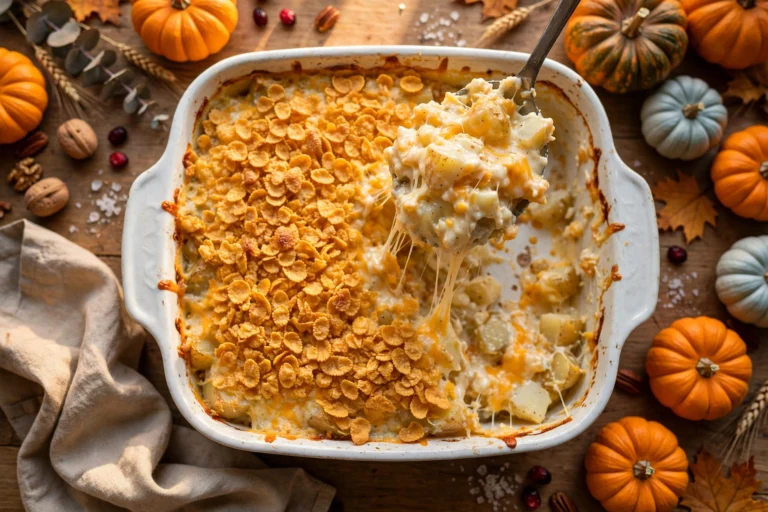
Funeral potatoes with a from scratch cheese sauce instead of canned soup: thawed hashbrowns squeezed dry, sharp cheddar melted in off the heat, sour cream for tang, and a buttered cornflake top that shatters. Assembles the day before for Thanksgiving.
- Total Time: 1 hour 5 minutes
- Yield: 10 servings 1x
Ingredients
- 30 oz (850 g) frozen shredded hashbrowns, thawed
- 4 tablespoons (56 g) unsalted butter, plus 3 tablespoons more, melted, for the topping
- 1 small yellow onion, finely diced, about 1 cup
- 2 garlic cloves, minced
- 1/4 cup (30 g) all-purpose flour
- 1 1/2 cups (360 ml) whole milk
- 1 cup (240 ml) low sodium chicken broth
- 1 cup (240 g) sour cream, at room temperature
- 3 cups (340 g) sharp cheddar, freshly shredded, divided
- 1 teaspoon fine salt
- 1/2 teaspoon black pepper
- 1/2 teaspoon onion powder
- 1 pinch sweet paprika
- 2 cups cornflakes, lightly crushed
Instructions
- Thaw the hashbrowns completely. Gather them in a clean kitchen towel and squeeze hard over the sink, twice, until almost no liquid drips out.
- Heat the oven to 350°F (175°C). Butter a 9×13 inch baking dish.
- Melt the 4 tablespoons of butter in a large saucepan over medium heat. Cook the onion 4 to 5 minutes, until soft and sweet. Add the garlic for 30 seconds.
- Sprinkle in the flour and stir for 1 full minute. Whisk in the milk and broth in a slow stream and simmer 3 to 4 minutes, until the sauce thickly coats a spoon.
- Take the pan off the heat. Stir in 2 cups of the cheddar until melted and glossy. Fold in the sour cream, salt, pepper, onion powder, and paprika.
- Fold the squeezed dry hashbrowns into the sauce until every shred is coated. Spread evenly in the prepared dish.
- Scatter the remaining 1 cup of cheddar over the top. Toss the crushed cornflakes with the 3 tablespoons of melted butter and cover the casserole evenly.
- Bake, uncovered, for 40 to 45 minutes, until the top is deep golden and the sauce bubbles thickly at the edges.
- Rest 10 full minutes before scooping so the sauce sets and the first scoop holds its shape.
- Prep Time: 20 minutes
- Cook Time: 45 minutes