In this article:
- The Ambrosia Salad Grandmothers Actually Made
- Real Whipped Cream, No Shortcuts in the Bowl
- Thirty Minutes of Draining Saves the Whole Salad
- Ingredients for Ambrosia Salad
- Folding the Salad Together, Gently
- Cherries Go In Last, and Here Is Why
- A Make Ahead Timeline That Protects the Texture
- Fresh Fruit, Lighter Cream and Other Variations
- Serving Ambrosia Next to the Turkey
- Conclusion
- FAQ
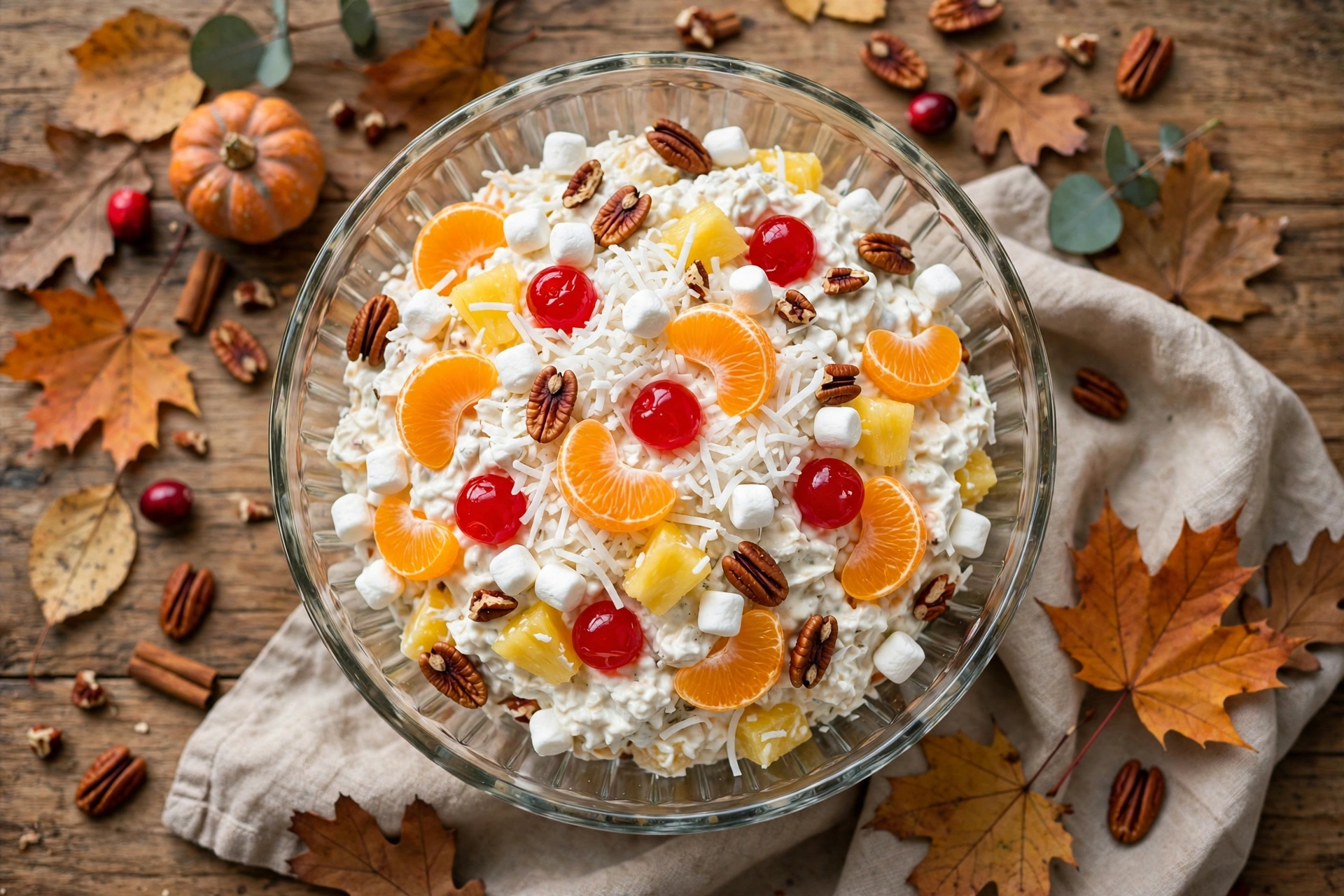
Ambrosia salad is the bowl that glows on the Thanksgiving table: mandarin segments like little suns, pineapple gold underneath, all of it folded into a cloud of cream with coconut snow and marshmallow pillows. It is sweet, cool, and unapologetically retro, the one side dish that behaves like dessert and gets away with it.
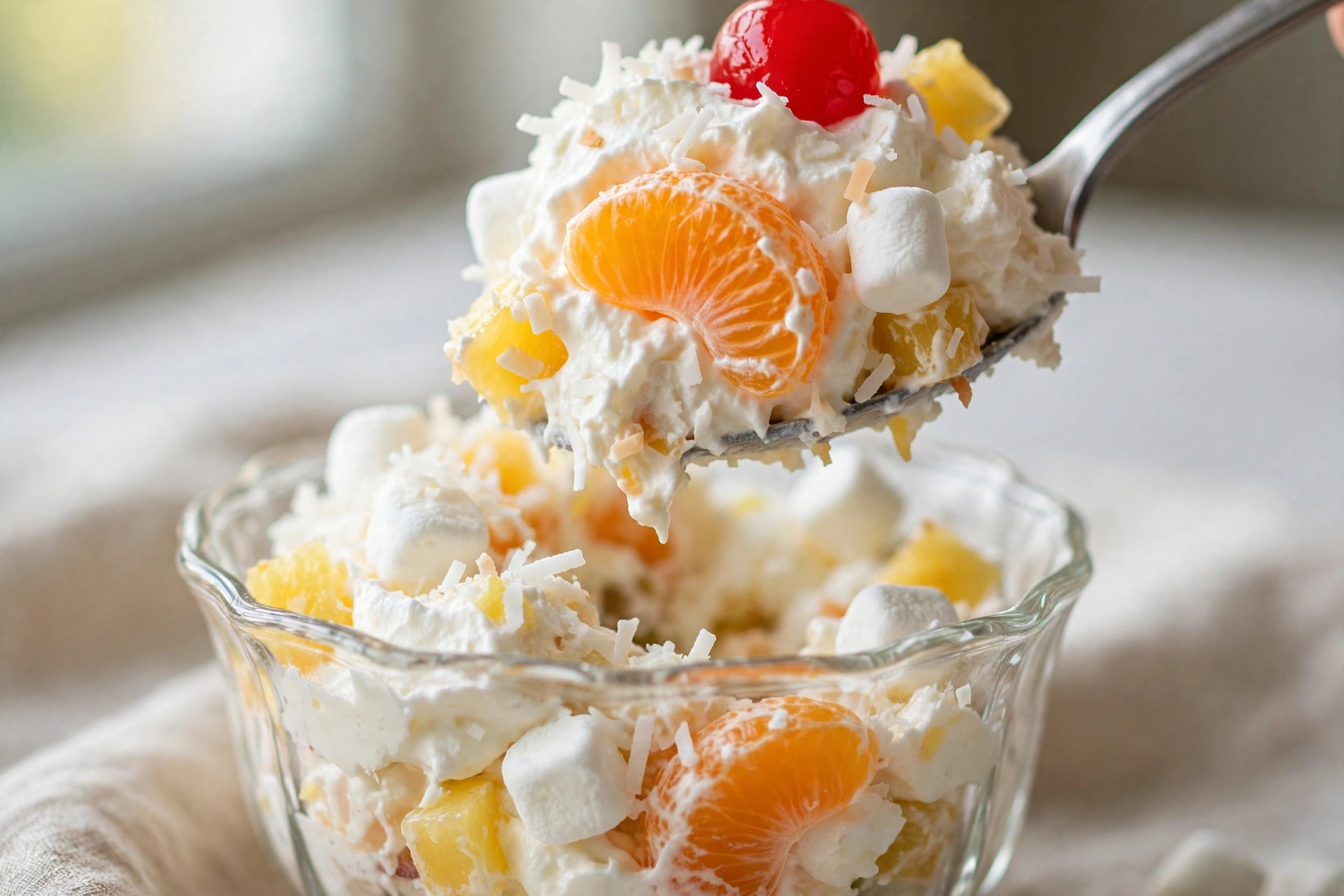
The texture is the whole pleasure. One spoonful carries soft cream, a burst of citrus, the chew of coconut, and the gentle give of marshmallows that have soaked up the dressing overnight. Nothing crunches except the toasted pecans scattered on top at the last second, and that contrast is exactly the point.
This is the from scratch version, the way this ambrosia salad was made before the tub era: real whipped cream folded with sour cream, fruit drained with actual patience, and cherries kept out of the bowl until serving so the cream stays white as snow. Fifteen minutes of folding, a few hours of chilling, and the classic is back.
The Ambrosia Salad Grandmothers Actually Made
Ambrosia salad began in the nineteenth century as little more than oranges, coconut, and sugar, a luxury bowl built on two ingredients that once arrived by ship and cost real money. The marshmallows, pineapple, and cream arrived later, generation by generation, until the salad became the holiday fixture Southern families now defend at the table.
What never changed is the balance: tart fruit against sweet cream, soft against soft, with coconut threading through every bite. When the balance is right, ambrosia tastes bright rather than sugary, which is why it survives next to rich gravy and buttered everything. It is the cold, sweet pause in a heavy meal.
The recipe also forgives. It scales for a crowd, waits in the refrigerator without complaint, and asks for no oven space on the one day the oven has none to spare. Among all our side dishes, it may be the only one that is fully finished the day before the holiday and better for it.
In many church cookbooks the same bowl travels under another name: five cup salad, for the easy era when the recipe was a cup each of pineapple, mandarins, coconut, marshmallows, and sour cream. Our version keeps that spirit of simplicity but returns to whipped cream for the body, because a salad built on five cups deserves a dressing with some ceremony to it.
Real Whipped Cream, No Shortcuts in the Bowl
The dressing is two ingredients deep: heavy cream whipped to firm peaks, and sour cream folded through it. The whipped cream brings the cloud; the sour cream brings the tang that keeps the cloud honest, plus a quiet stability that helps the dressing hold its body for hours on a buffet.
Whip the cream cold, in a cold bowl if your kitchen is warm, and stop at firm peaks that stand up and just begin to lean. Under whipped cream slumps by supper; over whipped cream turns grainy and starts its slow march toward butter. A tablespoon or two of powdered sugar sweetens and slightly stabilizes the foam at the same time.
Fold, never stir. The sour cream goes into the whipped cream in two additions, cut down the middle and folded over with a spatula, and the fruit goes in the same way. Every stir is air leaving the bowl, and air is the ingredient you cannot put back.
One more quiet detail separates a good bowl from a great one: salt. A tiny pinch whisked into the sour cream wakes up the fruit and keeps the sweetness from reading one note. It is invisible in the finished salad, the way a frame is invisible around a picture, and tasters will ask what you did differently without ever guessing.
Thirty Minutes of Draining Saves the Whole Salad
Ask anyone who has made a watery ambrosia salad and the story is the same: canned fruit, straight from the can, juices and all. Pineapple and mandarins sit in liquid that tastes sweet and behaves like a slow leak. Given four hours in the bowl, that liquid thins the cream into soup and leaves the salad swimming.
The fix is unglamorous and absolute. Tip both fruits into a colander set over a bowl and walk away for 30 minutes. Then spread the fruit on a clean towel or paper towels and pat the tops dry. The mandarins especially need gentle hands; they break if you press, and broken segments bleed juice and color.
Save the drained juices for another use, a glaze, a punch, tomorrow’s smoothie. Just keep them out of this bowl. Fruit that goes in dry stays suspended in the cream, and the salad you serve at six o’clock looks like the salad you folded at noon.
The same ritual applies to the cherries, which get their own shorter drain while you work. Ten minutes in a small strainer and a gentle pat with a paper towel are enough; they carry less liquid than the pineapple, but what they carry is crimson, and every drop you remove is a drop that will not marble the cream.
Ingredients for Ambrosia Salad
- 1 (20 oz) can pineapple chunks, drained for 30 minutes and patted dry
- 2 (11 oz) cans mandarin oranges, drained for 30 minutes and patted dry
- 1 cup (240 ml) heavy cream, very cold
- 2 tablespoons powdered sugar
- 1 teaspoon pure vanilla extract
- 3/4 cup (180 g) sour cream
- 1 1/2 cups (75 g) mini marshmallows
- 1 cup (85 g) sweetened shredded coconut
- 1/2 cup (70 g) maraschino cherries, halved, drained and patted dry
- 1/2 cup (55 g) pecans, toasted and roughly chopped
Folding the Salad Together, Gently
Everything about this ambrosia salad rewards a light hand, from the draining towel to the final fold. Work in a big bowl, bigger than you think you need, so the spatula can move in wide arcs instead of tight, deflating jabs.
- Set the pineapple and mandarin oranges in a colander over a bowl for 30 minutes. Lift the fruit onto a clean towel and pat the tops dry, handling the mandarins gently.
- In a large chilled bowl, whip the cold heavy cream with the powdered sugar and vanilla until firm peaks form, about 2 to 3 minutes with an electric mixer.
- Whisk the sour cream in a small bowl until smooth, then fold it into the whipped cream in two additions, keeping as much air as possible.
- Add the drained pineapple, mandarin oranges, mini marshmallows, and shredded coconut to the cream.
- Fold everything together with a wide spatula, cutting down the center and turning the bowl, until the fruit is evenly coated and no dry pockets of coconut remain.
- Cover and refrigerate at least 4 hours or overnight, so the marshmallows soften into the cream and the flavors marry.
- Just before serving, fold in the halved cherries and scatter the toasted pecans over the top. Serve very cold.
Cherries Go In Last, and Here Is Why
Maraschino cherries are beautiful and they are dye delivery systems. Folded in at noon, they tint the whole bowl a cheerful pink by dinner, which some families love and others consider a scandal. Kept out until serving, they stay garnets on snow, and the cream stays white.
There is a texture reason too. Cherries weep a little liquid as they sit, and that liquid is the reddest in the bowl. Added last, well drained and patted dry, they give up almost nothing before the salad is served. Halved cherries fold in more evenly than whole ones and are kinder to eat.
If your family belongs to the pink ambrosia salad tradition, fold the cherries in with everything else and embrace the blush. The salad does not judge. Just decide on purpose rather than by accident at serving time.
There is a middle road for households divided on the question: fold in half the cherries and crown the bowl with the rest. The cream blushes faintly, the top still looks deliberate, and both camps at the table can claim the recipe was made their way. Diplomacy, served cold, in a glass bowl.
A Make Ahead Timeline That Protects the Texture
Ambrosia is a planner’s friend, with one clock to respect: the marshmallows. Folded in the night before, they drink the dressing, soften, and turn the salad silky, which is exactly what you want. Past about 36 hours, they begin to dissolve entirely and the salad loosens, so build the bowl the day before the holiday at the earliest.
The ideal timeline runs like this. Drain the fruit and fold the salad on Wednesday for a Thursday table, holding back the cherries and pecans. On Thursday, fold in the cherries, crown the bowl with pecans, and carry it to the table still cold from the refrigerator.
Leftovers keep 3 days, covered and refrigerated, and the USDA’s guidance on leftovers and food safety sets the same outer window for refrigerated prepared dishes. Do not freeze ambrosia: the cream splits, the fruit goes watery, and the marshmallows never recover.
Fresh Fruit, Lighter Cream and Other Variations
The fresh fruit version swaps the cans for 2 cups of fresh pineapple chunks and 4 clementines, peeled and segmented. It tastes brighter and a little less nostalgic, and the draining step shortens to a quick pat dry. Add a cup of halved green grapes and the salad leans toward the old five cup formula that many families still swear by.
For a lighter bowl, replace half the sour cream with plain Greek yogurt, keeping the whipped cream untouched; the dressing stays fluffy with a cleaner tang. Coconut can be toasted for a deeper flavor, or left raw and snowy, as here. Our southern cornbread dressing and a pan of corn pudding cover the warm, savory side of the same table, which lets the ambrosia stay proudly sweet.
The coconut deserves its own small decision. Raw shredded coconut disappears into the cream and perfumes every bite; coconut toasted in a dry skillet until the edges turn gold stays distinct, almost nutty, and echoes the pecans on top. Neither is wrong, but choose deliberately: raw for the classic snowy bowl, toasted when the rest of the table runs deep and roasted.
For a potluck or a crowd, the recipe doubles cleanly in a very large bowl, and it portions gracefully into small glass cups for a buffet where guests carry plates. Individual cups also solve the buffet temperature question, since each serving waits in the refrigerator until the moment it is picked up.
Per serving (one eighth of the bowl), this ambrosia brings roughly 320 calories, 21 g fat, 34 g carbohydrates, and 3 g protein, most of the sweetness arriving from the fruit itself. It is a holiday portion, measured in spoonfuls next to the turkey rather than in bowls on its own.
Serving Ambrosia Next to the Turkey
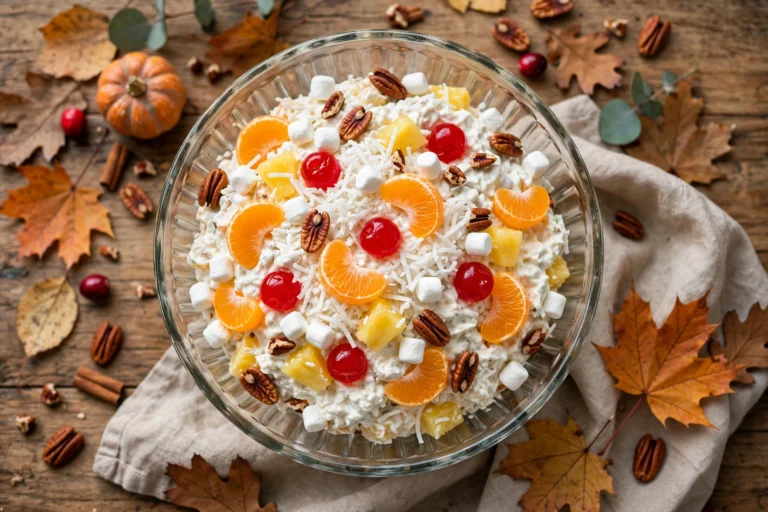
Serve ambrosia salad in glass if you possibly can. The colors are the decoration: orange, gold, white, and red, layered and marbled in a way that a ceramic bowl hides. A footed trifle bowl or a plain glass mixing bowl both show the salad the way it deserves.
On the plate, ambrosia belongs beside the savory anchors, a cold sweet spoonful next to hot slices of turkey and a scoop of funeral potatoes. The contrast is the tradition: rich and salty on one side, bright and chilly on the other, and somehow the fork keeps crossing the border.
Set the bowl out last and take it up first. Cream based salads should not linger at room temperature beyond 2 hours, so nest the serving bowl in a larger bowl of ice if your table runs long, and return leftovers to the refrigerator promptly.
A final flourish costs nothing: reserve a few perfect mandarin segments, three cherries, and a pinch of coconut before you fold, and arrange them on top after the pecans. The bowl goes to the table looking composed instead of stirred, and the first spoonful still finds everything the recipe promised.
Conclusion
Ambrosia salad earns its comeback one drained can and one gentle fold at a time: real whipped cream, fruit treated with patience, cherries saved for the finale. Make it the day before, keep it cold, and watch the oldest recipe on the table disappear first. Some classics survive because they are simple; this one survives because it is joyful.
FAQ
Why did my ambrosia salad turn watery?
The fruit went in with its canning liquid still on it. Drain pineapple and mandarins for a full 30 minutes and pat them dry before folding, and the cream stays thick for days. Folding the salad too far ahead, beyond about 36 hours, also loosens it as the marshmallows dissolve.
Can I use Greek yogurt instead of sour cream in ambrosia?
Yes, plain Greek yogurt is the closest substitute and keeps the same gentle tang. Use it for half or all of the sour cream, but keep the real whipped cream as the base, since the yogurt alone makes a thinner, sharper dressing.
How far ahead can I make ambrosia salad?
The sweet spot is 4 to 24 hours before serving: long enough for the marshmallows to soften into the cream, short enough that nothing breaks down. Hold the cherries and toasted pecans out and add them at serving time for the best color and crunch.
Should the marshmallows be plain or fruit flavored?
Plain mini marshmallows keep the classic look and let the fruit flavors lead. The pastel fruit flavored ones are a beloved retro variation and slightly sweeter; both soften the same way in the cream. Avoid the large marshmallows, which stay chewy and slice awkwardly.
Can ambrosia salad be frozen for later?
No, freezing ruins it. The whipped cream splits, the fruit releases water as it thaws, and the marshmallows turn spongy. Ambrosia keeps 3 days in the refrigerator, which is the right window for enjoying the leftovers.
Ambrosia Salad
The classic ambrosia salad made from scratch: real whipped cream folded with sour cream, pineapple and mandarins drained a full 30 minutes so the bowl never turns watery, and cherries and toasted pecans added at the last moment. Cool, fluffy, and made for the Thanksgiving table.
- Total Time: 4 hours 50 minutes
- Yield: 8 servings 1x
Ingredients
- 1 (20 oz) can pineapple chunks, drained 30 minutes and patted dry
- 2 (11 oz) cans mandarin oranges, drained 30 minutes and patted dry
- 1 cup (240 ml) heavy cream, very cold
- 2 tablespoons powdered sugar
- 1 teaspoon pure vanilla extract
- 3/4 cup (180 g) sour cream
- Pinch of fine salt
- 1 1/2 cups (75 g) mini marshmallows
- 1 cup (85 g) sweetened shredded coconut
- 1/2 cup (70 g) maraschino cherries, halved, drained and patted dry
- 1/2 cup (55 g) pecans, toasted and roughly chopped
Instructions
- Set the pineapple and mandarin oranges in a colander over a bowl for 30 minutes. Lift the fruit onto a clean towel and pat the tops dry, handling the mandarins gently.
- In a large chilled bowl, whip the cold heavy cream with the powdered sugar and vanilla until firm peaks form, about 2 to 3 minutes with an electric mixer.
- Whisk the sour cream with the pinch of salt until smooth, then fold it into the whipped cream in two additions, keeping as much air as possible.
- Add the drained pineapple, mandarin oranges, mini marshmallows, and shredded coconut to the cream.
- Fold everything together with a wide spatula, cutting down the center and turning the bowl, until the fruit is evenly coated and no dry pockets of coconut remain.
- Cover and refrigerate at least 4 hours or overnight, so the marshmallows soften into the cream and the flavors marry.
- Just before serving, fold in the halved cherries and scatter the toasted pecans over the top. Serve very cold.
- Prep Time: 20 minutes
- Cook Time: No cooking