

In this article:
- Why this gravy never turns out lumpy
- Start with the giblet stock, simmered while the turkey roasts
- Ingredients
- Making the gravy, step by step
- The gravy doctor: fixing lumps, thin sauce and pale color
- Make the base on Wednesday, finish it on Thursday
- How much gravy per person, and the scaling rule
- Questions I get about this turkey gravy
This turkey gravy is the last thing I make on Thanksgiving and the first thing everyone asks about: deep golden, glossy enough to coat a spoon, and rich with the actual flavor of the bird it is poured over. No packet, no jar, and no lumps hiding at the bottom of the boat.
The texture is what people remember. It should move like warm cream and settle over mashed potatoes in a slow sheet. Thin gravy is a disappointment nobody mentions out loud.
I have made this version for years, with turkeys from twelve pounds to twenty. The method never changes, because the method is the whole recipe: a real stock, a measured roux, and liquid added with patience.
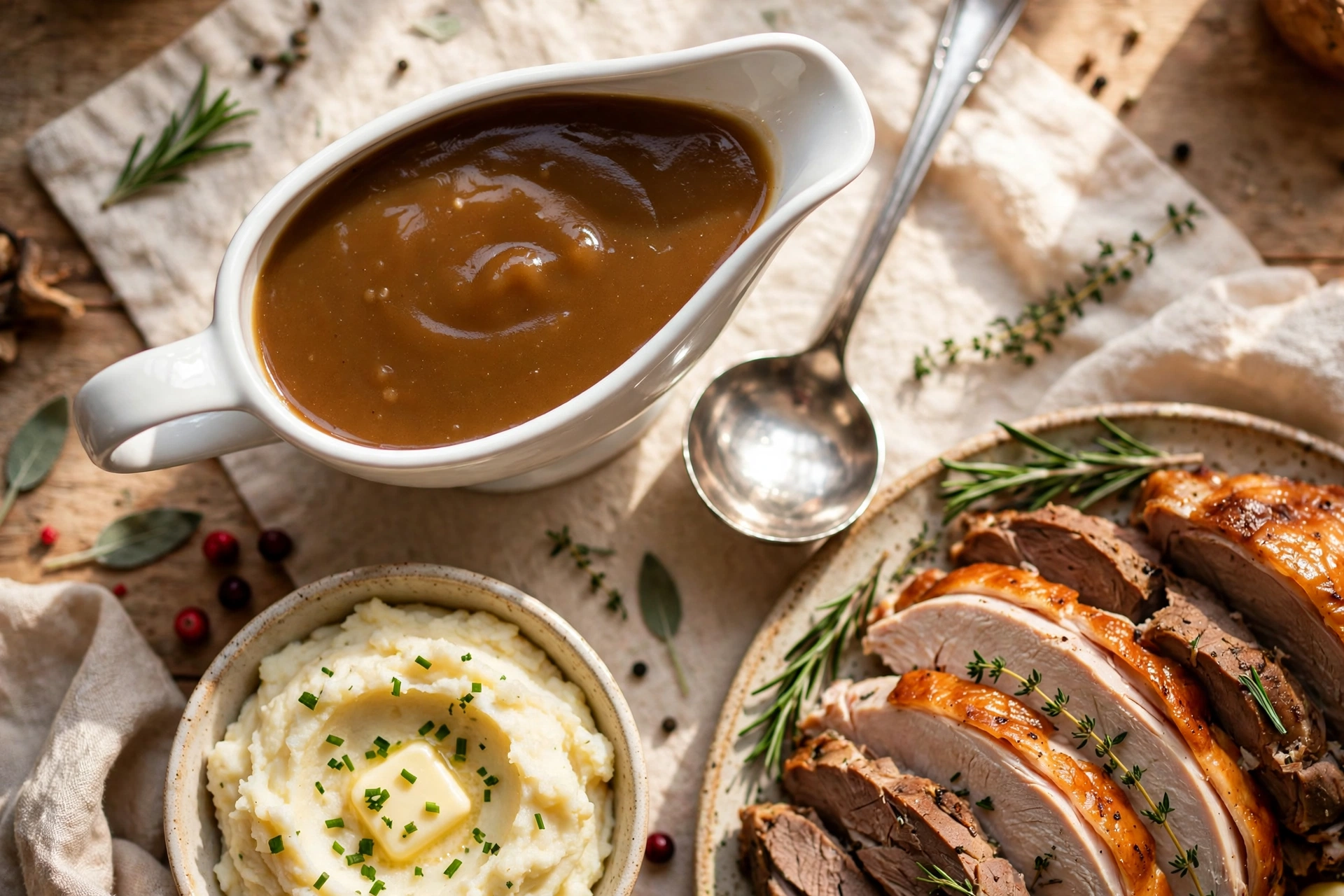
Why This Turkey Gravy Never Turns Out Lumpy
This turkey gravy stays smooth because the flour is never given the chance to clump. Lumps are not bad luck; they are dry flour meeting hot liquid faster than the whisk can separate the grains, and the fix is built into the order of operations.
The flour cooks first, alone with the fat, for two full minutes. Every grain gets coated, the raw taste cooks off, and the roux turns the color of pale honey. Coated flour disperses in liquid instead of balling up.
The liquid goes in the right way: a ladle at a time at the start, whisking in small circles at the corners of the pan where lumps like to hide. Once the pan holds a smooth, thick paste, the rest of the stock can follow in a steady stream.
Temperature does the quiet work. Cold stock into a screaming hot roux shocks the starch; warm stock into a gently bubbling roux thickens evenly. I keep the stock at a bare simmer on the back burner for exactly this reason.
Start With the Giblet Stock, Simmered While the Turkey Roasts
Most recipes reach for a carton of stock, and their gravy tastes like it. The neck and giblets tucked inside your turkey are a free pot of concentrated poultry flavor, and the oven hours give you the time to use them.
While the turkey roasts, the neck, gizzard and heart simmer with onion, celery, carrot, thyme and bay in six cups of water. Ninety minutes later you have a stock that tastes like the bird itself, precisely the flavor the drippings will amplify.
I skip the liver in the stock pot: it turns stock bitter and cloudy. If your family loves giblet gravy, chop the simmered gizzard and heart finely and stir them in at the end instead.
Strain the stock and keep it warm. When the turkey comes out to rest, its drippings get poured off, left to settle, and skimmed. The dark juices under the fat are liquid gold; the fat itself becomes the base of the roux, measured, not guessed. The same method scales down beside a maple glazed roast turkey breast: halve the quantities and simmer the neck alone.
One honest note on salt: drippings from a brined turkey can be intensely salty, so this turkey gravy builds with low sodium stock and seasons at the very end. Salt can always go in. It cannot come back out.
Ingredients
- Turkey neck and giblets (heart and gizzard; reserve the liver for another use), from 1 turkey
- 6 cups (1.4 L) water, for the stock
- 1 small yellow onion, quartered
- 1 celery stalk, cut in chunks
- 1 small carrot, cut in chunks
- 2 sprigs fresh thyme, plus 1 teaspoon thyme leaves for the gravy
- 1 bay leaf
- 6 black peppercorns
- Pan drippings from the roasted turkey, separated (you need 1/4 cup of the fat plus the dark juices)
- 1/4 cup (60 ml) separated turkey fat (from the drippings), or unsalted butter if you are short
- 1/4 cup (30 g) all-purpose flour
- About 4 cups (960 ml) warm liquid in total: the giblet stock plus the defatted pan juices, topped up with low sodium turkey or chicken stock as needed
- 1/2 teaspoon fine salt, plus more to taste
- 1/2 teaspoon black pepper, plus more to taste
- 1 tablespoon cold unsalted butter, to finish
Making the Gravy, Step by Step
- Start the stock when the turkey goes into the oven. Rinse the neck, heart and gizzard, then place them in a saucepan with the water, onion, celery, carrot, thyme sprigs, bay leaf and peppercorns. Bring to a gentle boil, skim any foam, then reduce to the barest simmer.
- Simmer for about 1 hour 30 minutes while the turkey roasts. Strain through a fine mesh sieve, discard the solids (or chop the gizzard and heart finely to stir in later), and keep the stock warm over the lowest heat.
- When the turkey comes out, transfer it to a platter to rest. Pour every bit of the pan drippings into a heatproof measuring jug or a fat separator and let it sit for 5 to 10 minutes, until the fat rises in a clear layer on top.
- Spoon or pour off 1/4 cup of the clear fat and set it aside for the roux. Pour the dark juices underneath into the warm stock. Measure the combined liquid: you want about 4 cups in total, so top up with extra stock if needed.
- Set a wide, heavy saucepan or the washed roasting pan over medium heat. Add the reserved turkey fat. When it shimmers, sprinkle in the flour and whisk it into a smooth paste.
- Cook the roux, whisking constantly, for about 2 minutes, until it smells faintly nutty and turns the color of pale honey. Do not rush this step; it cooks out the raw flour taste and sets the color of the finished gravy.
- Ladle in about 1/2 cup of the warm stock mixture and whisk vigorously until the paste loosens and looks glossy. Add another ladle and whisk again. Once the base is smooth and thick, pour in the rest of the liquid in a slow, steady stream, whisking the whole time.
- Bring the gravy to a gentle boil, then lower the heat and simmer for 5 to 8 minutes, whisking now and then, until it thickly coats the back of a spoon and leaves a clear trail when you run a finger through it.
- Stir in the thyme leaves, the salt and the pepper. Taste carefully: drippings vary, so adjust the salt a pinch at a time. If you saved chopped gizzard and heart, stir them in now.
- Take the pan off the heat and whisk in the cold butter until it melts and the surface turns glossy. Pour the gravy through a fine mesh sieve into a warmed gravy boat or a small saucepan, and serve hot.
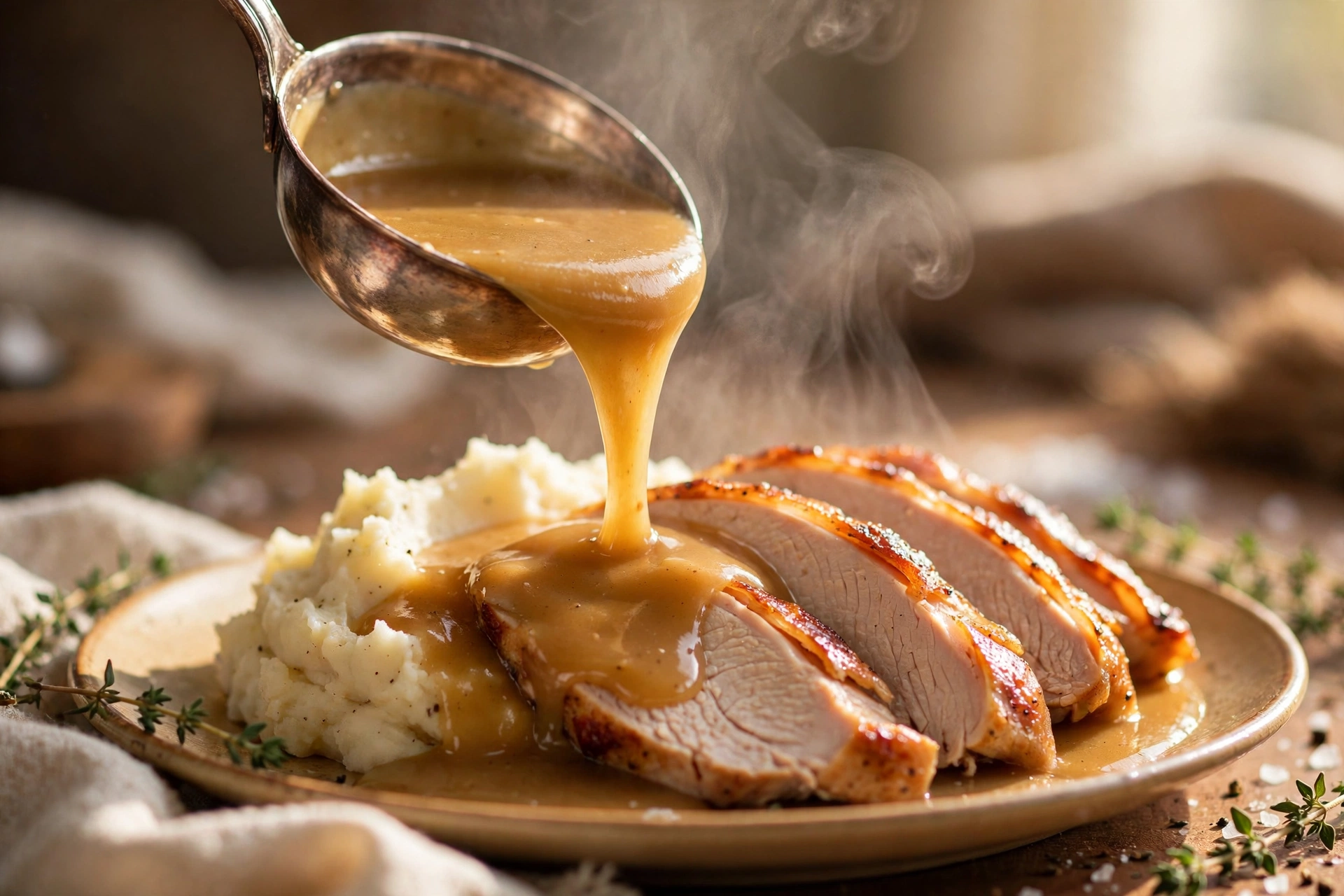
The Gravy Doctor: Fixing Lumps, Thin Sauce and Pale Color
Even a careful cook meets a gravy problem some years, usually with the turkey already carved. Every common failure has a calm fix, and none takes more than five minutes.
Lumps. Whisk hard first; small lumps often melt back in as the gravy simmers. For stubborn ones, pour the gravy through a fine mesh sieve and press the lumps through with the back of a ladle, or give the whole pot ten seconds with an immersion blender.
Too thin. Gravy thickens as it stands and cools, so judge it hot but not boiling. If it still pours like water, simmer it uncovered for 5 more minutes, or whisk 1 teaspoon of cornstarch with 1 tablespoon of cold water and drizzle in half the slurry, simmering a full minute before adding more.
Too thick. Whisk in warm stock a splash at a time until it relaxes. Gravy should ribbon off the spoon, not land in a mound, and it firms up in the boat, so err on the side of slightly loose in the pan.
Too salty. This is the drippings talking, especially with a brined bird. Dilute with unsalted stock or water, a quarter cup at a time, and rebuild body with a minute of simmering. A peeled raw potato chunk simmered in the pot for 10 minutes takes the edge off; fish it out before serving. Pale color. Color comes from the roux and the drippings, not from time in the pan. A teaspoon of soy sauce deepens the shade without changing the flavor at this quantity. Next year, let the roux go a shade darker before the liquid goes in.
Greasy surface. The fat was not fully separated, or the gravy sat and broke. Skim the surface with a spoon, or lay a paper towel flat on top for three seconds and lift: it drinks the fat and leaves the gravy behind. Keep the heat gentle at the end, because a hard boil after the butter goes in can split the finish.
Make the Base on Wednesday, Finish It on Thursday
The smartest move in this whole recipe is refusing to make turkey gravy from a standing start while a turkey rests and guests hover. Split the work and the day itself gets calmer.
On Wednesday, brown 1/4 cup of butter with the flour into a roux, whisk in 4 cups of good low sodium stock, and simmer it into a plain gravy base. Refrigerated, it keeps for three days and reheats like a sauce, because it is one.
On Thursday, the base goes back on the heat while the turkey rests. Whisk in the defatted pan juices a ladle at a time, tasting as you go, until the flavor turns unmistakably into your turkey. Ten minutes, and the gravy tastes day made, because the part that matters most was.
If your plans include slow cooker mashed potatoes, the same split applies beautifully: potatoes holding warm in the slow cooker, gravy finished at the last minute, nobody guarding two pots at once.
Leftovers follow the guidance I trust from the USDA FoodData Central era of careful home keeping: refrigerate gravy within two hours, use it within three to four days, and always bring it back to a full boil before serving, whisking in a spoonful of water if it set too firm in the cold.
Freezing works better than people expect. Cool the turkey gravy, freeze it flat in a zip bag, and use it within three months. Thaw overnight in the fridge and reboil gently, whisking well; a splash of stock restores the pour.
How Much Gravy Per Person, and the Scaling Rule
Plan on 1/3 to 1/2 cup of turkey gravy per person at Thanksgiving, and lean toward the higher figure without shame. Gravy goes on the turkey, the potatoes and the classic homemade stuffing, and on tomorrow’s leftovers sandwich too.
This recipe makes about 4 cups, which serves 10 to 12 people at the table with a modest reserve. For a bigger crowd, the recipe scales on one rule you can keep forever: for every cup of liquid, use 1 tablespoon of fat and 1 tablespoon of flour for a gravy that coats and pours.
By that rule, 2 cups of gravy needs 2 tablespoons each of fat and flour, 4 cups needs 1/4 cup of each, and 6 cups needs 6 tablespoons of each. The method does not change at all; only the pan gets bigger, and the roux gets one extra minute of whisking.
Doubling works cleanly in a wide pan. Tripling is where cooks get into trouble, because a deep pot of roux cooks unevenly. If you need more than 6 cups, make two batches side by side; both will stay smooth.
A final proportion worth knowing: a 14 to 16 pound turkey usually gives about 1 1/2 cups of defatted juice and just enough fat for the roux. The giblet stock is the other half of the flavor, and the two together are why this gravy tastes like Thanksgiving itself, just as welcome over Southern cornbread dressing as beside a bowl of homemade cranberry sauce.
The Last Thing Poured, and the First Thing Praised
Turkey gravy is a modest recipe with an outsized reputation, earned in about ten minutes of honest work at the end of a long day. Stock, roux, patience, a sieve: nothing here is difficult, and every step exists for a reason you can taste.
Make the base ahead, finish it with the drippings, and pour it into a warm boat so it stays glossy at the table. Then sit down. You have made the sauce that ties the whole plate together, and it will be smooth, because you built it that way.
Questions I Get About This Turkey Gravy
Can I make turkey gravy without drippings? Yes, and it is still worth making. Use butter for the roux and the best low sodium turkey or chicken stock you can buy, then add a teaspoon of soy sauce at the end to replace the roasted depth. It will not taste exactly like the drippings version, but it will be smooth, golden and genuinely good.
My roux turned darker than pale honey. Did I ruin it? Not at all. A darker roux makes a darker, toastier gravy with slightly less thickening power, so simmer it a minute longer and expect a deeper flavor. The only real failure is a roux that smells scorched; that one cannot be rescued and takes three minutes to restart.
Why does my gravy set like jelly in the fridge? That is the natural gelatin from the turkey stock doing its job, and it is a sign of a well made stock, not a problem. It melts back to a pourable sauce as soon as it reheats. Whisk while it warms and add a spoonful of water if it needs encouragement.
How long can turkey gravy sit out at the table? Two hours is the safe limit for any sauce built on stock and butter. Serve what the table needs, keep the rest at a bare simmer on the stove, and refrigerate leftovers promptly. Always bring reheated gravy back to a boil before it goes over food.
Can I freeze gravy made with flour? Yes, for up to three months with good results. Flour based gravy can look slightly separated when it thaws, but a gentle reboil and a vigorous whisk bring it back together. Freeze it in small portions so you can thaw just enough for a plate of leftovers.
Nutrition per serving (estimated, 16 servings of 1/4 cup): Calories 55, Total Fat 4 g, Saturated Fat 1.5 g, Carbohydrates 3 g, Fiber 0 g, Sugar 0 g, Protein 1 g, Sodium 180 mg.
Prep Time: 20 minutes Cook Time: 1 hour 30 minutes Total Time: 1 hour 50 minutes Yield: 16 servings (about 4 cups)
Print
Turkey Gravy From Drippings
Silky, lump-free turkey gravy built on a homemade giblet stock and a measured roux of separated turkey fat. Includes the make-ahead base plan, the scaling rule for any crowd, and a calm fix for lumps, thin sauce, pale color and oversalting.
- Total Time: 1 hour 50 minutes
- Yield: 16 servings (about 4 cups) 1x
Ingredients
- Turkey neck and giblets (heart and gizzard; reserve the liver for another use), from 1 turkey
- 6 cups (1.4 L) water, for the stock
- 1 small yellow onion, quartered
- 1 celery stalk, cut in chunks
- 1 small carrot, cut in chunks
- 2 sprigs fresh thyme, plus 1 teaspoon thyme leaves for the gravy
- 1 bay leaf
- 6 black peppercorns
- Pan drippings from the roasted turkey, separated (you need 1/4 cup of the fat plus the dark juices)
- 1/4 cup (60 ml) separated turkey fat (from the drippings), or unsalted butter if you are short
- 1/4 cup (30 g) all-purpose flour
- About 4 cups (960 ml) warm liquid in total: the giblet stock plus the defatted pan juices, topped up with low sodium turkey or chicken stock as needed
- 1/2 teaspoon fine salt, plus more to taste
- 1/2 teaspoon black pepper, plus more to taste
- 1 tablespoon cold unsalted butter, to finish
Instructions
- Start the stock when the turkey goes into the oven. Rinse the neck, heart and gizzard, then place them in a saucepan with the water, onion, celery, carrot, thyme sprigs, bay leaf and peppercorns. Bring to a gentle boil, skim any foam, then reduce to the barest simmer.
- Simmer the stock for about 1 hour 30 minutes while the turkey roasts, topping up with a little water if it drops below 4 cups. Strain through a fine mesh sieve into a clean pan, discard the solids (or pick out the gizzard and heart, chop them finely, and save them to stir in later). Keep the stock warm over the lowest heat.
- When the turkey comes out, transfer it to a platter to rest. Pour every bit of the pan drippings into a heatproof measuring jug or a fat separator and let it sit for 5 to 10 minutes, until the fat rises in a clear layer on top.
- Spoon or pour off 1/4 cup of the clear fat and set it aside for the roux. Pour the dark juices underneath into the warm stock. Measure the combined liquid: you want about 4 cups in total, so top up with extra stock or thin with a little water if the drippings were very concentrated.
- Set a wide, heavy saucepan or the washed roasting pan over medium heat. Add the reserved turkey fat. When it shimmers, sprinkle in the flour and whisk it into a smooth paste.
- Cook the roux, whisking constantly, for about 2 minutes, until it smells faintly nutty and turns the color of pale honey. Do not rush this step; it cooks out the raw flour taste and sets the color of the finished gravy.
- Ladle in about 1/2 cup of the warm stock mixture and whisk vigorously until the paste loosens and looks glossy. Add another ladle and whisk again. Once the base is smooth and thick, pour in the rest of the liquid in a slow, steady stream, whisking the whole time.
- Bring the gravy to a gentle boil, then lower the heat and simmer for 5 to 8 minutes, whisking now and then, until it thickly coats the back of a spoon and leaves a clear trail when you run a finger through it.
- Stir in the thyme leaves, the salt and the pepper. Taste carefully: drippings vary, so adjust the salt a pinch at a time. If you saved chopped gizzard and heart, stir them in now.
- Take the pan off the heat and whisk in the cold butter until it melts and the surface turns glossy. Pour the gravy through a fine mesh sieve into a warmed gravy boat or a small saucepan, and serve hot.
- Prep Time: 20 minutes
- Cook Time: 1 hour 30 minutes
1 thought on “Turkey Gravy From Drippings, Silky and Lump-Free Every Time”