Cauliflower Gratin With Gruyère, Sharp Cheddar and a Toasted Panko Top
In this article:
- Why cauliflower gratin turns watery and how this one stays thick
- Choosing and cutting a head of cauliflower
- Ingredients
- Blanching, drying and building the gratin
- The two cheese sauce, Gruyere and sharp cheddar
- When the sauce breaks or the top stays pale
- Serving it beside turkey and dressing
- Assemble Wednesday, bake Thursday: the make ahead plan
- Cauliflower, broccoli and other easy swaps
- Your gratin questions, answered
- The side that steals the Thanksgiving table
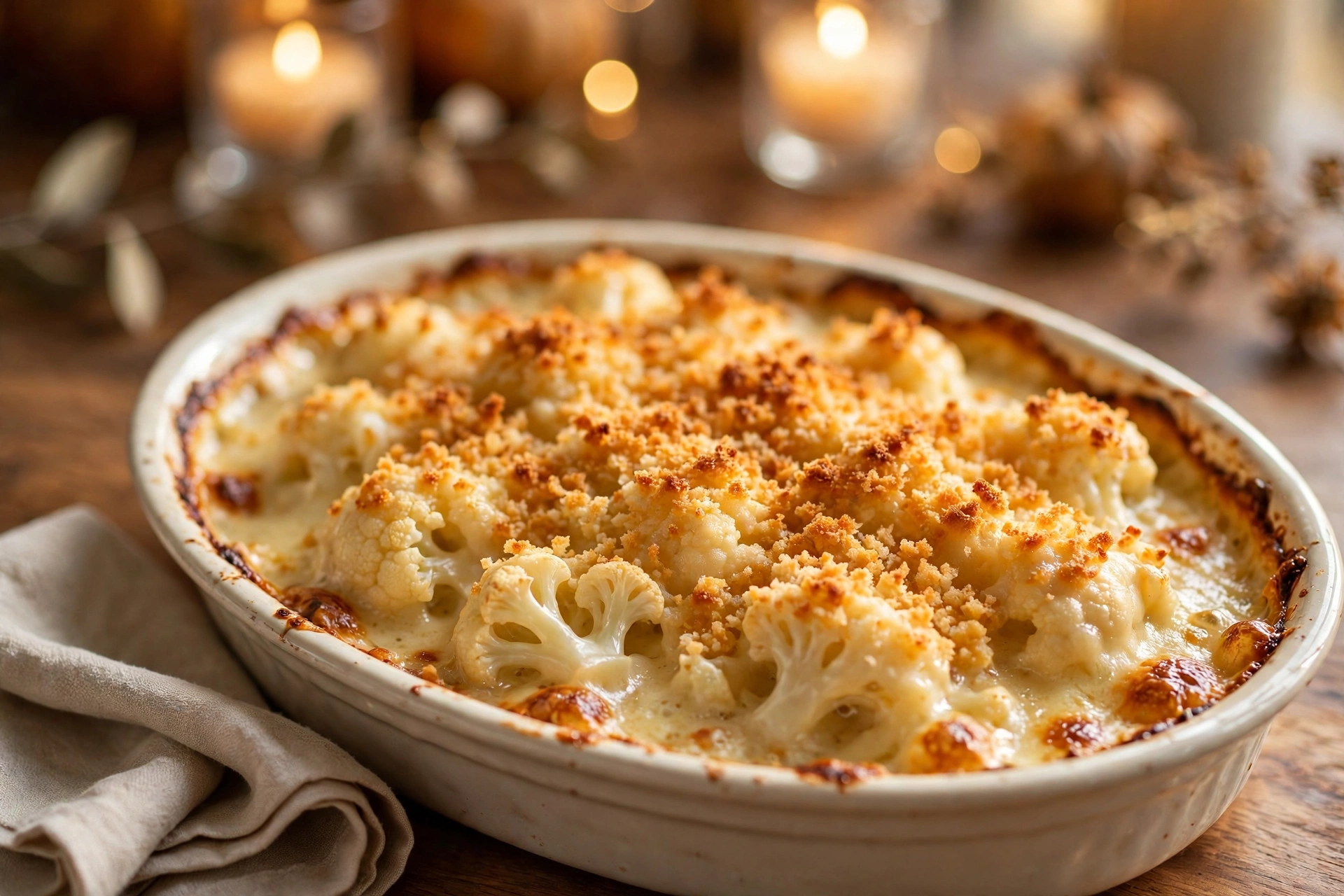
Cauliflower gratin is the quiet overachiever of the Thanksgiving table. It looks like it took all afternoon, it smells like a French bistro, and it gives the table a creamy, golden centerpiece that is not another potato.
The contrast is what hooks people. Tender florets under a sauce that coats rather than drowns, and a top that shatters softly under the spoon before giving way to all that cheese. It is comfort food with its shoulders back.
Most gratins fail on one point, and it is not the cheese. It is the water hiding inside the cauliflower, which leaks out in the oven and turns a proud sauce into a puddle. This recipe is built around that single fix.
Once the drying step is done, everything else is easy. A ten minute sauce, one baking dish, and an oven that does the browning while you deal with the turkey.
Why Cauliflower Gratin Turns Watery and How This One Stays Thick
The gratin starts with a vegetable that is mostly water. Blanch it, drain it in a colander, and it still holds enough moisture in its nooks to thin a sauce by half in a hot oven.
The fix is a drying step that costs five minutes and changes everything. After blanching, the florets go back into the hot empty pot for a minute, then spread on a towel lined pan while the sauce comes together. Steam leaves, surfaces dry, and the sauce stays where it belongs.
The second guard is the sauce itself. A sauce that coats the back of a spoon thickly before baking will still be a sauce after baking. A thin sauce that looks right in the pot will not survive the cauliflower’s last release of steam.
Heat finishes the job. At 400 degrees F, the oven browns the top before the florets have time to give up more water. A cooler oven cooks the dish longer and gives the moisture more chances to escape.
That is the whole theory, and it is why this gratin slices cleanly instead of slumping. Dry florets, thick sauce, hot oven, short bake.
Choosing and Cutting a Head of Cauliflower for the Gratin
Pick a head that feels heavy for its size and wears tight, creamy white curds with no brown freckles. Weight means density, and density means florets that hold their shape instead of dissolving into the sauce.
Check the leaves. Fresh green leaves hugging the head mean the cauliflower was cut recently. Yellowing or limp leaves mean it has been sitting, and older heads cook unevenly.
Cut the head into florets about the size of a golf ball, with a flat side where each floret sat on the stem. Uniform pieces cook at the same speed, and the flat sides brown nicely against the dish.
Do not cut the florets tiny. Small pieces overcook in the blanch and turn to mash under the sauce. Big, proud florets are the texture of this dish, so keep them generous.
One large head, about 3 pounds, fills a 9 by 13 inch dish for eight servings. If your head is small, add a second half head rather than stretching the sauce thinner.
Ingredients
- 1 large head cauliflower, about 3 pounds, cut into bite size florets
- 1 tablespoon fine salt, for the blanching water
- 4 tablespoons unsalted butter, divided
- 3 tablespoons all purpose flour
- 2 cups whole milk, warmed
- 1/2 cup heavy cream
- 1 teaspoon Dijon mustard
- 1/4 teaspoon ground nutmeg
- 1/2 teaspoon fine salt
- 1/4 teaspoon black pepper
- 1 1/2 cups shredded Gruyere cheese, divided
- 1 cup shredded sharp cheddar cheese
- 1/4 cup grated Parmesan cheese
- 3/4 cup panko breadcrumbs
- 1 tablespoon chopped fresh thyme leaves, optional
Warm milk matters more than it sounds. Cold milk into a hot roux cools the pan and invites lumps, while warm milk lets the sauce thicken in a smooth, even climb.
Blanching, Drying and Building the Gratin
- Heat the oven to 400 degrees F. Butter a 9 by 13 inch baking dish and set it near the stove.
- Bring a large pot of water to a rolling boil and add the tablespoon of salt. Add the cauliflower florets and blanch for 4 minutes, until a knife meets slight resistance at the thickest stem.
- Drain the florets in a colander, then return them to the hot empty pot. Shake the pot over low heat for 1 minute, until the steam thins and the florets look matte instead of wet.
- Spread the florets on a clean kitchen towel lined sheet pan in a single layer while you make the sauce. They should feel dry to the touch before they meet the cheese.
- Melt 3 tablespoons of the butter in a medium saucepan over medium heat. Whisk in the flour and cook for 1 minute, stirring constantly, until it smells faintly nutty but has not browned.
- Pour in the warm milk and cream a little at a time, whisking constantly. Simmer for 3 to 4 minutes, until the sauce coats the back of a spoon and a finger drawn through it leaves a clean line.
- Take the pan off the heat. Whisk in the Dijon mustard, nutmeg, 1/2 teaspoon salt and pepper, then 1 cup of the Gruyere and all of the cheddar until melted and smooth.
- Put the dried florets in a large bowl and pour the sauce over them. Fold gently until every floret is coated, then transfer to the buttered dish and spread into an even layer.
- Melt the remaining 1 tablespoon of butter in a small skillet over medium heat. Add the panko, Parmesan and thyme if using, and stir for 2 minutes, until the crumbs are lightly golden. Scatter evenly over the dish.
- Bake for 20 to 22 minutes, until the sauce bubbles at the edges and the top is deep golden. If the top needs more color, slide the dish under the broiler for 1 to 2 minutes and watch it the whole time.
- Rest the gratin for 10 minutes before serving so the sauce sets into a spoonable coat instead of a puddle.
The Two Cheese Sauce, Gruyere and Sharp Cheddar
Gruyere does the melting. It flows smoothly, stretches gently and brings a nutty depth that plain cheddar never reaches on its own. It is the backbone of the sauce.
Sharp cheddar does the talking. Its tang cuts through the cream and keeps the sauce from tasting flat, which is the usual complaint about white sauces. Together they cover both jobs.
Parmesan stays out of the sauce and goes into the topping instead. In the sauce it can turn grainy, but toasted with the panko it gives the top a salty, savory crunch.
Dijon mustard is the quiet fourth player. One teaspoon will not make the sauce taste like mustard, but it sharpens the cheese and makes the whole dish taste more like itself.
Shred your own cheese if you can. Pre shredded cheese carries anti caking starch that thickens sauces unevenly and melts into a slightly grainy coat.
When the Sauce Breaks or the Top Stays Pale
A grainy sauce almost always means the heat was too high after the cheese went in. Cheese melts best off the heat, in a sauce that is hot but no longer simmering. If yours looks gritty, whisk in a splash of warm cream off the heat and it usually comes back together.
A thin sauce at serving means the florets were still wet. There is no rescue at the table, but the dish still tastes good, so serve it with a slotted spoon and remember the drying step next time. It is the step that decides the dish.
A pale top means the oven ran cool or the dish sat too low. Move the dish to the upper third of the oven for the last five minutes, or finish under the broiler for a minute. Toasted crumbs brown fast, so stay close.
If the top browns before the sauce bubbles, tent the dish loosely with foil and let the center catch up. The foil comes off for the final two minutes so the crumbs crisp again.
Overcooked florets are the one mistake that cannot be fixed, only avoided. Four minutes in the blanch, no more, and trust that the oven finishes the cooking.
Serving the Gratin Beside Turkey and Dressing
This gratin earns its place between the turkey and the dressing because it brings creaminess the table otherwise lacks. It sits happily next to maple glazed roast turkey breast, where the sweet glaze and the savory sauce balance each other.
Pair it with southern cornbread dressing and green bean casserole and you have the classic trio of textures: crumbly, creamy and crisp. The gratin is the creamy one, and it should be served from the dish it baked in.
A spoon, not a spatula, is the right tool. Cut portions like a casserole and lift with a large spoon so each serving keeps its topping and its sauce together.
For color on the table, honey glazed roasted carrots sit beautifully beside the pale gold of the gratin. The two dishes share an oven temperature, so they can bake side by side.
Assemble Wednesday, Bake Thursday: the Make Ahead Plan
Thanksgiving cooking rewards any dish that can be built a day early, and this dish is one of the best. Assemble it fully on Wednesday, cover it tightly, and refrigerate it unbaked.
Hold the panko topping back and store it separately in an airtight container. Crumbs that sit on a wet sauce overnight go soft, and no oven fully rescues them.
On Thursday, pull the dish out of the fridge while the turkey rests. Let it sit at room temperature for 20 minutes so the dish does not go into a hot oven ice cold.
Scatter the topping over the top and bake at 400 degrees F for 25 to 28 minutes, a few minutes longer than the fresh version, until the sauce bubbles hard at the edges. The broiler finish still applies if the top needs color.
Leftovers keep four days in the fridge and reheat beautifully. Warm single portions in a covered dish at 350 degrees F for 15 minutes, then uncover for five minutes to crisp the top again.
Cauliflower, Broccoli and Other Easy Swaps
Broccoli is the closest swap and follows the same method, blanched for 3 minutes instead of 4. It brings a greener flavor and a slightly firmer bite, and the cheese sauce loves it just as much.
A half and half mix of cauliflower and broccoli is a good bridge for a table with picky eaters. The colors look festive together and the method does not change at all.
For a lighter sauce, use all milk and skip the cream, and add an extra 1/4 cup of Gruyere to keep the body. The sauce will be a touch thinner, so dry the florets extra well.
Out of Gruyere, use Emmental or Fontina for melt and keep the cheddar for flavor. Out of panko, crushed buttery crackers work, though they brown faster, so watch them under the broiler.
For a gluten free table, swap the flour for a gluten free all purpose blend and use gluten free panko or fine dry gluten free crumbs. The sauce thickens the same way.
Your Gratin Questions, Answered
Can I make cauliflower gratin ahead for Thanksgiving?
Yes, and this recipe is written for it. Assemble the dish without the topping on Wednesday, refrigerate it covered, and add the toasted crumbs just before baking on Thursday. The bake takes 25 to 28 minutes from cold, and the gratin holds beautifully while the turkey rests.
Why did my cauliflower gratin come out watery?
The florets were still wet when they met the sauce. Blanching alone does not dry cauliflower, because water hides in the curds. Dry the florets in the hot pot and on a towel lined pan before saucing, and use a sauce that coats a spoon thickly.
Can I use only cheddar instead of Gruyere?
You can, and the gratin will still be good, but it will be sharper and less silky. Gruyere is what makes the sauce flow smoothly and taste nutty rather than simply cheesy. If you swap, use a mild cheddar for half the Gruyere and keep the rest sharp.
Can I use frozen cauliflower?
Frozen cauliflower works if you thaw it completely first and dry it even more aggressively, because it holds more water than fresh. Thaw it overnight in the fridge, pat it dry, and skip the blanch, going straight to the hot pot drying step.
How do I reheat leftovers without breaking the sauce?
Reheat gently and covered. A 350 degree F oven for 15 minutes, covered with foil, warms the sauce without splitting it, and five uncovered minutes at the end re crisps the top. Microwaving works in a pinch, but the topping goes soft.
Does it freeze well?
It freezes acceptably for up to a month if you freeze it unbaked, without the topping, in a freezer safe dish. Thaw overnight in the fridge and bake as the make ahead version. The texture softens a little, so freezing is a backup, not the first choice.
The Side That Steals the Thanksgiving Table
Cauliflower gratin asks for a sharp knife, a hot pot and five extra minutes of drying, and it pays back like a dish that took all afternoon. That exchange is the whole reason it belongs in the Thanksgiving rotation.
The method is honest about its pressure points: dry florets, thick sauce, hot oven, short bake. Master those and the recipe repeats perfectly, year after year.
Serve it once beside the turkey and watch what happens. The dish that comes back scraped clean first is rarely the one anyone predicted, and this golden gratin has a way of winning that contest.
Nutrition per serving, estimated for 8 servings: Calories 310, Total Fat 21 g, Saturated Fat 12 g, Unsaturated Fat 8 g, Trans Fat 0 g, Carbohydrates 16 g, Fiber 3 g, Sugar 5 g, Protein 14 g, Sodium 480 mg, Cholesterol 65 mg. Ingredient values are informed by USDA FoodData Central.
Print
Cauliflower Gratin With Gruyere, Sharp Cheddar and a Toasted Panko Top
Cauliflower gratin with tender blanched florets dried before saucing, a thick Gruyere and sharp cheddar sauce, and a Parmesan panko top toasted before baking. Includes the assemble Wednesday, bake Thursday plan for Thanksgiving.
- Total Time: 50 minutes
- Yield: 8 servings 1x
Ingredients
- 1 large head cauliflower, about 3 pounds, cut into bite size florets
- 1 tablespoon fine salt, for the blanching water
- 4 tablespoons unsalted butter, divided
- 3 tablespoons all purpose flour
- 2 cups whole milk, warmed
- 1/2 cup heavy cream
- 1 teaspoon Dijon mustard
- 1/4 teaspoon ground nutmeg
- 1/2 teaspoon fine salt
- 1/4 teaspoon black pepper
- 1 1/2 cups shredded Gruyere cheese, divided
- 1 cup shredded sharp cheddar cheese
- 1/4 cup grated Parmesan cheese
- 3/4 cup panko breadcrumbs
- 1 tablespoon chopped fresh thyme leaves (optional)
Instructions
- Heat the oven to 400 degrees F. Butter a 9 by 13 inch baking dish.
- Bring a large pot of water to a rolling boil and add the tablespoon of salt. Blanch the cauliflower florets for 4 minutes, until a knife meets slight resistance at the thickest stem.
- Drain the florets, return them to the hot empty pot, and shake over low heat for 1 minute until the steam thins. Spread on a towel lined sheet pan to dry while you make the sauce.
- Melt 3 tablespoons of the butter in a medium saucepan over medium heat. Whisk in the flour and cook for 1 minute, stirring constantly.
- Pour in the warm milk and cream a little at a time, whisking constantly. Simmer 3 to 4 minutes, until the sauce coats the back of a spoon.
- Take the pan off the heat. Whisk in the Dijon mustard, nutmeg, 1/2 teaspoon salt and pepper, then 1 cup of the Gruyere and all of the cheddar until melted and smooth.
- Fold the dried florets through the sauce until every floret is coated. Transfer to the buttered dish and spread into an even layer.
- Melt the remaining 1 tablespoon of butter in a small skillet. Add the panko, Parmesan and thyme if using, and stir for 2 minutes until lightly golden. Scatter evenly over the dish.
- Bake for 20 to 22 minutes, until the sauce bubbles at the edges and the top is deep golden. Broil 1 to 2 minutes if the top needs more color, watching constantly.
- Rest for 10 minutes before serving so the sauce sets.
- Prep Time: 20 minutes
- Cook Time: 30 minutes
Nutrition
- Serving Size: about 1 cup
- Calories: 310
- Sugar: 5
- Sodium: 480
- Fat: 21
- Saturated Fat: 12
- Unsaturated Fat: 8
- Trans Fat: 0
- Carbohydrates: 16
- Fiber: 3
- Protein: 14
- Cholesterol: 65