Buckeyes, Smooth Peanut Butter Centers in a Snapping Chocolate Coat
In this article:
- What Makes a Buckeye a Buckeye
- The Ratio That Rolls Clean and Stays Creamy
- Ingredients
- Rolling, Freezing and Dipping the Buckeyes, Step by Step
- The Chocolate Window: Warm Enough to Flow, Cool Enough to Snap
- Reading the Tray: Seams, Slumps and Streaks
- The Cookie Box Calendar: Make, Freeze, Thaw, Gift
- Swaps for Nuts, Chocolate and Sweetness
- Your Buckeye Questions, Answered
- The First Tin Leaves the House
Buckeyes are the candy that never makes it to the cookie tin in the numbers you planned. Someone is always passing through the kitchen, and a small, cold, chocolate capped peanut butter ball is exactly the size of a decision you do not have to think about.
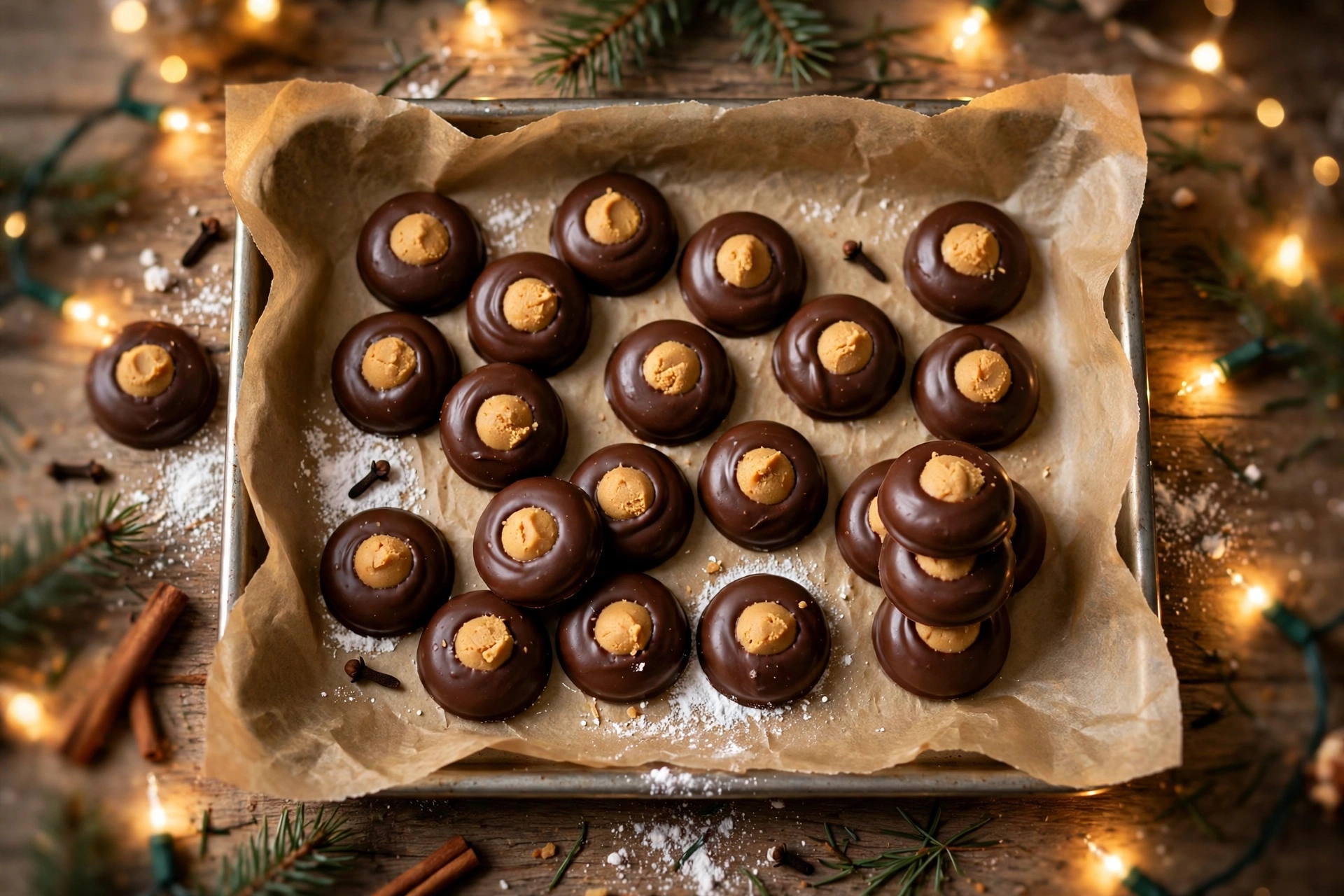
They come from Ohio, where the buckeye tree drops a glossy brown nut with one pale tan eye. The candy copies the nut faithfully: a smooth peanut butter center dipped in chocolate almost all the way, with that one golden circle left showing on top.
No oven, no thermometer, no water bath. The whole recipe is a bowl, a tray and a freezer, which is why buckeyes anchor so many December baking schedules. The dough can be rolled on a quiet evening and dipped days later, minutes before the boxes are packed.
This version is weighed and tested rather than guessed. Every ball is the same 20 grams, the chocolate is dipped at the temperature where it coats thin and sets with a snap, and the calendar at the end tells you exactly when to make, freeze and give them.
What Makes a Buckeye a Buckeye
A buckeye is defined by restraint. A fully dipped peanut butter ball is a fine candy, but it is not a buckeye. The exposed eye of peanut butter on top is the signature, the mark that ties the candy to the nut of the Ohio buckeye tree, whose story Ohio State University Extension tells well.
That eye is also information. It tells the eater exactly what is inside before the first bite, and it gives the chocolate coat a clean edge to set against. Dipped at three quarters depth, every candy on the tray reads as a matched set.
The center matters just as much. It should taste like the inside of a peanut butter cup, only softer and richer: sweet, salty at the edges, and smooth enough to melt rather than chew. A dry, crumbly center is the sign of too much sugar worked in too fast.
Size is the last discipline. At about 20 grams, a buckeye is two honest bites. Bigger balls chill unevenly, crack their coats, and overwhelm the box; smaller ones vanish before the chocolate flavor registers.
There is also a practical reason the candy endures. It travels without complaint, stacks in tins, freezes for months, and never asks for an oven in the busiest baking week of the year. Recipes that respect the cook’s December tend to survive every December.
The Ratio That Rolls Clean and Stays Creamy
Most buckeye recipes disagree about butter, and the disagreement is the recipe. Too little butter and the centers roll dry and crack at the seams. Too much and the balls slump in the freezer and grease the chocolate from underneath. Six tablespoons against a cup and a half of peanut butter is the tested middle.
The sugar goes in slowly, in three additions, for a structural reason. Powdered sugar dumped in at once traps dry pockets that no amount of mixing fully repairs, and those pockets become the gritty streaks in a finished center.
Salt is small and non-negotiable. A quarter teaspoon will not make the candy taste salty; it makes the peanut butter taste like itself, and it keeps three cups of sugar from reading as flat sweetness.
Use a standard creamy peanut butter, the kind that is smooth and stable in the jar. Natural peanut butter, with its oil layer, makes a dough that weeps oil as it chills and refuses to hold a clean ball.
Weighing the balls sounds fussy until you have dipped a tray of mismatched sizes. A small scoop, a scale for the first few, then muscle memory takes over. Uniform balls freeze at the same rate, dip at the same depth, and set in the same twenty minutes.
Ingredients
- 1 1/2 cups creamy peanut butter (384 g), not natural style
- 6 tablespoons unsalted butter, softened
- 1 teaspoon vanilla extract
- 1/4 teaspoon fine sea salt
- 3 cups powdered sugar (360 g), sifted
- 10 ounces semisweet chocolate, chopped, or semisweet chips
- 2 teaspoons coconut oil
Rolling, Freezing and Dipping the Buckeyes, Step by Step
- Beat the peanut butter, softened butter, vanilla and salt in a large bowl with a hand mixer for about 1 minute, until completely smooth and a shade lighter in color.
- Add the powdered sugar in three additions, mixing on low after each one. The dough is ready when it feels like stiff play dough: it holds a fingerprint, does not stick to your hands, and rolls clean. If it feels soft, mix in 2 more tablespoons of sugar.
- Scoop level tablespoons of dough, about 20 grams each, and roll into smooth balls between your palms. Set them on a parchment lined tray as you go. You should get about 36 balls.
- Freeze the tray for 30 minutes, until the balls are hard all the way through. Cold centers are what keep the chocolate coat thin, clean and free of streaks.
- Melt the chocolate with the coconut oil in a microwave safe bowl in 25 second bursts, stirring after each one, until smooth. Let it stand for 5 minutes, until it feels warm rather than hot against your lip.
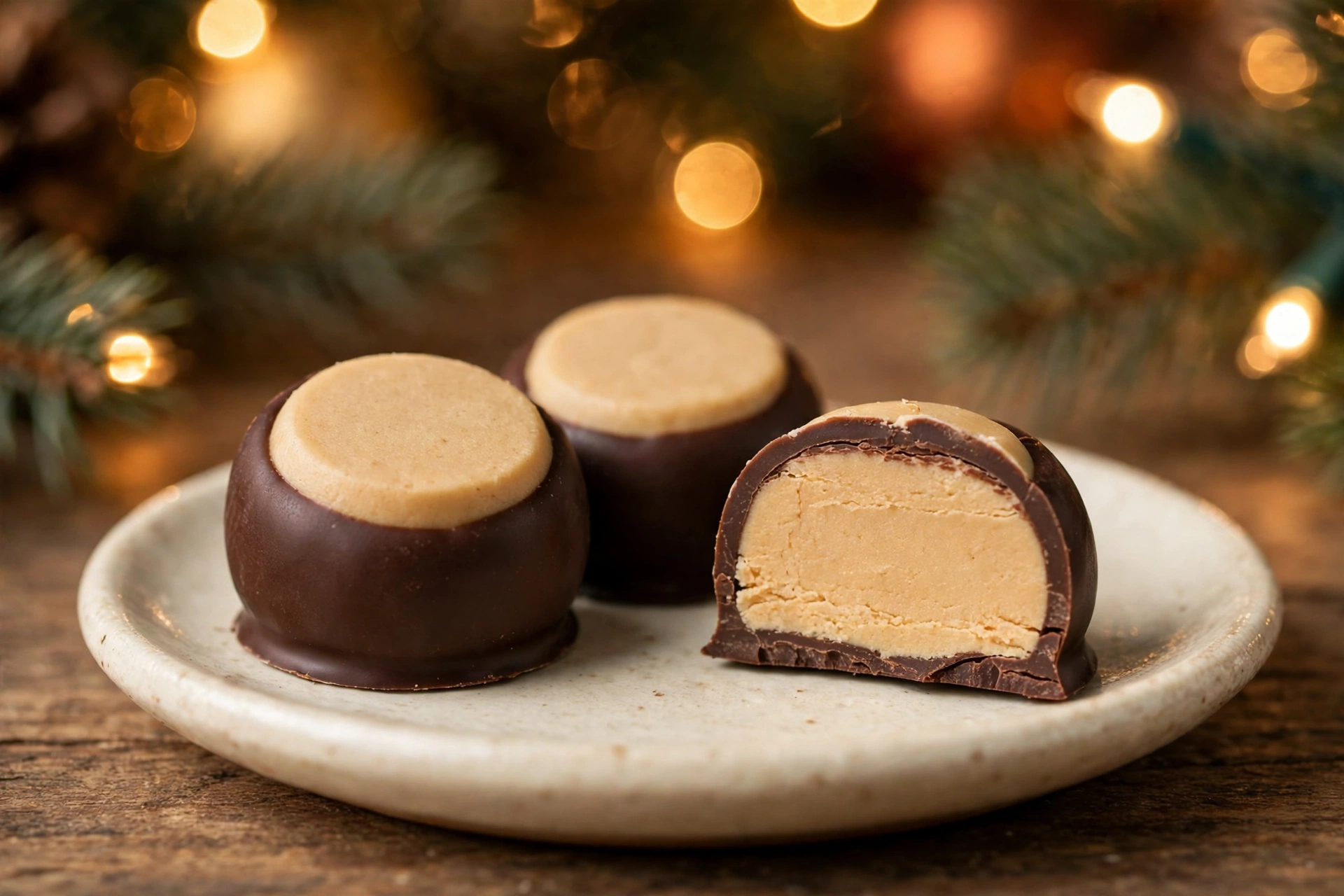
- Work with 6 balls at a time and keep the rest in the freezer. Push a toothpick into the top of a ball, dip it three quarters of the way into the chocolate, let the excess drip back, and set it on a clean parchment lined tray. Slide the toothpick out and smooth the little hole closed with a fingertip.
- Chill the dipped buckeyes for 20 minutes, until the chocolate is set and glossy. Store in an airtight container in the refrigerator for up to 2 weeks, or freeze for up to 3 months.
The Chocolate Window: Warm Enough to Flow, Cool Enough to Snap
Every failed batch of buckeyes I have ever seen failed at the bowl of chocolate. Melted chocolate has a working window, roughly body temperature, where it flows like paint and sets like glass. Inside that window, dipping is calm. Outside it, everything fights you.
Too hot, and the chocolate melts the surface of the frozen center. The ball slides on its toothpick, the coat goes on blotchy, and a pale peanut butter swirl blooms through the chocolate as it sets.
Too cool, and the coat sets the moment it lands, thick and dull, with drag marks around the eye. If the bowl cools while you work, ten seconds in the microwave and a good stir bring it back. Work in small batches out of the freezer and the rhythm stays easy.
The coconut oil is the quiet helper here. Two teaspoons thin the chocolate just enough to drain cleanly off each ball, and the set coat keeps a gentle snap instead of a waxy bend.
Reading the Tray: Seams, Slumps and Streaks
A finished tray tells you everything about the batch, if you read it before packing. Seams around the middle of a ball mean the dough was rolled while too warm, then shrank slightly as it froze. Roll with cool hands, rest the tray ten minutes in the refrigerator, then freeze.
Slumped, flat bottomed buckeyes sat out too long before dipping, or the butter was melted instead of softened when the dough was mixed. Melted butter makes a dough that never firms properly, and no freezer fully repairs it. Start the dough with butter that yields to a finger but holds its shape.
Streaks and pale swirls in the coat mean the chocolate was too hot and melted the surface of the center as it dipped. The fix is patience, not technique: let the bowl stand, stir it twice, and test a single sacrificial ball before committing the tray.
White bloom on stored buckeyes looks alarming and means almost nothing. It is cocoa butter that migrated in a warm room, the flavor is unchanged, and a cold, closed container prevents it. Serve bloomed buckeyes at room temperature and nobody will ever know.
The Cookie Box Calendar: Make, Freeze, Thaw, Gift
Buckeyes are the first candy to make in December because they wait so patiently. Roll and freeze the undipped balls up to a month ahead, bagged on their tray, and dip them on packing day for the freshest looking coat.
Dipped buckeyes keep two weeks in the refrigerator and three months in the freezer, layered between parchment in a rigid container. Thaw them overnight in the refrigerator, still closed in the container, so condensation forms on the box and not on the chocolate.
In a mixed cookie box, buckeyes want a paper cup or a parchment divider. Their chocolate coat picks up the perfume of spiced neighbors, so give them a wall between themselves and strong flavors like our pfeffernusse cookies.
They pair naturally with the other no bake residents of the box: our homemade peppermint bark for snap and color, peppermint white chocolate fudge for a soft square, and snowball cookies for the pale, powdery contrast. One tin, four textures, no oven schedule at all.
Swaps for Nuts, Chocolate and Sweetness
Sunflower seed butter replaces the peanut butter one for one for a nut free batch, and the centers set slightly softer, so give the tray a full 45 minutes in the freezer. The flavor stays close enough that most tasters guess almond.
The chocolate coat is your tuning dial. Dark chocolate at 70 percent makes a grown up, barely sweet buckeye. Milk chocolate leans candy shop sweet and sets a touch softer. White chocolate is not traditional, but a white coat with the golden eye reads beautifully on a dark tin.
For a less sweet center, cut the powdered sugar to 2 3/4 cups and add 2 tablespoons of finely ground graham crumbs for body. The balls roll a little softer, so chill them before rolling and again before dipping.
A pinch of flaky salt over the wet chocolate, one or two flakes per candy, is the fastest upgrade in the whole recipe. It disappears visually and makes the peanut butter taste deeper.
For a crunchy center in the style of a candy bar, fold 1/2 cup of finely crushed graham crumbs or crisp rice cereal into the finished dough. Roll and chill exactly as written. The texture turns playful, the eye stays clean, and children tend to claim these first.
Espresso powder, just 1/2 teaspoon whisked into the melted chocolate, deepens the coat without making the candy taste like coffee. It is the swap to reach for when the box is headed to adults who claim they do not like sweet things.
Your Buckeye Questions, Answered
Why did my chocolate coat crack?
The centers were rock hard from a long freeze and the chocolate was warm, so the coat contracted as it set over a center that later expanded slightly. Dip after 30 minutes of freezing, not two hours, and let the chocolate cool those 5 minutes first.
Can I use natural peanut butter if it is all I have?
You can, with adjustments. Stir it completely smooth, then expect a softer dough: add powdered sugar a spoonful at a time until the dough rolls without sticking, and freeze the balls a full 45 minutes before dipping.
How do I keep the eye clean and round?
Dip straight down and straight up, three quarters deep, with no swirling. Swirling pulls chocolate over the top edge. A level tray and a steady toothpick angle make every eye the same size.
Can I make the dough a week ahead?
Yes. Roll the balls, freeze them on the tray, then bag them airtight. They hold a full month in the freezer without losing flavor. Dip them straight from frozen on packing day; there is no need to thaw first, and the cold center is exactly what the chocolate wants.
Do buckeyes need to be refrigerated?
For anything beyond two days, yes. The butter in the centers keeps best cold, and the chocolate holds its snap. At a party they sit out happily for an afternoon; return the leftovers to the refrigerator the same night.
Can I dip the whole ball and skip the eye?
You can, and the candy is still delicious, but call them peanut butter balls, because the eye is the whole point of a buckeye. The uncovered circle is how the candy got its name and its look.
The First Tin Leaves the House
Buckeyes ask for almost nothing: one bowl, one tray, one cold half hour, and a bowl of chocolate at the right warmth. In return they give you the candy that every December box is quietly judged by.
Roll a batch this week, freeze them with confidence, and dip them when the boxes come out. The first tin that leaves your house will come back empty, with a request attached.
Print
Buckeyes, Peanut Butter Balls Dipped in Chocolate
The Ohio Christmas candy that looks like the nut it is named for: smooth peanut butter centers rolled into 20 gram balls, frozen hard, then dipped three quarters of the way in warm semisweet chocolate so a golden eye of peanut butter stays on top. A tested, weighed ratio, a chocolate temperature window that keeps the coat snapping, and a full make, freeze and gift calendar for cookie boxes.
- Total Time: 1 hour 30 minutes
- Yield: About 36 candies 1x
Ingredients
- 1 1/2 cups creamy peanut butter (384 g), not natural style
- 6 tablespoons unsalted butter, softened
- 1 teaspoon vanilla extract
- 1/4 teaspoon fine sea salt
- 3 cups powdered sugar (360 g), sifted
- 10 ounces semisweet chocolate, chopped, or semisweet chips
- 2 teaspoons coconut oil
Instructions
- Beat the peanut butter, softened butter, vanilla and salt in a large bowl with a hand mixer for about 1 minute, until completely smooth and a shade lighter.
- Add the powdered sugar in three additions, mixing on low after each one. The dough is ready when it feels like stiff play dough: it holds a fingerprint, does not stick to your hands, and rolls clean. If it feels soft, mix in 2 more tablespoons of sugar.
- Scoop level tablespoons of dough (about 20 g each) and roll into smooth balls between your palms. Set them on a parchment lined tray as you go. You should get about 36 balls.
- Freeze the tray for 30 minutes, until the balls are hard all the way through. Cold centers are what keep the chocolate coat thin and clean.
- Melt the chocolate with the coconut oil in a microwave safe bowl in 25 second bursts, stirring after each one, until smooth. Let it stand for 5 minutes: the chocolate should feel warm, not hot, on your lip, about 90 degrees F. Too hot and it melts the centers, too cool and the coat goes on thick.
- Work with 6 balls at a time and keep the rest in the freezer. Push a toothpick into the top of a ball, dip it three quarters of the way into the chocolate, let the excess drip back, and set it on a clean parchment lined tray. Slide the toothpick out and smooth the little hole closed with a fingertip.
- Chill the dipped buckeyes for 20 minutes, until the chocolate is set and glossy. Store in an airtight container in the refrigerator for up to 2 weeks, or freeze for up to 3 months.
- Prep Time: 25 minutes
- Cook Time: 5 minutes
Nutrition
- Serving Size: 1
- Calories: 165
- Sugar: 13
- Sodium: 55
- Fat: 11
- Saturated Fat: 5
- Unsaturated Fat: 6
- Trans Fat: 0
- Carbohydrates: 15
- Fiber: 1
- Protein: 4
- Cholesterol: 8