Pumpkin Roll With a Cream Cheese Swirl That Slices Clean
In this article:
- Why This Pumpkin Roll Bakes Thin, Rolls Hot and Never Cracks
- Warm Spice, Soft Crumb and a Cool Tangy Center
- The Ribbon Stage: How Beaten Eggs Lift the Sponge
- Ingredients for the Pumpkin Roll and Its Cream Cheese Filling
- How to Make the Pumpkin Roll, Step by Step
- Roll It Hot: The Two Minute Window That Sets the Spiral
- Slicing the Pumpkin Roll Without Squashing the Swirl
- A Crack, a Leak, a Soggy Bottom: Pumpkin Roll Fixes
- The Thanksgiving Timeline: Bake Tuesday, Fill Wednesday, Serve Thursday
- Storage: Five Days in the Fridge, Two Months in the Freezer
- The Platter That Empties Before the Pie
- FAQ
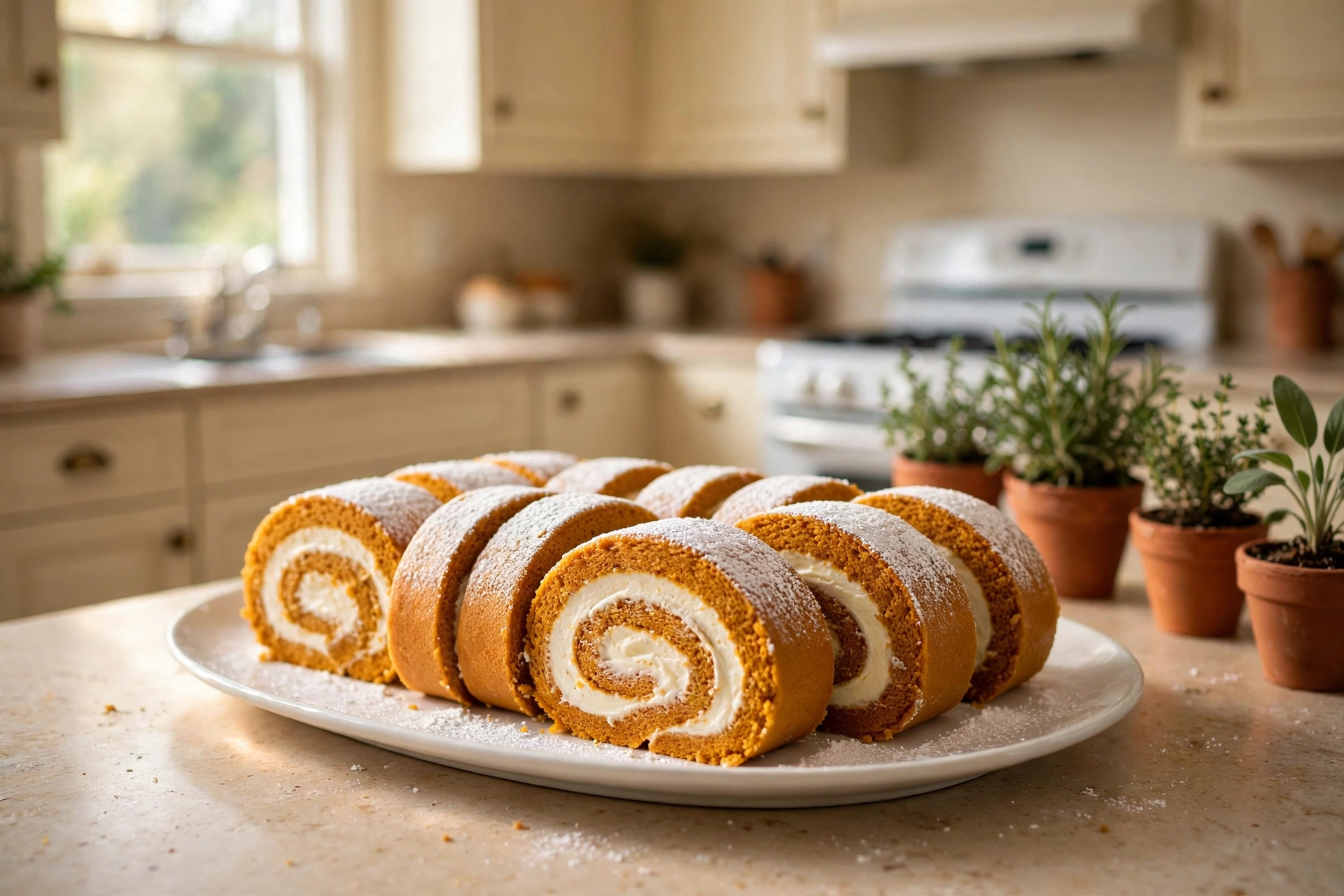
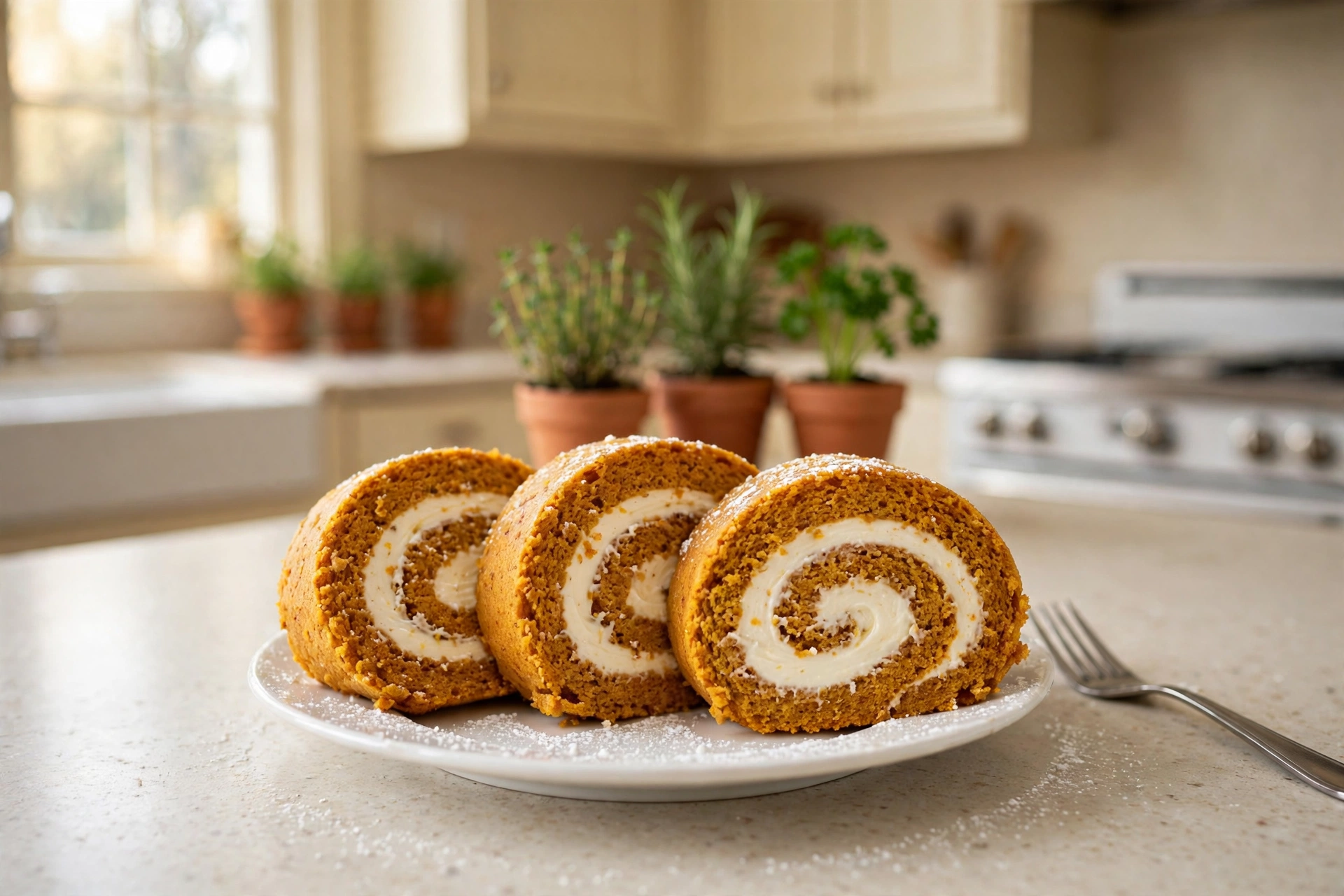
Pumpkin Roll is the dessert that makes a Thanksgiving table go quiet for a second, because every slice shows the same perfect spiral of spiced orange sponge around cool white filling.
The fear attached to this recipe is always the crack, and the crack is almost never bad luck. It is a cake that cooled flat, or baked two minutes too long, or met a filling too cold to spread. This version removes each of those causes, one by one, in the order they happen.
What you get at the end is a roll that can be baked on Tuesday, filled on Wednesday and sliced at the table on Thursday, with edges so clean the swirl looks printed.
Why This Pumpkin Roll Bakes Thin, Rolls Hot and Never Cracks
Pumpkin Roll works because the cake is engineered to bend before it is ever asked to. The batter spreads thin in a jelly roll pan, barely half an inch deep, so it bakes fast and stays flexible. A thick cake resists rolling; a thin one folds like it was designed for it, because it was.
The second reason is timing. The hot cake rolls up in a sugared towel the moment it leaves the oven, while its crumb is still soft and steamy. It cools in that curled shape, and the shape becomes its memory. When you unroll it later, it opens without a fight and closes again the same way.
The third reason is the eggs. Beaten with sugar to a thick ribbon, they trap enough air to keep the sponge light and springy instead of dense and fragile. That spring is what lets the cake survive two rollings, one hot and one filled, without a single crack along the top.
The filling plays its part too. Cream cheese and butter, both fully soft, spread without dragging, so you never press hard enough to tear the crumb.
Warm Spice, Soft Crumb and a Cool Tangy Center
The sponge tastes like the best part of pumpkin pie, concentrated. Cinnamon leads, ginger warms the back of the tongue, and nutmeg and cloves stay low and dark underneath. The pumpkin itself keeps the crumb moist and gives the cake its deep amber color.
Against that warmth sits the filling, cool and tangy, sweet but not heavy. Cream cheese brings a gentle sharpness that keeps each bite from sliding into plain sweetness.
Texture matters as much as flavor here. The crumb is soft and fine, almost like a steamed pudding cake, while the filling stays smooth and dense enough to hold the spiral. Served cold from the fridge, the roll slices into firm, clean rounds; give a slice ten minutes on the counter and the filling softens to a cream.
The Ribbon Stage: How Beaten Eggs Lift the Sponge
Most pumpkin roll recipes tell you to mix the eggs and sugar until combined, and that shortcut is where the dense, crack prone cakes begin. This batter asks for five full minutes of beating instead. The mixture turns pale, thick and glossy, and falls from the whisk in a ribbon that sits on the surface for two seconds.
That ribbon is trapped air, and it does two jobs. It lightens the crumb so the thin cake stays tender, and it gives the sponge elasticity, the quality that lets a cake curl without splitting. Room temperature eggs whip faster and higher, so take them out of the fridge thirty minutes ahead.
Once the pumpkin goes in, the touch changes completely. Stir it in on the lowest speed, just until the color evens out. Then fold the dry ingredients in by hand, in two additions, lifting from the bottom. Every hard stir at this stage knocks out the air you just built.
Ingredients for the Pumpkin Roll and Its Cream Cheese Filling
For the pumpkin sponge:
- 3 large eggs, at room temperature
- 1 cup granulated sugar
- 2/3 cup pumpkin puree, not pumpkin pie filling
- 1 teaspoon vanilla extract
- 3/4 cup all-purpose flour, spooned and leveled
- 1/2 teaspoon baking powder
- 1/2 teaspoon baking soda
- 1 1/2 teaspoons ground cinnamon
- 1/2 teaspoon ground ginger
- 1/4 teaspoon ground nutmeg
- 1/4 teaspoon ground cloves
- 1/2 teaspoon fine sea salt
For the cream cheese filling:
- 8 ounces cream cheese, block style, at room temperature
- 6 tablespoons unsalted butter, at room temperature
- 1 cup powdered sugar, sifted, plus more for the towel and for dusting
- 1 teaspoon vanilla extract
- 1/8 teaspoon fine sea salt
You also need a 15 by 10 inch jelly roll pan, parchment paper, and a thin, lint free kitchen towel. The towel is equipment here, not an afterthought, so choose a smooth one without a raised pattern.
How to Make the Pumpkin Roll, Step by Step
- Heat the oven to 375 degrees F. Line the jelly roll pan with parchment, leaving an inch of overhang on the two short sides, then grease the parchment lightly. The overhang works as handles when the hot cake has to move fast.
- Beat the eggs in a large bowl on high speed for 2 minutes. Add the granulated sugar gradually and keep beating for 3 more minutes, until the mixture is pale, thick and falls in a ribbon. This is the lift of the whole cake, so give it the full time.
- Beat in the pumpkin puree and the vanilla on low speed, just until the batter turns evenly orange. Scrape the bowl once so no pale streaks hide at the bottom.
- Whisk the flour, baking powder, baking soda, cinnamon, ginger, nutmeg, cloves and salt in a separate bowl. Fold the dry mixture into the batter by hand in two additions, lifting gently from the bottom, until no white streaks remain.
- Spread the batter into the prepared pan, pushing it into the corners with an offset spatula so the layer is even. Tap the pan once on the counter to release large bubbles. Bake for 13 to 15 minutes, until the top springs back under a fingertip, the edges pull slightly from the parchment and the center looks set and matte.
- While the cake bakes, lay the clean towel flat on the counter and dust it generously with powdered sugar, edge to edge. Do not be shy with the sugar; it is the release layer between cake and cloth.
- The second the cake comes out, run a knife around any stuck edges, lift it by the parchment handles and turn it out onto the sugared towel. Peel the parchment away slowly. Starting from a short end, roll the cake up inside the towel, snug but not tight, and set it seam side down on a rack to cool completely, about 1 hour.
- Beat the cream cheese and butter together until smooth and fluffy, about 2 minutes. Add the sifted powdered sugar, vanilla and salt, then beat until the filling is light, smooth and spreadable. If it feels stiff, let it sit 10 minutes; never microwave it.
- Unroll the cooled cake gently; it will keep a soft curl, and that is fine. Spread the filling over the surface, reaching three edges fully and leaving a 1 inch bare strip at the far end. Roll the cake back up without the towel, finishing seam side down, and wrap it tightly in plastic wrap.
- Chill the wrapped roll for at least 1 hour, or overnight for the cleanest slices. Trim the two ends with a sharp knife, dust the top with powdered sugar, and cut into 1 inch slices, wiping the blade between cuts.
Roll It Hot: The Two Minute Window That Sets the Spiral
Everything in this recipe bends around one short window: the two minutes after the pan leaves the oven. A hot sponge is flexible because its starches are still soft and its steam has not escaped. Wait ten minutes on the counter and the same cake has set flat, and rolling it then is what splits the surface.
So the towel is prepared before the cake, not after. Turn the cake out, peel, roll, and only then take a breath.
Roll from a short end, always. Rolling from the long side gives a wide, flat spiral that is harder to keep even. A short end roll produces the tall, handsome swirl that fits a dessert plate.
Slicing the Pumpkin Roll Without Squashing the Swirl
The cleanest slices come from a cold roll and a hot knife. Chill the wrapped roll until the filling is firm, at least 1 hour and better overnight. A soft filling smears under the blade and drags through the sponge, which is how good rolls end up looking messy on the platter.
Use your longest, thinnest knife. Run it under hot water, dry it, then make one smooth downward cut with almost no sawing. Wipe the blade clean and repeat the hot water for every slice.
Cut slices a full inch thick. Thinner slices tear at the center of the swirl where the filling is softest. Trim the two end pieces first and set them aside; they are the cook’s reward, not the guests’ portion.
A Crack, a Leak, a Soggy Bottom: Pumpkin Roll Fixes
If the cake cracks as you unroll it, the usual cause is overbaking, even by two minutes. The sponge should come out the moment the center springs back. For this batch, place the crack on the underside when you serve, and dust the top generously; for the next batch, check at 13 minutes without fail.
If filling squeezes out the end as you roll, it was spread too close to the far edge or beaten too soft. Keep that last inch bare, since rolling pushes the filling forward into it. A loose filling goes back in the fridge for 15 minutes before spreading, not onto the cake.
If the bottom of the sponge turns soggy in the fridge, the roll was wrapped while still warm inside. The cake must be completely cool before filling. Steam has nowhere to go inside tight wrap.
The Thanksgiving Timeline: Bake Tuesday, Fill Wednesday, Serve Thursday
This is a dessert built for the busiest cooking week of the year, because almost none of it happens on the day. Bake and roll the sponge on Tuesday and keep it in the fridge. Wednesday, unroll, fill, re-roll and chill; the flavors settle overnight and the slices firm up.
Thursday, your only jobs are trimming, dusting and slicing, which takes four minutes while the turkey rests. On a table that also carries classic pumpkin pie for the traditionalists, the roll is the slice the younger guests reach for first, and it never fights for oven space.
The same planning frees your hands for the rest of the menu. The cranberry sauce improves over the same two days, and the make ahead mashed potatoes wait in their baking dish, so dessert is one of three dishes that simply need uncovering when dinner lands.
Storage: Five Days in the Fridge, Two Months in the Freezer
Keep the filled roll wrapped tightly in plastic, or in an airtight container, in the refrigerator for up to 5 days. The sponge actually improves on day two, when the spices settle into the crumb and the filling firms to its best slicing texture.
Because the filling is cream cheese, the roll follows the same rule as any cooked egg dish: no more than 2 hours on the table. The USDA leftover guidance is blunt on this point, and a dessert buffet is exactly where the rule gets forgotten. Put out half the slices, keep the rest cold, and refill the platter.
To freeze, wrap the whole filled roll in plastic, then in foil, and freeze for up to 2 months. Thaw it overnight in the refrigerator, still wrapped, so condensation lands on the foil and not on the cake. Dust with fresh powdered sugar after thawing.
The Platter That Empties Before the Pie
Pumpkin Roll earns its place because it behaves like a planned dessert and tastes like a special one. It asks for one pan, one towel and fifteen minutes of oven time, and it pays you back with the prettiest slice on the Thanksgiving table.
Make it once and the technique stays with you: thin batter, ribbon beaten eggs, a hot roll and a cold slice. Every autumn after that, the only real question is how many rolls to bake, because the first one is spoken for before dinner starts.
FAQ
Why did my pumpkin roll crack when I unrolled it?
Cracking almost always means the cake was overbaked or rolled too late. Check the sponge at 13 minutes and take it out the moment the center springs back, then roll it in the towel within 2 minutes of leaving the oven. A cake that cools flat first will split when you ask it to curl.
Can I use pumpkin pie filling instead of pumpkin puree in a pumpkin roll?
No. Pumpkin pie filling is already sweetened and spiced, and its extra liquid makes the thin sponge heavy and prone to tearing. Use plain pumpkin puree and the spice amounts in the recipe; the flavor lands exactly where a roll needs it.
How far ahead can I make a pumpkin roll for Thanksgiving?
The full cycle stretches comfortably over three days. Bake and roll the sponge on Tuesday, fill and re-roll it on Wednesday, and slice it on Thursday. The filled roll keeps 5 days in the fridge in total, so a Sunday bake for a Thursday table also works.
My cream cheese filling is lumpy. What went wrong?
The cream cheese or the butter was still cold in the center. Both need a full hour on the counter until they yield to a fingertip with no resistance. Beat them together first, before the sugar goes in, and if lumps persist, press the filling through a sieve rather than beating it longer.
Can I freeze a filled pumpkin roll whole?
Yes. Wrap the filled roll tightly in plastic, then in foil, and freeze for up to 2 months. Thaw it overnight in the refrigerator without unwrapping it, then dust with fresh powdered sugar before slicing, since the first dusting fades as the cake defrosts.

Pumpkin Roll
A thin, warmly spiced pumpkin sponge beaten to the ribbon stage, rolled hot in a sugared towel and cooled in its spiral, then filled with a smooth cream cheese filling and chilled for clean, bakery style slices. Baked in 15 minutes and built to be made ahead for Thanksgiving.
- Total Time: 2 hours 40 minutes
- Yield: 1 roll, 10 slices 1x
Ingredients
- 3 large eggs, at room temperature
- 1 cup granulated sugar
- 2/3 cup pumpkin puree, not pumpkin pie filling
- 1 teaspoon vanilla extract, for the sponge
- 3/4 cup all-purpose flour, spooned and leveled
- 1/2 teaspoon baking powder
- 1/2 teaspoon baking soda
- 1 1/2 teaspoons ground cinnamon
- 1/2 teaspoon ground ginger
- 1/4 teaspoon ground nutmeg
- 1/4 teaspoon ground cloves
- 1/2 teaspoon fine sea salt, for the sponge
- 8 ounces cream cheese, block style, at room temperature
- 6 tablespoons unsalted butter, at room temperature
- 1 cup powdered sugar, sifted, plus more for the towel and for dusting
- 1 teaspoon vanilla extract, for the filling
- 1/8 teaspoon fine sea salt, for the filling
Instructions
- Heat the oven to 375 degrees F. Line a 15 by 10 inch jelly roll pan with parchment, leaving an inch of overhang on the two short sides, and grease the parchment lightly.
- Beat the eggs on high speed for 2 minutes. Add the granulated sugar gradually and beat 3 more minutes, until the mixture is pale, thick and falls from the whisk in a ribbon.
- Beat in the pumpkin puree and vanilla on low speed, just until the batter turns evenly orange.
- Whisk the flour, baking powder, baking soda, cinnamon, ginger, nutmeg, cloves and salt. Fold the dry mixture into the batter by hand in two additions until no white streaks remain.
- Spread the batter evenly into the pan, pushing it into the corners, and tap the pan once on the counter. Bake for 13 to 15 minutes, until the top springs back under a fingertip and the edges pull slightly from the parchment.
- While the cake bakes, lay a thin, lint free kitchen towel on the counter and dust it generously with powdered sugar, edge to edge.
- Turn the hot cake out onto the sugared towel at once and peel off the parchment. Starting from a short end, roll the cake up inside the towel and cool it completely on a rack, seam side down, about 1 hour.
- Beat the cream cheese and butter until smooth and fluffy, about 2 minutes. Add the sifted powdered sugar, vanilla and salt and beat until the filling is light and spreadable.
- Unroll the cooled cake, spread the filling over the surface leaving a 1 inch bare strip at the far end, and roll it back up without the towel. Wrap tightly in plastic wrap.
- Chill for at least 1 hour or overnight. Trim the ends, dust the top with powdered sugar, and slice into 1 inch rounds with a hot, dry knife, wiping the blade between cuts.
Notes
Nutrition is an estimate based on the ingredients and cooking methods used.
- Prep Time: 25 minutes
- Cook Time: 15 minutes
Nutrition
- Serving Size: 1 slice
- Calories: 318
- Sugar: 36
- Sodium: 262
- Fat: 14
- Saturated Fat: 8
- Unsaturated Fat: 5
- Trans Fat: 0
- Carbohydrates: 44
- Fiber: 1
- Protein: 5
- Cholesterol: 92