Roasted Root Vegetables With Crackly Edges and a Honey Thyme Butter Finish
In this article:
- Why These Roots Caramelize Instead of Steaming
- Cut by Density: Small Rutabaga, Long Carrots, and the Reason Size Is Seasoning
- Ingredients for the Two Pans and the Honey Thyme Butter
- How to Roast Root Vegetables, Pan by Pan
- Sharing the Oven With the Turkey: the Thanksgiving Schedule
- Pale, Soggy or Scorched: Roasting Fixes With Numbers
- Storage and the Ten Minute Return to a Hot Pan
- Swap the Roots, Keep the Method: Turnip, Squash and Potato Rules
- The Side That Balances a Table Full of Soft Food
- FAQ
Roasted root vegetables are the side dish that quietly rescues Thanksgiving. Everything else on the table is soft: mashed potatoes, stuffing, casseroles under blankets of sauce. These arrive with crackly edges, deep gold faces and centers that stay tender, and the plate suddenly has contrast again.
The disappointing version is easy to picture. Pale chunks, steamed soft in their own juices, seasoned with salt and hope. That failure is never about the vegetables. It is about crowded pans, equal sized cuts for unequal vegetables, and a glaze that burned long before dinner.
This recipe fixes those three things in order. The vegetables are cut by density, so a dense rutabaga and a quick carrot finish in the same minute. The pans are hot before anything touches them. And the honey butter waits outside the oven until the last five minutes, when it can lacquer instead of scorch.
Why These Roots Caramelize Instead of Steaming
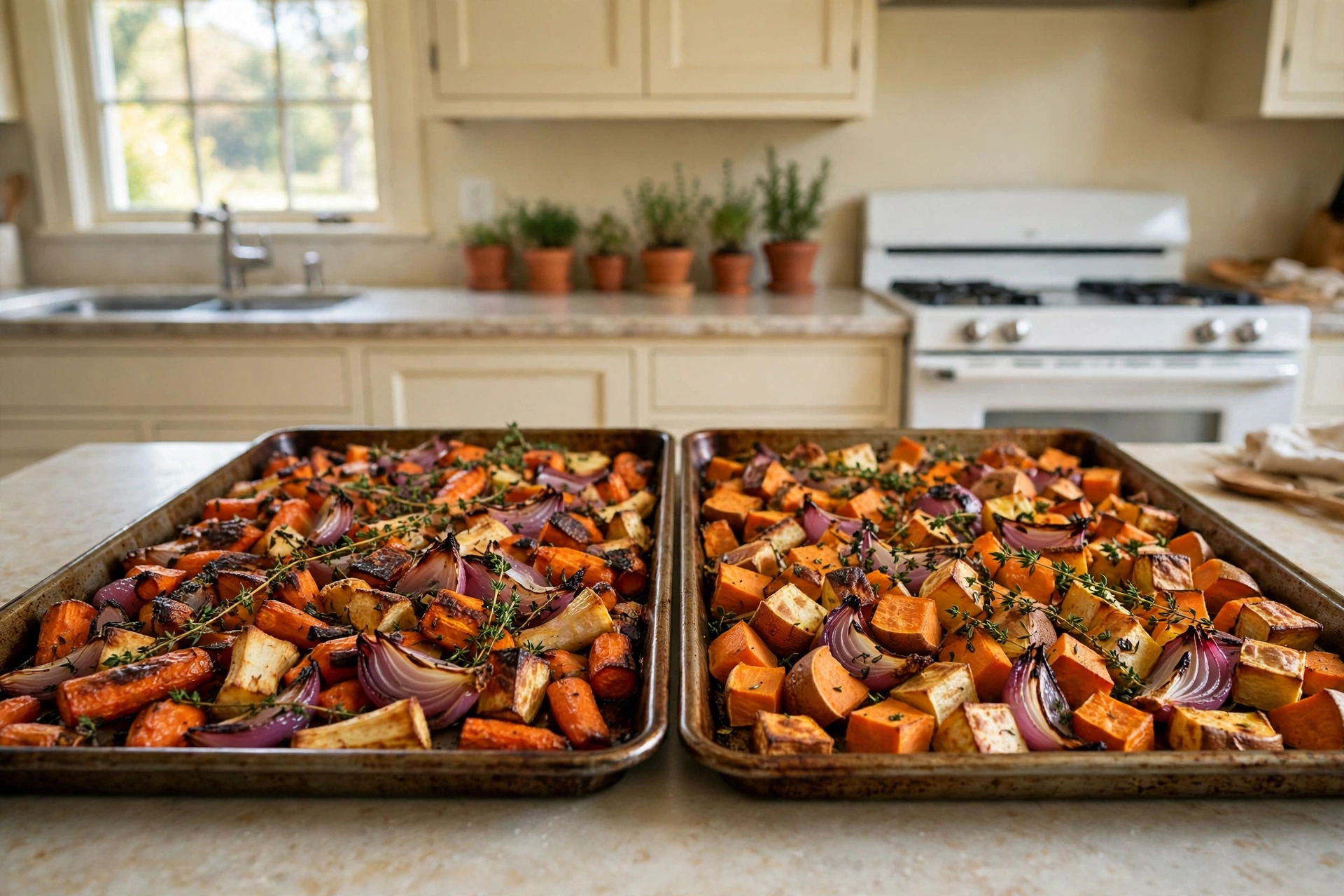
Roasted root vegetables caramelize when three conditions meet: dry surfaces, real space between the pieces, and a pan that is already hot. Water is the enemy at the start. A vegetable that lands on cold metal releases its moisture slowly, and that moisture pools and steams instead of evaporating.
A preheated pan changes the first minute completely. The cut faces sizzle on contact, the surface water flashes off, and the sugars in the carrot, parsnip and sweet potato start their slow turn toward amber. That is where the flavor lives, in the browned edges, not in the soft middle.
Space is the second condition, and it is non-negotiable. Pieces that touch trap steam between them, and steamed edges never brown. Two pans for six pounds of vegetables sounds generous until you see the alternative: one crowded pan of beige. Give every chunk a border of bare metal.
The glaze timing is the third condition, and the one most recipes get wrong. Honey at 425 degrees F for forty minutes does not caramelize, it burns, turning bitter at the edges. Brushed on for the final five minutes, the same honey turns glossy and stays sweet, and the butter in it never sees the punishing heat at all.
Cut by Density: Small Rutabaga, Long Carrots, and the Reason Size Is Seasoning
Equal sized pieces are the standard advice, and they are the reason mixed roots never finish together. A one inch cube of rutabaga is still firm when a one inch cube of sweet potato has gone completely soft. Density, not diameter, decides the cooking time, so the cuts follow the density.
Rutabaga is the slowest vegetable on the pan, dense and waxy, so it gets the smallest cut: one inch chunks. Carrots and parsnips come next, cut into two inch lengths, thick ends halved lengthwise so no piece is much wider than your thumb. They roast down to tenderness right at the forty five minute mark.
Sweet potatoes sit in the middle: one and a half inch chunks, big enough to keep a creamy center while the corners crisp. Cut them smaller and they slump into the pan. Cut them larger and their centers lag behind everything else, which is how a mixed pan ends up half raw and half perfect.
The red onion plays by different rules because it is there for sweetness and char, not body. Cut it into eight wedges straight through the root, and leave the root end intact on every wedge. The layers stay together in the heat instead of scattering and burning as loose petals.
One more cutting habit matters: flat faces. Round, rolling pieces brown in spots. A chunk with one flat cut face sits still on the pan and browns across the whole face. When you halve a thick carrot lengthwise, put that flat side down first. It is the easiest browning you will ever earn.
Ingredients for the Two Pans and the Honey Thyme Butter
- 1 1/2 pounds carrots, peeled and cut into 2 inch chunks
- 1 1/2 pounds parsnips, peeled and cut into 2 inch chunks
- 1 1/2 pounds sweet potatoes, peeled and cut into 1 1/2 inch chunks
- 1 pound rutabaga, peeled and cut into 1 inch chunks
- 1 large red onion, cut into 8 wedges through the root
- 3 tablespoons olive oil
- 1 1/4 teaspoons fine sea salt
- 1/2 teaspoon black pepper
- 1 teaspoon garlic powder
- 2 tablespoons unsalted butter, melted
- 1 tablespoon honey
- 1 teaspoon fresh thyme leaves, plus more to serve
- Flaky salt, for finishing
Olive oil does the roasting because it handles 425 degrees F without complaint, and its job is heat transfer, not flavor. The butter arrives at the end with the honey, where its flavor survives. Splitting the fats this way gives you the performance of oil and the taste of butter in the same bite.
Garlic powder, not fresh garlic, is a deliberate choice. Fresh garlic at this temperature for this long turns harsh and dark. The powder coats every piece evenly and reads as a warm background note. The thyme waits for the glaze too, so its leaves stay green and fragrant instead of crisping to dust.
How to Roast Root Vegetables, Pan by Pan
- Heat the oven to 425 degrees F with two rimmed sheet pans inside, one on the upper rack and one on the lower rack. Hot pans are the first step, not a detail.
- Toss the carrots, parsnips, sweet potatoes, rutabaga and onion wedges in a large bowl with the olive oil, fine salt, pepper and garlic powder, using your hands until every cut face shines.
- Pull the hot pans out one at a time and divide the vegetables between them in a single layer, flat sides down, with a little space around each piece. Work quickly so the pans stay hot.
- Roast for 25 minutes without opening the door. The bottoms need that uninterrupted time to take on color.
- Rotate the pans top to bottom and front to back, and flip the larger pieces with a thin spatula, scraping up the browned faces as you go.
- Roast 15 to 20 minutes more, until the edges are deep golden and a knife slides into the rutabaga, the densest piece, with no resistance.
- Stir the melted butter, honey and thyme together and brush the mixture over the vegetables on both pans, getting the glaze on the browned faces.
- Return the pans to the oven for 5 minutes, until the glaze is glossy and just starting to darken at the edges. Watch this step; honey moves fast at the end.
- Pile the vegetables onto a warm platter, finish with flaky salt and a few fresh thyme leaves, and serve hot.

Sharing the Oven With the Turkey: the Thanksgiving Schedule
The oven is the contested territory of Thanksgiving, and roasted root vegetables win their place by being flexible about when they roast. The bird wants hours at a moderate temperature, the vegetables want forty five fierce minutes. The answer is not compromise. It is sequence.
Start the day before. Peel and cut everything on Wednesday, following the density sizes, and refrigerate the chunks in a sealed container with a paper towel to catch moisture. The onion wedges keep best in their own small bag, since their sulfur perfume migrates into everything nearby overnight.
On Thursday morning, roast the vegetables at 425 degrees F before the turkey goes in, or while it is still coming up to temperature on the counter. Let them cool on their pans. They will look slightly underwhelming at this point, and that is fine. Their second act is scheduled.
When the classic roast turkey comes out to rest, tented and untouchable for thirty minutes, the oven is empty and already hot. The vegetables go back in for ten minutes at 425 degrees F. They emerge re-crisped and glazed, looking for all the world like they roasted to order, which, in every way that matters, they did.
If your turkey roasts straight through and the vegetables must share its oven at 350 degrees F, the method still works with one change: add fifteen minutes to the roast and put the pans on the rack furthest from the bird. The edges will be a shade paler, and the glaze at the end covers the difference.
Pale, Soggy or Scorched: Roasting Fixes With Numbers
Pale and soft means steam won. The usual cause is a pan that was cool, crowded, or both, and the fix starts at the next batch: preheat the pans a full fifteen minutes, and if the pieces touch on two pans, accept a third pan. Vegetables shrink as they roast, but they only brown if they start with room.
Soggy the next day is a storage problem, not a roasting problem. Vegetables packed warm into a sealed container steam themselves soft overnight. Cool them completely on the pan before refrigerating, and reheat them uncovered, spread out, never in a covered dish and never in the microwave if edges matter to you.
Scorched edges with raw centers mean the cuts drifted too large or too uneven, almost always the rutabaga. Test doneness by piercing the densest vegetable on the pan, never the sweet potato, which lies about being done a full ten minutes early. If one pan races ahead, pull it and hold the other; the two pans rarely finish in the same minute.
Bitter glaze means the honey went on too early or the oven crept hot. Honey should see no more than five to seven minutes of high heat. If your oven runs hot, drop the roast to 415 degrees F and keep the glaze firmly in the final five minutes.
Storage and the Ten Minute Return to a Hot Pan
Leftovers keep well because the vegetables are sturdy. Refrigerated in a shallow container, they hold four days, in line with the guidance in the USDA FoodKeeper for cooked vegetables. The glaze softens in storage, but the structure survives.
To reheat, spread the vegetables on a sheet pan in a single layer and give them ten minutes in a 425 degrees F oven. They come back with their edges restored, not merely warm. A dry pan and high heat are doing the work; sauce, broth or a lid would undo it.
Freezing is possible but honest cooks admit the texture changes. The sweet potato turns softer and the onion goes limp. Frozen roasted roots are better folded into a soup or a hash than served as a side. If you freeze them, use them within two months and reheat from frozen on a hot pan.
Swap the Roots, Keep the Method: Turnip, Squash and Potato Rules
The method travels to almost any root, as long as the density rule comes with it. Turnips cut like rutabaga, at one inch, since they share its firmness. Butternut squash cuts like sweet potato, at one and a half inches, and benefits from the same glaze. Yukon Gold potatoes cut at one and a quarter inches, between the two.
Beets are the one deliberate absence from the main pans. They are welcome at the table, our honey butter roasted parsnips and carrots crowd pleaser aside, but beets bleed their color into everything they touch and tint the whole platter pink. Roast them on their own small pan at the same temperature and fold them in at serving, like jewels on top.
For a sweeter profile, swap the honey for maple syrup in the same measure and finish with a pinch of cinnamon, a direction our maple roasted acorn squash takes in squash form. For a savory profile, skip the honey entirely, double the thyme, and finish with a squeeze of lemon over the hot platter to lift the earthiness.
Celeriac and parsley root behave like parsnips and take the two inch cut. Brussels sprouts are not roots, but halved and added for the final twenty minutes, cut sides down, they belong on this pan at any November table, especially next to candied yams at the sweet end of the spread.
The Side That Balances a Table Full of Soft Food
Roasted root vegetables earn their place because they do the one job no other Thanksgiving side attempts: they give the plate texture, acidity free brightness and vegetables that still taste like themselves. A forkful after rich gravy and soft stuffing tastes like a reset, and the meal stays interesting to the last bite.
Serve them in a warm shallow bowl rather than a deep one, so the glazed faces stay visible, and pass them after the turkey gravy from drippings has gone around once. People take more of what they can see.
FAQ
Why do my roasted root vegetables come out soft instead of crisp?
Almost always, the pan was crowded or cold. Pieces that touch steam each other, and a cold pan lets moisture pool before it evaporates. Preheat the pans for 15 minutes, use two pans for this quantity, and leave a border of bare metal around every piece.
Can I roast the vegetables at 350 degrees F with the turkey?
Yes, with more time. Add about 15 minutes to the roast, use the rack furthest from the bird, and keep the honey glaze for the final five minutes as written. The edges will be a shade paler, but the method and the result hold up well.
Which vegetable should I test to know the whole pan is done?
Test the rutabaga, the densest vegetable on the pan. If a knife slides into a rutabaga chunk with no resistance, everything else is done. Sweet potato feels tender ten minutes too early and is an unreliable judge for the rest.
Can I cut the vegetables the day before Thanksgiving?
Yes, and it is the smart move. Cut everything to the density sizes, refrigerate in a sealed container with a paper towel, and keep the onion wedges in a separate bag so their flavor does not migrate. Roast straight from the refrigerator, adding two or three minutes.
Why is the honey glaze brushed on at the end instead of the start?
Honey burns at 425 degrees F over a long roast, turning bitter at the edges. Brushed on for the last five minutes, it lacquers the already browned faces, stays glossy and sweet, and the butter mixed into it never faces the full heat of the oven.
Roasted Root Vegetables
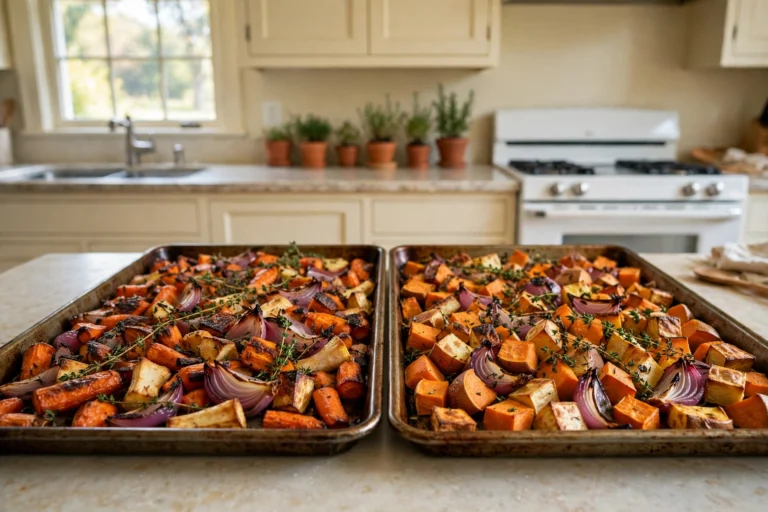
Five roots cut by density instead of one equal size, so the rutabaga, carrots, parsnips and sweet potatoes all finish tender in the same 45 minutes at 425 degrees F. Two hot pans, no crowding, and a honey thyme butter brushed on in the last five minutes, late enough to lacquer the edges instead of burning. Built for the Thanksgiving oven, with a morning roast and a ten minute return while the turkey rests.
- Total Time: 1 hour 10 minutes
- Yield: Two sheet pans, 8 side servings
Ingredients
- 1 1/2 pounds carrots, peeled and cut into 2 inch chunks
- 1 1/2 pounds parsnips, peeled and cut into 2 inch chunks
- 1 1/2 pounds sweet potatoes, peeled and cut into 1 1/2 inch chunks
- 1 pound rutabaga, peeled and cut into 1 inch chunks
- 1 large red onion, cut into 8 wedges through the root
- 3 tablespoons olive oil
- 1 1/4 teaspoons fine sea salt
- 1/2 teaspoon black pepper
- 1 teaspoon garlic powder
- 2 tablespoons unsalted butter, melted
- 1 tablespoon honey
- 1 teaspoon fresh thyme leaves, plus more to serve
- Flaky salt, for finishing
Instructions
- Heat the oven to 425 degrees F with two rimmed sheet pans inside, one on the upper rack and one on the lower rack.
- Toss the carrots, parsnips, sweet potatoes, rutabaga and onion wedges in a large bowl with the olive oil, fine salt, pepper and garlic powder until every cut face is coated.
- Pull the hot pans out, divide the vegetables between them in a single layer with space between the pieces, cut sides down where you can.
- Roast for 25 minutes. Rotate the pans top to bottom and front to back, and flip the larger pieces with a thin spatula.
- Roast 15 to 20 minutes more, until the edges are deep golden and a knife slides into the rutabaga with no resistance.
- Stir the melted butter, honey and thyme together. Brush the mixture over the vegetables on both pans.
- Return the pans to the oven for 5 minutes, until the glaze is glossy and just beginning to caramelize at the edges.
- Pile onto a warm platter, finish with flaky salt and extra thyme leaves, and serve hot.
Notes
Nutrition is an estimate based on the ingredients and cooking methods used.
- Prep Time: 25 minutes
- Cook Time: 45 minutes
Nutrition
- Serving Size: about 1 cup
- Calories: 195
- Sugar: 13
- Sodium: 330
- Fat: 6
- Saturated Fat: 2
- Unsaturated Fat: 4
- Trans Fat: 0
- Carbohydrates: 34
- Fiber: 6
- Protein: 2
- Cholesterol: 8